Biology · Health, Disease and Cancer
Cancer
Cancer starts when the controls on cell division fail. This lesson explains what a tumour is, the difference between benign and malignant tumours, how cancer spreads and what raises the risk.
Learning Objectives
- 1Describe cancer as the result of changes in cells that lead to uncontrolled growth and division.
- 2Describe the differences between benign and malignant tumours.
- 3Explain how cancer can spread to other parts of the body.
- 4Describe lifestyle and genetic risk factors for cancer.
Retrieval practice
-
1
What type of cell division makes new body cells?
Show answerHide answer
Mitosis.
-
2
What is a carcinogen?
Show answerHide answer
A substance or radiation that can cause cancer.
-
3
What is the cell cycle?
Show answerHide answer
The series of stages in which a cell grows, copies its DNA and divides.
-
4
Give a lifestyle risk factor for lung cancer.
Show answerHide answer
Smoking.
When cell division goes wrong
Normally the body controls how fast cells divide so that the right number of new cells replaces the old ones. In cancer, changes in cells make them divide again and again in an uncontrolled way. The extra cells form a lump called a tumour. Cancer is a non-communicable disease: it is not caused by a pathogen and you cannot catch it from another person.
Tumours
Not every tumour is cancer. The important question is whether it spreads.
-
Benign tumours
Growths of abnormal cells that stay in one area, usually inside a membrane. They do not invade other parts of the body, and they are not cancer.
-
Malignant tumours
Their cells invade neighbouring tissues and spread to other parts of the body in the blood. They are cancers.
-
Secondary tumours
Cancer cells that break away from a malignant tumour travel in the blood to other places, where they start new growths called secondary tumours.
Benign and malignant tumours
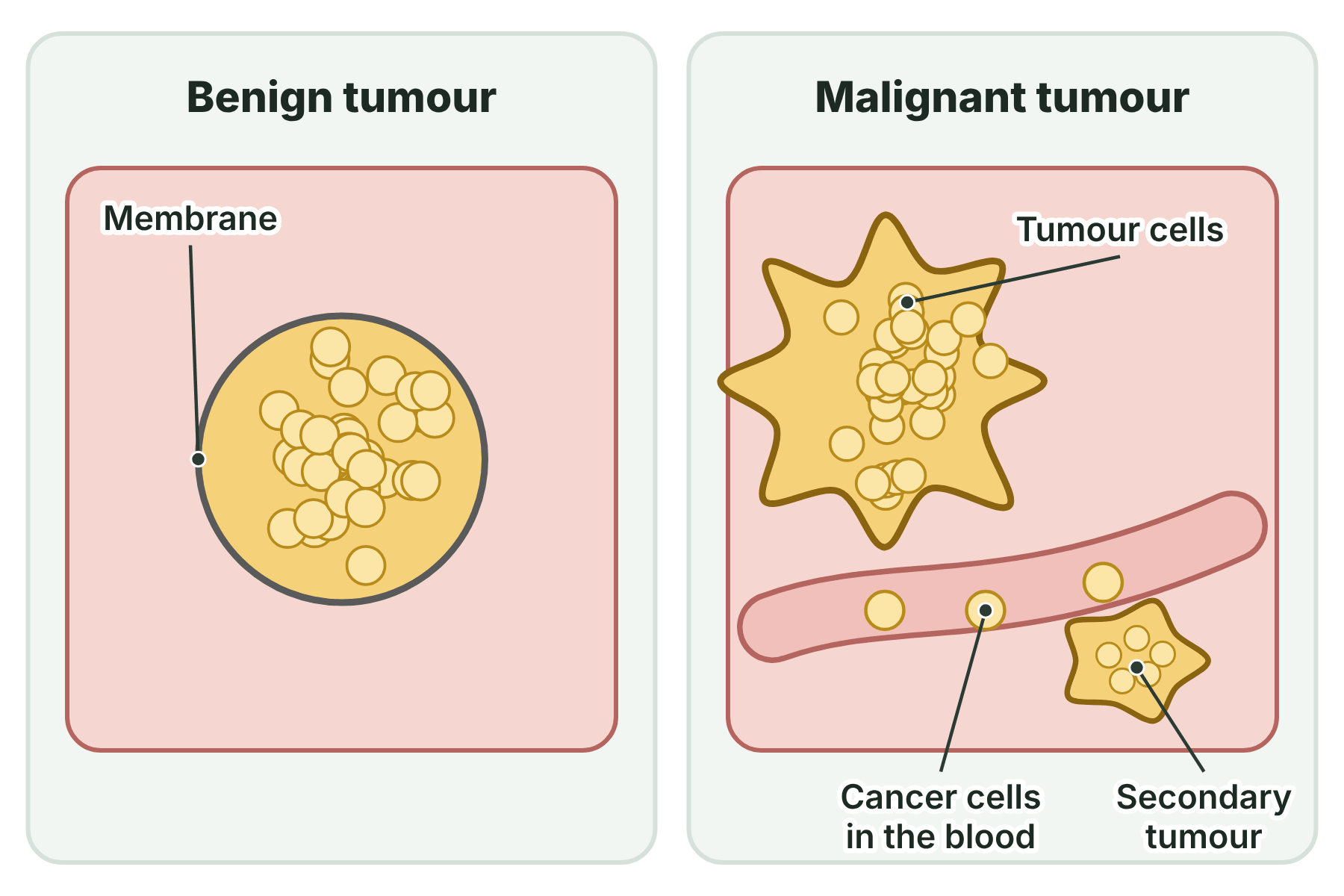
A benign tumour stays where it started. A malignant tumour spreads.
Benign and malignant tumours compared
Benign tumour
- A growth of abnormal cells
- Contained in one area, usually inside a membrane
- Does not invade other tissues
- Not cancer
Malignant tumour
- A growth of abnormal cells
- Invades neighbouring tissues
- Cells spread in the blood to other parts of the body
- Forms secondary tumours, and is cancer
Risk factors for cancer
Scientists have identified several things that make some cancers more likely.
-
Lifestyle risk factors
Smoking is linked to lung and other cancers, and diet, obesity and a lack of exercise are linked to other types.
-
Carcinogens
Chemicals in tobacco smoke and ionising radiation, such as X-rays and gamma rays, can damage cells and make cancer more likely.
-
Viruses
Some viruses that live in cells can trigger cancer, for example human papillomavirus and cervical cancer.
-
Genetic risk factors
Some people inherit changes in particular genes that make them more likely to develop certain cancers, such as some breast cancers.
How a cancer spreads
The danger of a malignant tumour is that it does not stay in one place.
-
1
Cells change
A change in a cell makes it divide in an uncontrolled way.
-
2
A tumour forms
The cells build up into a lump, which keeps growing.
-
3
Invasion
The cells of a malignant tumour invade the tissues around it.
-
4
Spreading in the blood
Cells break off and travel round the body in the blood.
-
5
Secondary tumours
The cells settle in other organs and start new tumours there.
Case study
Smoking and lung cancer
Cigarette smoke contains many carcinogens. Over years, they can change the cells that line the airways so that they begin to divide in an uncontrolled way. The proportion of people who get lung cancer is much higher among smokers than among non-smokers, and stopping smoking reduces the risk. This is one of the clearest examples of a lifestyle risk factor for cancer.
The big idea
Cancer is uncontrolled cell division. A tumour is dangerous when it is malignant, because it spreads.
Cancer
Cancer
-
Cause
- changes in cells
- uncontrolled growth and division
-
Benign tumour
- stays in one area
- not cancer
-
Malignant tumour
- invades tissues
- spreads in blood
- cancer
-
Secondary tumours
- new tumours elsewhere
-
Risk factors
- lifestyle
- carcinogens
- viruses
- genes
Summary and exam focus
- Cancer results from changes in cells that cause uncontrolled growth and division.
- Benign tumours stay in one area, usually inside a membrane, and are not cancer.
- Malignant tumours invade neighbouring tissues and spread in the blood to form secondary tumours.
- Smoking, other carcinogens, some viruses and some inherited genes are risk factors.
- Cancer is non-communicable.
Exam focus
Describe the difference between a benign tumour and a malignant tumour. (3 marks) (3 marks)
Make it a comparison. Say that a benign tumour is contained in one area and does not invade other tissues, while a malignant tumour invades neighbouring tissues and spreads in the blood to form secondary tumours.
Key terms
The words this lesson expects you to use. Each one is linked from the first place it appears above.
- Cancer
- A disease caused by changes in cells that lead to uncontrolled growth and division.
- Tumour
- A lump of abnormal cells.
- Benign tumour
- A tumour that stays in one area and does not invade other parts of the body.
- Malignant tumour
- A tumour whose cells invade nearby tissues and spread to other parts of the body. It is cancer.
- Secondary tumour
- A new tumour formed by cancer cells that have spread from the first one.
- Carcinogen
- A substance or radiation that can cause cancer.
- Mutation
- A change in a cell's DNA.
- Risk factor
- Something linked to an increased rate of a disease.
You've finished the notes
Check your understanding
Test yourself while it is fresh. Start with the flashcards, then try the exam questions.
Something here looks wrong?
Tell us what and we will go and look. It goes to whoever writes these pages, nobody else, and we do not ask who you are — so there is nothing to sign and nothing comes back to you.