Exam questions · Biology
Monoclonal Antibodies
- 14 exam questions
- 38 marks
- 16 quick checks
Producing Monoclonal Antibodies
Just this lesson-
1 State [1 mark]
State what is meant by a monoclonal antibody.
Show answerHide answer
Model answer
An antibody produced from a single clone of cells that is specific to one binding site on one antigen.
Mark scheme
- Single clone / specific to one antigen — 1 mark
-
2 Name [3 marks]
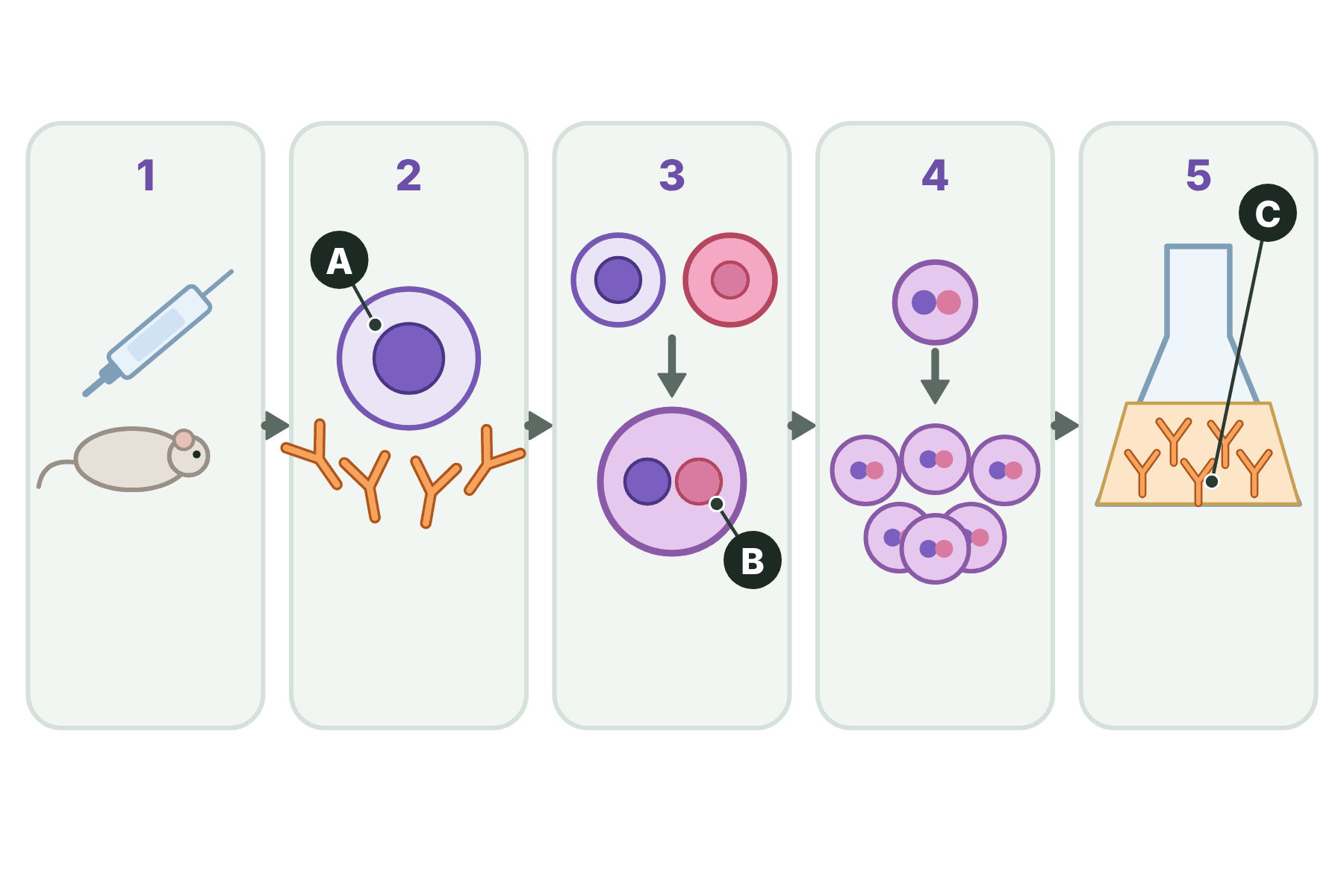
Figure 1 shows how monoclonal antibodies are made. Name the parts labelled A, B and C.
Show answerHide answer
Model answer
A is a lymphocyte. B is a hybridoma cell. C is (monoclonal) antibodies.
Mark scheme
- A: lymphocyte — 1 mark
- B: hybridoma cell — 1 mark
- C: antibodies — 1 mark
-
3 Explain [3 marks]
Explain why a hybridoma cell is used to make monoclonal antibodies.
Show answerHide answer
Model answer
A hybridoma cell is made by combining a lymphocyte with a tumour cell. It can make the specific antibody, like a lymphocyte, and it can divide again and again, like a tumour cell. This allows a large amount of the antibody to be produced.
Mark scheme
- Combines a lymphocyte and a tumour cell — 1 mark
- Makes the antibody and divides — 1 mark
- Large amounts of antibody can be made — 1 mark
-
4 Describe [5 marks]
Describe how monoclonal antibodies are produced.
Show answerHide answer
Model answer
A mouse is injected with an antigen, which stimulates its lymphocytes to produce a particular antibody. The lymphocytes are collected and combined with tumour cells to make hybridoma cells. Single hybridoma cells that make the right antibody are cloned, to produce many identical cells. These cells all produce the same antibody. A large amount of the antibody is collected and purified.
Mark scheme
- Mouse injected with antigen to stimulate lymphocytes — 1 mark
- Lymphocytes combined with tumour cells — 1 mark
- Hybridoma cells formed — 1 mark
- Single hybridoma cells cloned — 1 mark
- Antibody collected and purified — 1 mark
-
5 Explain [2 marks]
Explain why the antibodies produced by a clone of hybridoma cells are all identical.
Show answerHide answer
Model answer
All the cells in the clone come from a single hybridoma cell, so they are genetically identical. Each cell therefore makes the same antibody.
Mark scheme
- Cells genetically identical / from one cell — 1 mark
- Each makes the same antibody — 1 mark
-
6 Explain [2 marks]
Explain why a monoclonal antibody can be used to target one specific chemical.
Show answerHide answer
Model answer
The antibody is specific to one binding site on one antigen. It will only bind to that chemical and not to other molecules.
Mark scheme
- Specific to one binding site — 1 mark
- Only binds to that chemical — 1 mark
-
7 Suggest [3 marks]
A student suggests that lymphocytes alone could be grown in a laboratory to make monoclonal antibodies. Suggest why this would not work.
Show answerHide answer
Model answer
Lymphocytes can make the antibody, but they cannot divide many times, so only a small amount of antibody would be made. A tumour cell can divide, but it does not make the specific antibody. Combining them makes a hybridoma cell, which does both.
Mark scheme
- Lymphocytes divide only a limited number of times — 1 mark
- So only a small amount of antibody — 1 mark
- A hybridoma cell can divide and make antibody — 1 mark
Quick check
-
1
What is a hybridoma cell?
Show answerHide answer
B: A lymphocyte combined with a tumour cell
A hybridoma cell is formed by combining a lymphocyte with a tumour cell.
-
2
What does a hybridoma cell do?
Show answerHide answer
D: Divides and makes the antibody
It can both divide and make the antibody.
-
3
Which animal's lymphocytes are used to make monoclonal antibodies?
Show answerHide answer
A: Mouse
Mouse lymphocytes are stimulated to make the antibody.
-
4
Why are monoclonal antibodies all identical?
Show answerHide answer
C: They come from one clone of cells
They are produced by a single clone of identical cells.
-
5
What is the purpose of cloning single hybridoma cells?
Show answerHide answer
B: To make many identical cells
Cloning makes many identical cells that all make the same antibody.
-
6
What is a tumour cell used for in making monoclonal antibodies?
Show answerHide answer
A: It divides rapidly
Tumour cells divide rapidly and keep dividing, which is what the hybridoma cells need.
-
7
What does the antibody bind to?
Show answerHide answer
D: One specific binding site on one antigen
A monoclonal antibody binds to one binding site on one antigen.
-
8
What stimulates the mouse lymphocytes to make the antibody?
Show answerHide answer
C: Injection with the antigen
The mouse is injected with the antigen.
Uses of Monoclonal Antibodies
Just this lesson-
1 State [1 mark]
State one use of monoclonal antibodies in diagnosis.
Show answerHide answer
Model answer
In pregnancy tests, to detect the hormone hCG in urine.
Mark scheme
- Pregnancy test — 1 mark
-
2 Name [3 marks]
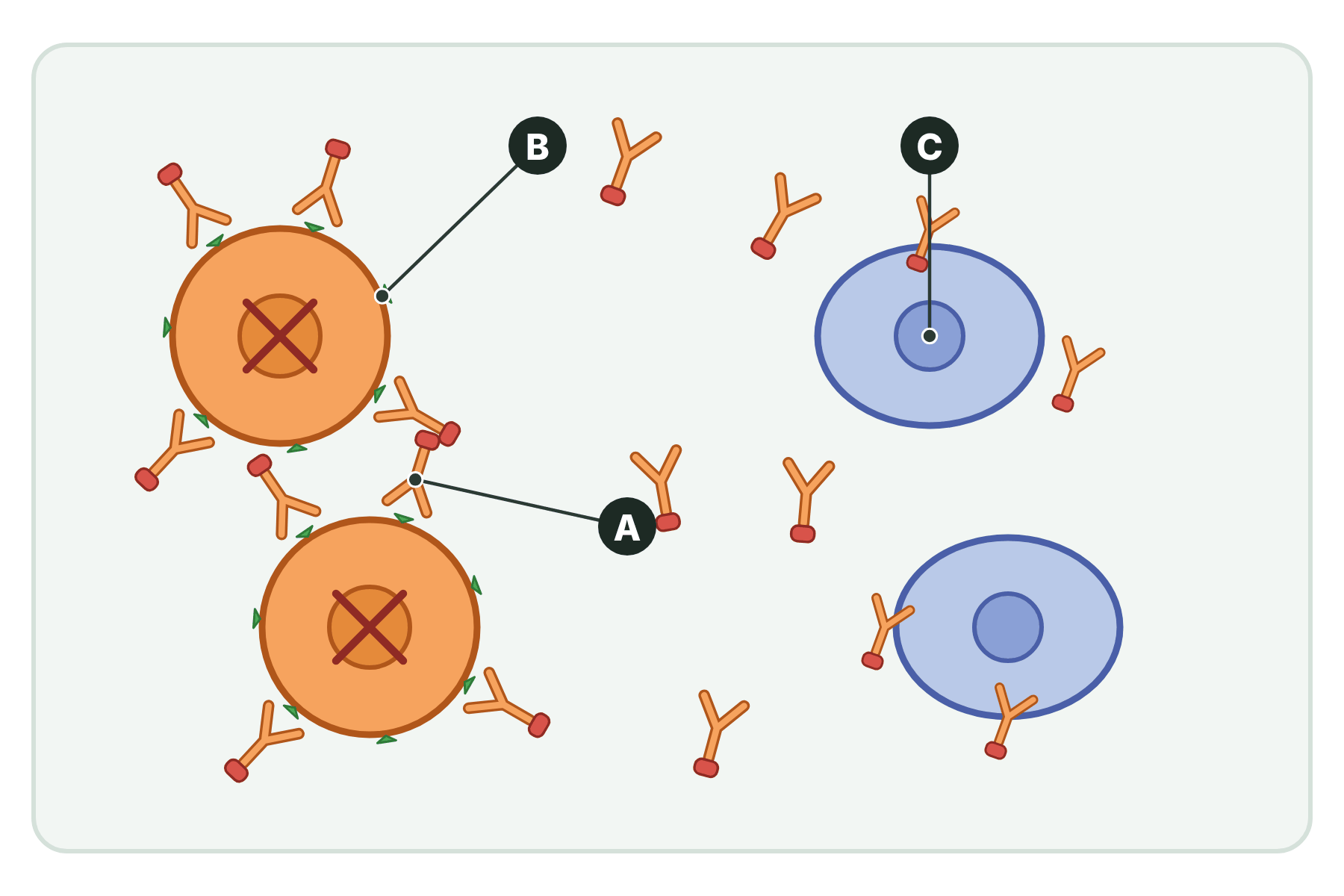
Figure 1 shows a treatment for cancer. Name the parts labelled A, B and C.
Show answerHide answer
Model answer
A is a monoclonal antibody. B is an antigen (on the cancer cell). C is a normal cell.
Mark scheme
- A: monoclonal antibody — 1 mark
- B: antigen — 1 mark
- C: normal cell — 1 mark
-
3 Explain [3 marks]
Explain how a monoclonal antibody can be used to treat cancer without harming other cells.
Show answerHide answer
Model answer
The antibody is specific to antigens on the surface of cancer cells, so it binds only to cancer cells. A drug is attached to the antibody, so it is delivered to the cancer cells. Normal cells do not have the antigen, so they are not harmed.
Mark scheme
- Antibody binds to antigen on cancer cells — 1 mark
- Drug attached is delivered to the cancer cells — 1 mark
- Normal cells do not have the antigen / not harmed — 1 mark
-
4 Explain [3 marks]
In a pregnancy test, the test line turns blue only if the woman is pregnant. Explain how the test uses monoclonal antibodies to show this.
Show answerHide answer
Model answer
The urine of a pregnant woman contains the hormone hCG. The hormone binds to mobile monoclonal antibodies that carry blue beads. Fixed antibodies on the test line bind to the hormone and trap the beads, so the line turns blue. Without hCG the beads are not trapped.
Mark scheme
- hCG binds to antibodies with beads — 1 mark
- Fixed antibodies on the test line trap them — 1 mark
- Beads cause a blue line only if hCG is present — 1 mark
-
5 Describe [2 marks]
Describe how monoclonal antibodies can be used in research to find where a particular protein is in a cell.
Show answerHide answer
Model answer
An antibody that binds to the protein is attached to a fluorescent dye. It is added to the cells or tissue and sticks to the protein. The dye glows, which shows where the protein is.
Mark scheme
- Antibody with a fluorescent dye binds the protein — 1 mark
- Dye shows its position — 1 mark
-
6 Evaluate [4 marks]
Evaluate the advantages and disadvantages of using monoclonal antibodies to treat disease.
Show answerHide answer
Model answer
Monoclonal antibodies are specific, so they can deliver a drug straight to the cancer cells without harming the rest of the body. They can also be used to diagnose and monitor disease. However, they have created more side effects than expected, and they are not yet as widely used as was hoped. They can also be expensive to produce. Overall they are very useful for targeted treatment, but have limitations.
Mark scheme
- Advantage: specific and targeted — 1 mark
- Advantage: other uses — 1 mark
- Disadvantage: more side effects than expected — 1 mark
- Disadvantage: not as widely used / cost, and a conclusion — 1 mark
-
7 Suggest [3 marks]
Scientists want to use a monoclonal antibody to measure the level of a hormone in a blood sample. Suggest how the antibody could be used and why it is suitable.
Show answerHide answer
Model answer
The antibody is made to bind to the hormone. It is added to the sample and the amount that binds is measured, for example using a dye. The antibody is suitable because it is specific, so it binds only to that hormone and not to other chemicals in the blood.
Mark scheme
- Antibody binds to the hormone — 1 mark
- The amount bound is measured — 1 mark
- Specific, so only that hormone is detected — 1 mark
Quick check
-
1
Which hormone does a pregnancy test detect?
Show answerHide answer
C: hCG
A pregnancy test detects hCG in the urine.
-
2
Why are monoclonal antibodies useful for treating cancer?
Show answerHide answer
B: They can deliver a drug to cancer cells only
They are specific and can carry a drug to cancer cells without harming other cells.
-
3
What is used to show where an antibody has bound in research?
Show answerHide answer
D: A fluorescent dye
A fluorescent dye glows to show the position of the antibody.
-
4
What is a disadvantage of monoclonal antibodies?
Show answerHide answer
A: More side effects than expected
They have created more side effects than expected.
-
5
Why does the control line on a pregnancy test always turn blue?
Show answerHide answer
C: It shows the test has worked
It shows that the test has worked, whether or not hCG is present.
-
6
Which of these can monoclonal antibodies do in a laboratory?
Show answerHide answer
D: Detect pathogens
They can measure the level of hormones and other chemicals in blood, or detect pathogens.
-
7
Why do monoclonal antibodies bind only to certain cells?
Show answerHide answer
A: They are specific to one antigen
They are specific to an antigen found on only those cells.
-
8
Which statement about monoclonal antibodies is correct?
Show answerHide answer
B: They are not yet as widely used as hoped
They are not yet as widely used as was hoped when they were first developed.