Exam questions · Biology · Monoclonal Antibodies
Producing Monoclonal Antibodies
- 7 exam questions
- 19 marks
- 8 quick checks
-
1 State [1 mark]
State what is meant by a monoclonal antibody.
Show answerHide answer
Model answer
An antibody produced from a single clone of cells that is specific to one binding site on one antigen.
Mark scheme
- Single clone / specific to one antigen — 1 mark
-
2 Name [3 marks]
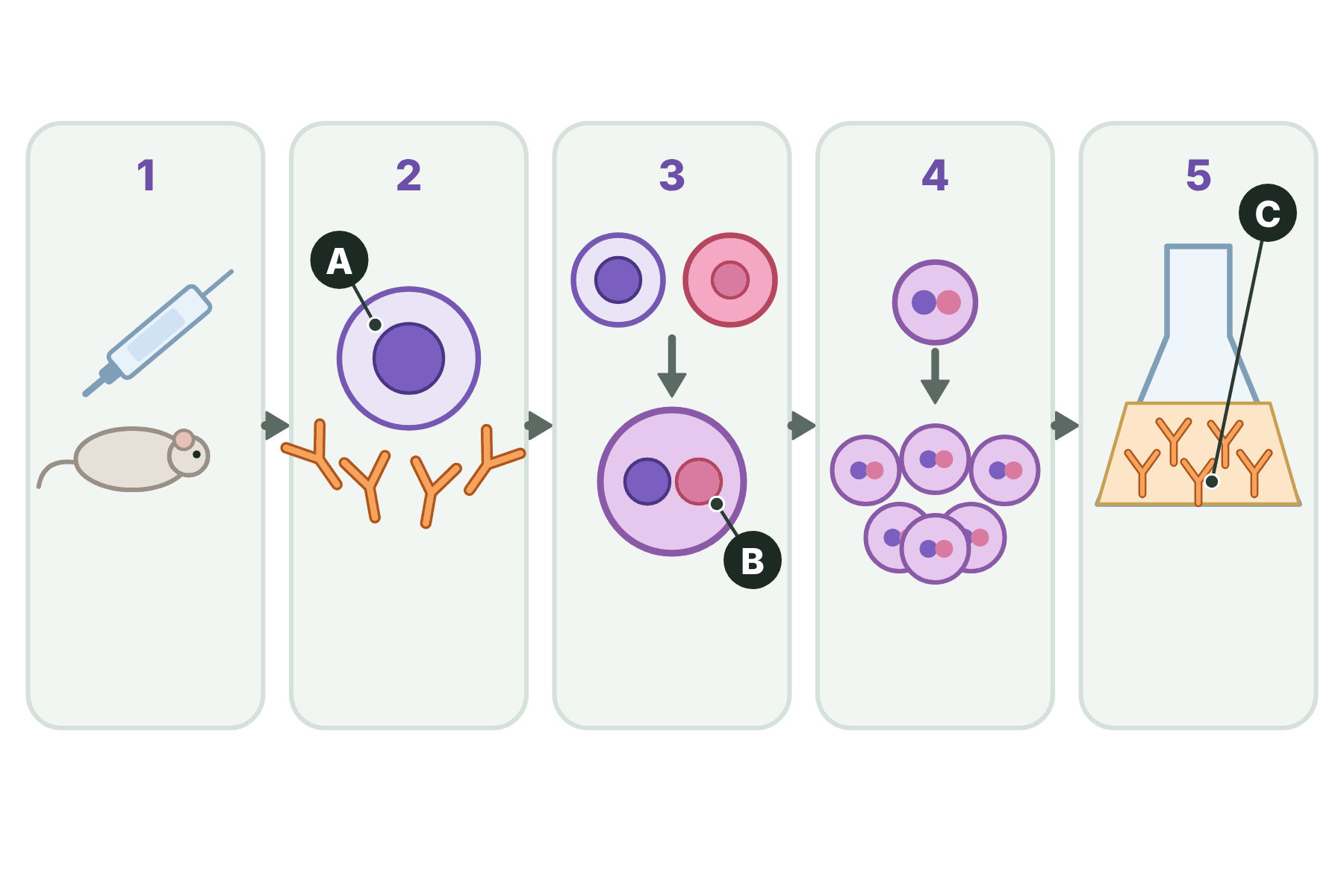
Figure 1 shows how monoclonal antibodies are made. Name the parts labelled A, B and C.
Show answerHide answer
Model answer
A is a lymphocyte. B is a hybridoma cell. C is (monoclonal) antibodies.
Mark scheme
- A: lymphocyte — 1 mark
- B: hybridoma cell — 1 mark
- C: antibodies — 1 mark
-
3 Explain [3 marks]
Explain why a hybridoma cell is used to make monoclonal antibodies.
Show answerHide answer
Model answer
A hybridoma cell is made by combining a lymphocyte with a tumour cell. It can make the specific antibody, like a lymphocyte, and it can divide again and again, like a tumour cell. This allows a large amount of the antibody to be produced.
Mark scheme
- Combines a lymphocyte and a tumour cell — 1 mark
- Makes the antibody and divides — 1 mark
- Large amounts of antibody can be made — 1 mark
-
4 Describe [5 marks]
Describe how monoclonal antibodies are produced.
Show answerHide answer
Model answer
A mouse is injected with an antigen, which stimulates its lymphocytes to produce a particular antibody. The lymphocytes are collected and combined with tumour cells to make hybridoma cells. Single hybridoma cells that make the right antibody are cloned, to produce many identical cells. These cells all produce the same antibody. A large amount of the antibody is collected and purified.
Mark scheme
- Mouse injected with antigen to stimulate lymphocytes — 1 mark
- Lymphocytes combined with tumour cells — 1 mark
- Hybridoma cells formed — 1 mark
- Single hybridoma cells cloned — 1 mark
- Antibody collected and purified — 1 mark
-
5 Explain [2 marks]
Explain why the antibodies produced by a clone of hybridoma cells are all identical.
Show answerHide answer
Model answer
All the cells in the clone come from a single hybridoma cell, so they are genetically identical. Each cell therefore makes the same antibody.
Mark scheme
- Cells genetically identical / from one cell — 1 mark
- Each makes the same antibody — 1 mark
-
6 Explain [2 marks]
Explain why a monoclonal antibody can be used to target one specific chemical.
Show answerHide answer
Model answer
The antibody is specific to one binding site on one antigen. It will only bind to that chemical and not to other molecules.
Mark scheme
- Specific to one binding site — 1 mark
- Only binds to that chemical — 1 mark
-
7 Suggest [3 marks]
A student suggests that lymphocytes alone could be grown in a laboratory to make monoclonal antibodies. Suggest why this would not work.
Show answerHide answer
Model answer
Lymphocytes can make the antibody, but they cannot divide many times, so only a small amount of antibody would be made. A tumour cell can divide, but it does not make the specific antibody. Combining them makes a hybridoma cell, which does both.
Mark scheme
- Lymphocytes divide only a limited number of times — 1 mark
- So only a small amount of antibody — 1 mark
- A hybridoma cell can divide and make antibody — 1 mark
Quick check
-
1
What is a hybridoma cell?
Show answerHide answer
B: A lymphocyte combined with a tumour cell
A hybridoma cell is formed by combining a lymphocyte with a tumour cell.
-
2
What does a hybridoma cell do?
Show answerHide answer
D: Divides and makes the antibody
It can both divide and make the antibody.
-
3
Which animal's lymphocytes are used to make monoclonal antibodies?
Show answerHide answer
A: Mouse
Mouse lymphocytes are stimulated to make the antibody.
-
4
Why are monoclonal antibodies all identical?
Show answerHide answer
C: They come from one clone of cells
They are produced by a single clone of identical cells.
-
5
What is the purpose of cloning single hybridoma cells?
Show answerHide answer
B: To make many identical cells
Cloning makes many identical cells that all make the same antibody.
-
6
What is a tumour cell used for in making monoclonal antibodies?
Show answerHide answer
A: It divides rapidly
Tumour cells divide rapidly and keep dividing, which is what the hybridoma cells need.
-
7
What does the antibody bind to?
Show answerHide answer
D: One specific binding site on one antigen
A monoclonal antibody binds to one binding site on one antigen.
-
8
What stimulates the mouse lymphocytes to make the antibody?
Show answerHide answer
C: Injection with the antigen
The mouse is injected with the antigen.