Biology · Monoclonal Antibodies
Producing Monoclonal Antibodies
A monoclonal antibody is an antibody that targets one specific chemical, and it can be made in large amounts. This lesson explains how the hybridoma cell, which both divides and makes an antibody, is produced and cloned.
Learning Objectives
- 1Describe what a monoclonal antibody is and why it is specific.
- 2Describe how monoclonal antibodies are produced from mouse lymphocytes and tumour cells.
- 3Explain why a hybridoma cell is useful.
- 4Explain why cloning produces large amounts of one antibody.
Retrieval practice
-
1
What is an antibody?
Show answerHide answer
A protein made by white blood cells that sticks to a specific antigen.
-
2
What is an antigen?
Show answerHide answer
A molecule on the surface of a pathogen that triggers an immune response.
-
3
What is a lymphocyte?
Show answerHide answer
A white blood cell that makes antibodies.
-
4
What is a clone?
Show answerHide answer
A genetically identical copy of a cell or organism.
One antibody, one target
When a pathogen enters the body, many different lymphocytes make many different antibodies. A monoclonal antibody is different. It is produced by a single clone of cells, so all the antibodies are identical and are specific to one binding site on one protein antigen. This means that a monoclonal antibody can be used to target a specific chemical, or specific cells in the body, such as cancer cells.
The problem and its solution
A lymphocyte makes one kind of antibody, but it cannot be grown in the laboratory for long.
-
Lymphocytes
Make a particular antibody, but they divide only a limited number of times and so cannot give a large amount of antibody.
-
Tumour cells
Divide again and again and can be grown in culture for a long time, but they do not make the antibody.
-
Hybridoma cells
A cell made by combining a lymphocyte with a tumour cell. It can both divide and make the antibody.
Making monoclonal antibodies
The same steps are used to make an antibody against any antigen.
-
1
Stimulate the lymphocytes
A mouse is injected with the antigen, which stimulates its lymphocytes to make the particular antibody.
-
2
Collect the lymphocytes
Lymphocytes that make the antibody are taken from the mouse.
-
3
Make hybridoma cells
The lymphocytes are combined with a particular kind of tumour cell to make hybridoma cells.
-
4
Select and clone
Single hybridoma cells that make the right antibody are picked out and cloned, to produce many identical cells.
-
5
Collect and purify
The identical cells all produce the same antibody, which is collected from the culture and purified in large amounts.
How monoclonal antibodies are made
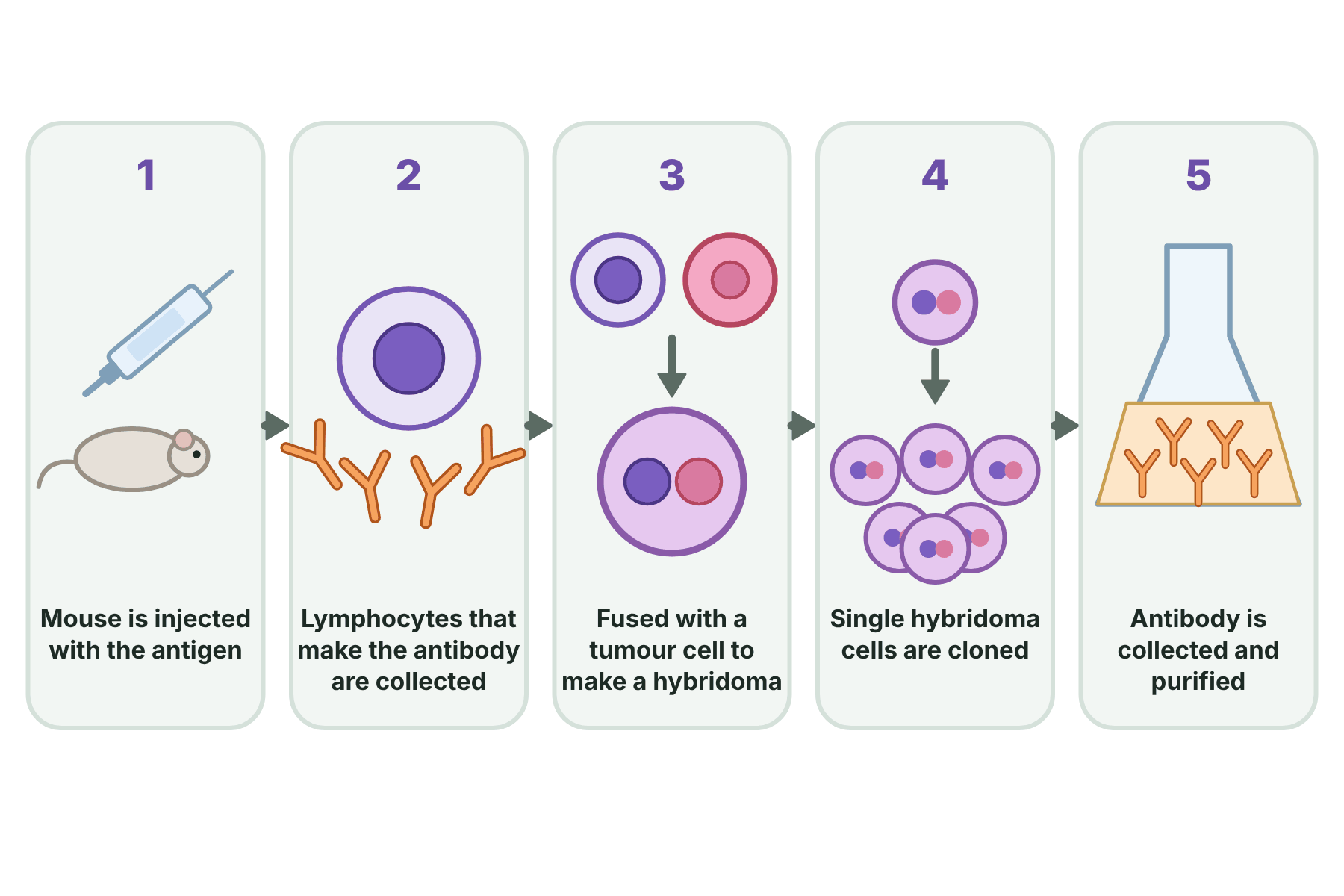
A hybridoma cell can both divide and make the antibody.
Lymphocytes, tumour cells and hybridoma cells compared
Lymphocyte and tumour cell
- A lymphocyte makes the antibody but cannot divide for long
- A tumour cell divides over and over but makes no useful antibody
- Neither is any use for making large amounts on its own
Hybridoma cell
- Made by combining the two
- Makes the specific antibody
- Divides again and again
- Can be cloned to give a huge number of identical cells
Why the antibodies are monoclonal
The word monoclonal means that all the antibodies come from one clone.
-
One cell
A single hybridoma cell is chosen, so all its descendants are genetically identical.
-
Identical antibodies
Every cell in the clone makes exactly the same antibody.
-
Specific
Each antibody has one shape, so it binds to one binding site on one antigen only.
Case study
Why use mouse cells?
The first monoclonal antibodies were made using mice, because mouse lymphocytes are easy to stimulate and the animals are small and cheap to keep. A disadvantage is that the human immune system can see mouse antibodies as foreign, which can cause side effects when they are given to patients. Newer methods change the antibody to make it more like a human antibody.
The big idea
A monoclonal antibody comes from one clone of cells, so every antibody is identical and targets the same chemical.
Monoclonal antibodies
Monoclonal antibodies
-
Meaning
- one clone
- identical antibodies
- one specific target
-
Lymphocyte
- makes the antibody
-
Tumour cell
- divides rapidly
-
Hybridoma
- does both
-
Production
- inject
- collect
- fuse
- clone
- purify
Summary and exam focus
- Monoclonal antibodies are produced from a single clone of cells and are specific to one binding site on one antigen.
- Mouse lymphocytes are stimulated to make a particular antibody.
- Lymphocytes are combined with tumour cells to make hybridoma cells.
- A hybridoma cell can both divide and make the antibody.
- Single hybridoma cells are cloned, and the identical antibody is collected and purified.
Exam focus
Describe how monoclonal antibodies are produced. (5 marks) (5 marks)
Give the steps in order: stimulate mouse lymphocytes with the antigen, combine them with tumour cells to make hybridoma cells, clone single hybridoma cells, then collect and purify the antibody. Explain why a hybridoma cell is needed.
Key terms
The words this lesson expects you to use. Each one is linked from the first place it appears above.
- Monoclonal antibody
- An antibody made by a single clone of cells, which is specific to one binding site on one antigen.
- Hybridoma cell
- A cell formed by combining a lymphocyte with a tumour cell, which can both divide and make an antibody.
- Lymphocyte
- A white blood cell that makes antibodies.
- Tumour cell
- A cell that divides in an uncontrolled way.
- Clone
- A group of genetically identical cells.
- Antigen
- A molecule on the surface of a pathogen or cell that triggers an immune response.
- Binding site
- The part of an antigen to which an antibody attaches.
- Purify
- To separate a substance from everything else in a mixture.
You've finished the notes
Check your understanding
Test yourself while it is fresh. Start with the flashcards, then try the exam questions.
Something here looks wrong?
Tell us what and we will go and look. It goes to whoever writes these pages, nobody else, and we do not ask who you are — so there is nothing to sign and nothing comes back to you.