Exam questions · Biology · Respiration and Metabolism
Response to Exercise
- 9 exam questions
- 26 marks
- 8 quick checks
-
1 State [2 marks]
State two ways in which breathing changes during exercise.
Show answerHide answer
Model answer
The breathing rate increases and the breath volume (depth of each breath) increases.
Mark scheme
- Breathing rate increases — 1 mark
- Breath volume increases — 1 mark
-
2 Describe [3 marks]
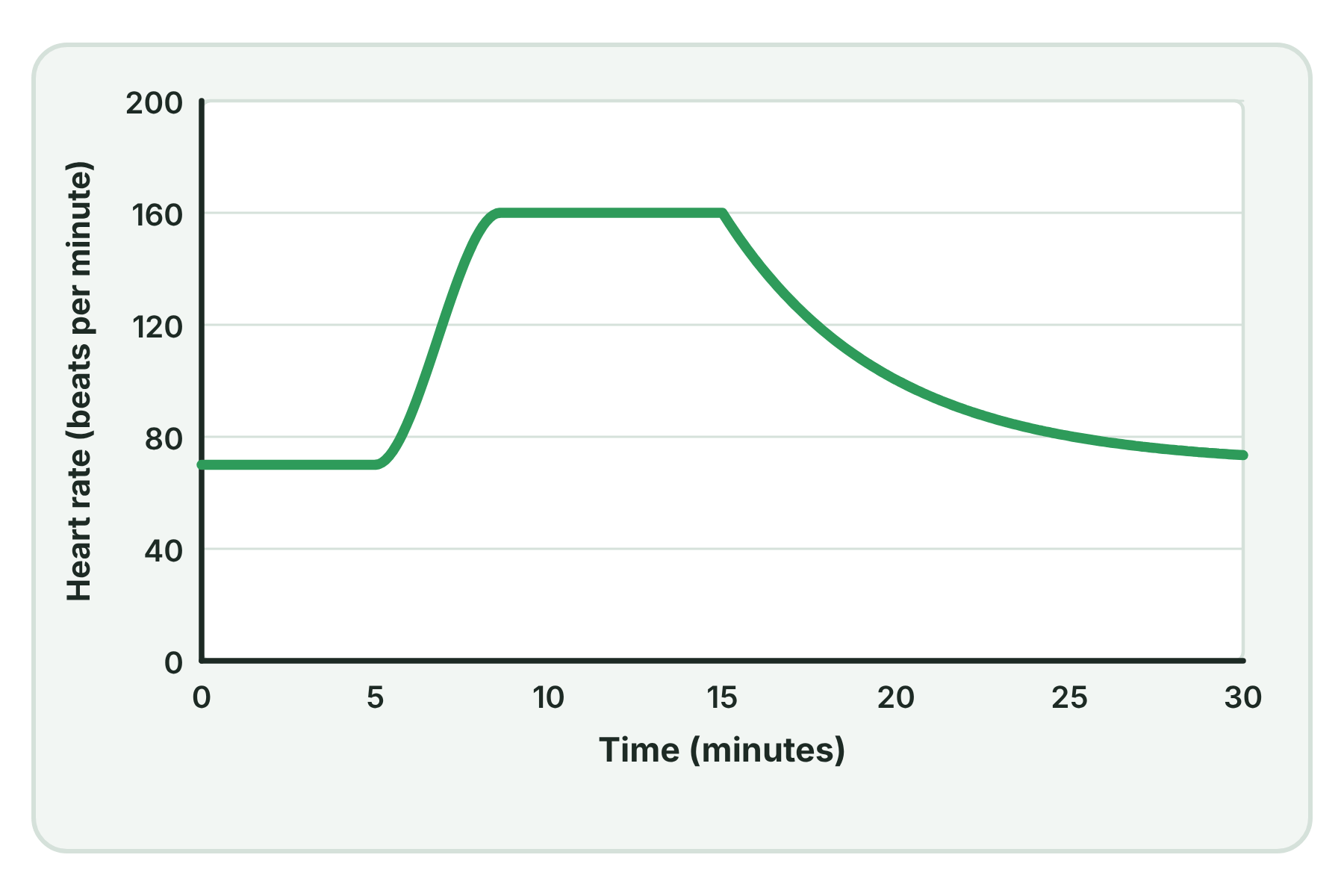
Figure 1 shows a person's heart rate before, during and after exercise. Describe the changes in heart rate shown in Figure 1.
Show answerHide answer
Model answer
The heart rate is steady at about 70 beats per minute at first. It increases when the exercise starts, to about 160 beats per minute. After the exercise it falls slowly, taking about 15 minutes to get back to the resting rate.
Mark scheme
- Steady at about 70 beats per minute at first — 1 mark
- Rises to about 160 beats per minute during exercise — 1 mark
- Falls slowly back to the resting rate after exercise — 1 mark
-
3 Explain [4 marks]
Explain why the heart rate and the breathing rate increase during exercise.
Show answerHide answer
Model answer
The muscles contract more, so they respire faster and need more oxygen and glucose. They also make more carbon dioxide. The heart rate and breathing rate increase so that more oxygenated blood is supplied to the muscles, and carbon dioxide is removed faster.
Mark scheme
- Muscles respire faster during exercise — 1 mark
- More oxygen and glucose are needed — 1 mark
- More oxygenated blood is supplied to the muscles — 1 mark
- Carbon dioxide is removed faster — 1 mark
-
4 Calculate [2 marks]
A person's heart rate is 60 beats per minute at rest and 150 beats per minute during exercise. Calculate the percentage increase in heart rate.
Show answerHide answer
Model answer
150%
Mark scheme
- \(150 - 60 = 90\), then \(90 \div 60 \times 100\) — 1 mark
- 150% — 1 mark
-
5 Explain [3 marks]
Explain why the muscles of a long-distance runner become fatigued.
Show answerHide answer
Model answer
During long periods of vigorous activity not enough oxygen reaches the muscles, so they respire anaerobically. The incomplete oxidation of glucose makes lactic acid, which builds up. The muscles then stop contracting efficiently.
Mark scheme
- Not enough oxygen, so anaerobic respiration — 1 mark
- Lactic acid builds up — 1 mark
- Muscles stop contracting efficiently — 1 mark
-
6 Describe [4 marks]
Describe how you could investigate the effect of exercise on the heart rate of a student.
Show answerHide answer
Model answer
Measure the resting pulse by counting the beats for a minute. Make the student exercise for a set time, for example 2 minutes of step-ups. Measure the pulse straight away and then every minute until it returns to normal. Repeat and calculate a mean, keeping the type and time of exercise the same.
Mark scheme
- Measure the resting pulse — 1 mark
- Exercise for a set time — 1 mark
- Measure the pulse after exercise until it returns to normal — 1 mark
- Repeat and calculate a mean / control variables — 1 mark
-
7 Explain [2 marks]
Explain what is meant by oxygen debt.
Show answerHide answer
Model answer
Oxygen debt is the extra oxygen the body needs after exercise. It reacts with the accumulated lactic acid to remove it from the cells.
Mark scheme
- The extra oxygen needed after exercise — 1 mark
- To react with / remove the lactic acid — 1 mark
-
8 Explain [3 marks]
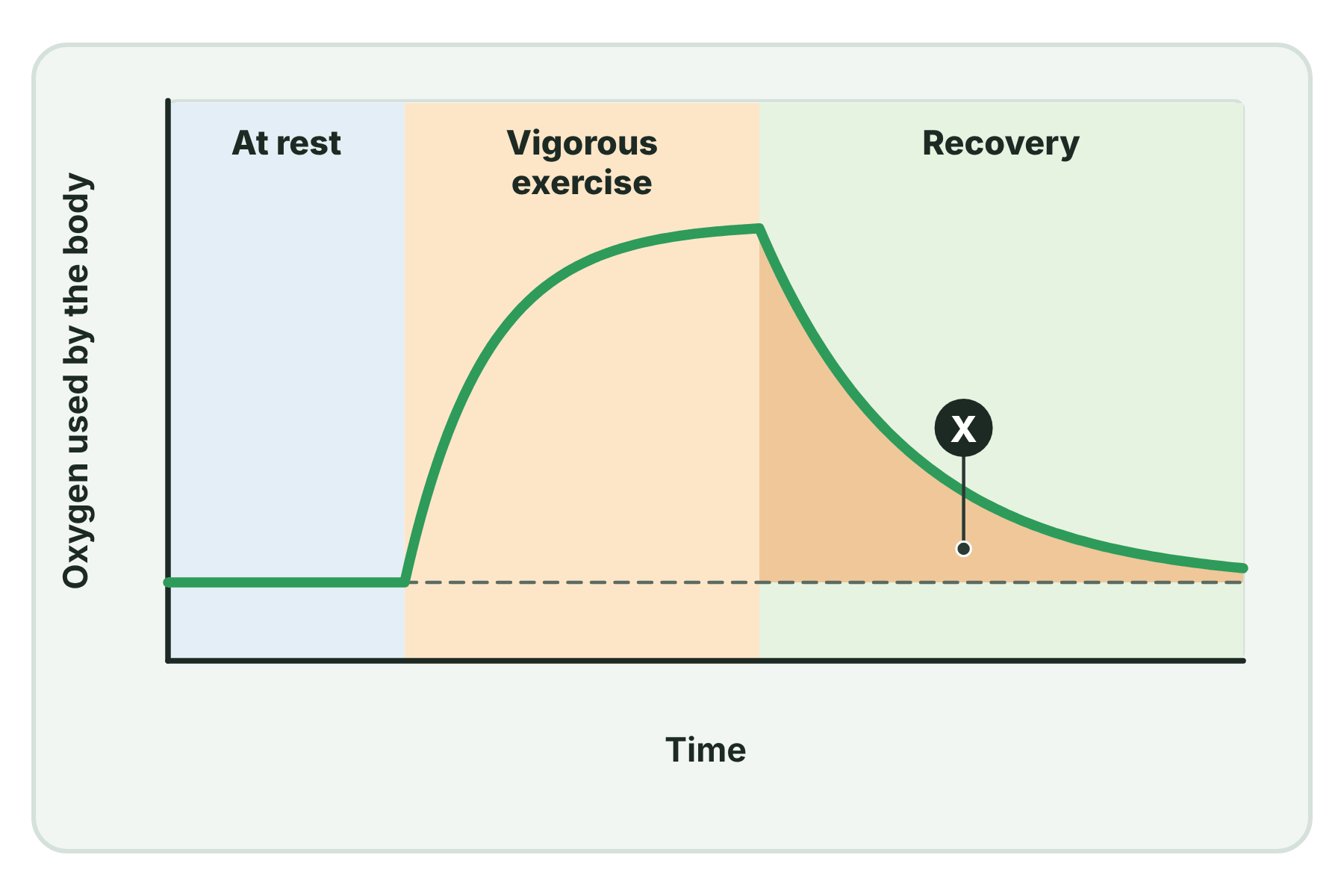
Figure 2 shows how much oxygen a person's body uses before, during and after vigorous exercise. Explain what the shaded area X shows and why it happens.
Show answerHide answer
Model answer
The shaded area shows the extra oxygen used after exercise, which is the oxygen debt being repaid. During the exercise the muscles respired anaerobically and made lactic acid. The extra oxygen is needed to react with the lactic acid and remove it.
Mark scheme
- Area X is the oxygen debt, the extra oxygen used after exercise — 1 mark
- Muscles respired anaerobically and made lactic acid — 1 mark
- The oxygen reacts with the lactic acid to remove it — 1 mark
-
9 Name [3 marks]
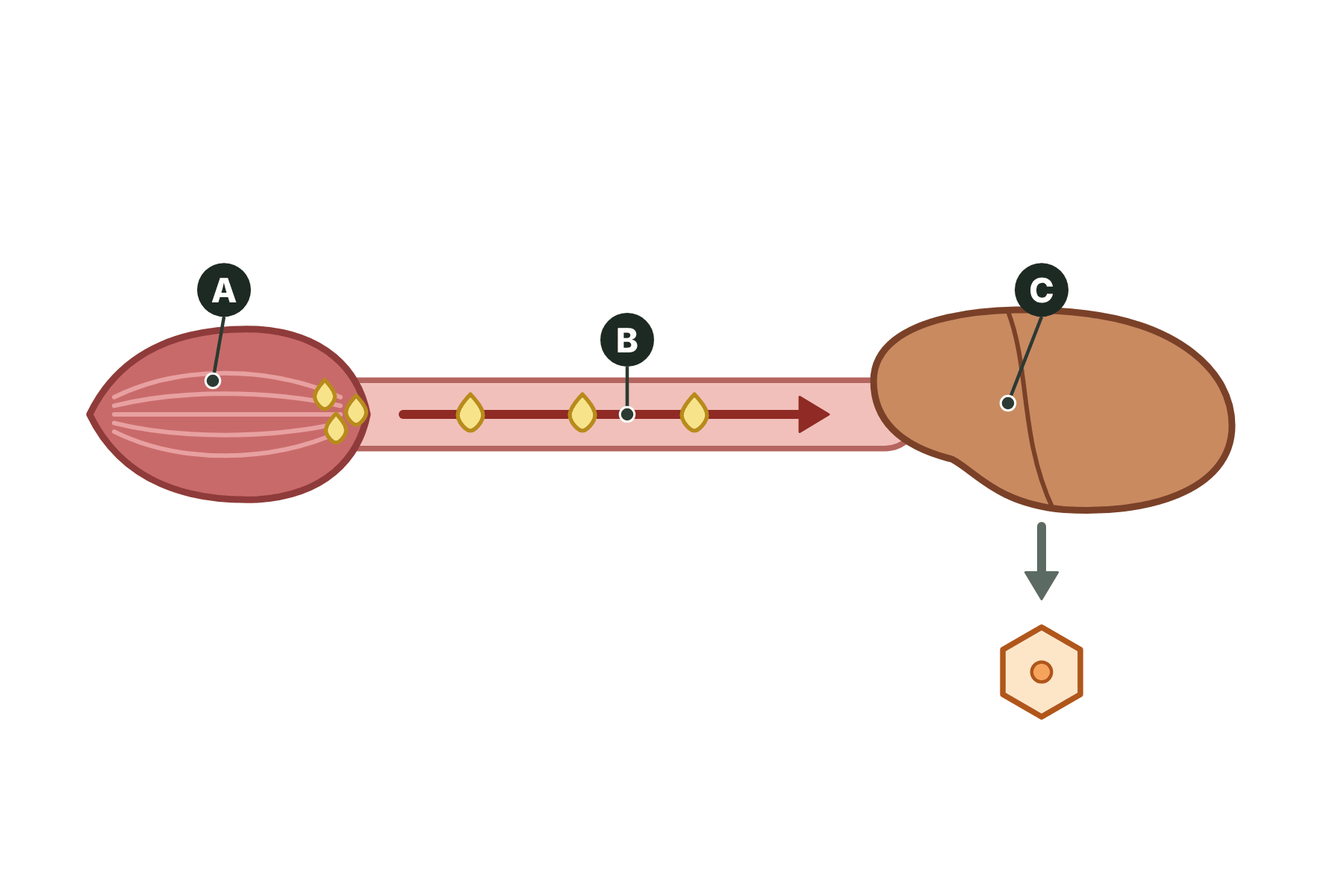
Figure 3 shows what happens to a substance that builds up in muscles during vigorous exercise. Name the part or substance shown at A, B and C.
Show answerHide answer
Model answer
A is the muscle. B is lactic acid, carried in the blood. C is the liver.
Mark scheme
- A: muscle — 1 mark
- B: lactic acid — 1 mark
- C: liver — 1 mark
Quick check
-
1
What happens to the breath volume during exercise?
Show answerHide answer
A: It increases
Each breath is deeper, so the breath volume increases.
-
2
Why does the heart rate increase during exercise?
Show answerHide answer
C: To supply the muscles with more oxygenated blood
A faster heart rate pumps more oxygenated blood to the muscles.
-
3
Which substance builds up in muscles during anaerobic respiration?
Show answerHide answer
B: Lactic acid
Anaerobic respiration in muscles makes lactic acid.
-
4
A student's heart rate is 80 beats per minute at rest and 160 during exercise. What is the percentage increase?
Show answerHide answer
D: 100%
The increase is 80, and 80 ÷ 80 × 100 = 100%.
-
5
Which word describes muscles that stop contracting efficiently after long periods of vigorous activity?
Show answerHide answer
C: Fatigued
Muscle fatigue is when muscles stop contracting efficiently.
-
6
A person takes 20 breaths per minute and each breath is 1.0 dm³. What volume of air do they breathe in each minute?
Show answerHide answer
A: 20 dm³ per minute
Volume per minute = breathing rate × breath volume = 20 × 1.0 = 20 dm³.
-
7
Where is lactic acid converted back to glucose?
Show answerHide answer
D: In the liver
The blood carries lactic acid to the liver, which converts it back into glucose.
-
8
What is oxygen debt?
Show answerHide answer
B: The extra oxygen needed after exercise to remove lactic acid
Oxygen debt is the extra oxygen needed after exercise to react with the lactic acid and remove it.