Exam questions · Biology · DNA and the Genome
The Structure of DNA
- 7 exam questions
- 20 marks
- 8 quick checks
-
1 Name [2 marks]
Name the four bases found in DNA.
Show answerHide answer
Model answer
A, C, G and T (adenine, cytosine, guanine and thymine).
Mark scheme
- Any two bases correct — 1 mark
- All four bases correct — 1 mark
-
2 Describe [3 marks]
Describe the structure of one nucleotide of DNA.
Show answerHide answer
Model answer
A nucleotide has a sugar and a phosphate group. One of four bases is attached to the sugar.
Mark scheme
- A sugar — 1 mark
- A phosphate group — 1 mark
- One of four bases attached to the sugar — 1 mark
-
3 Name [3 marks]
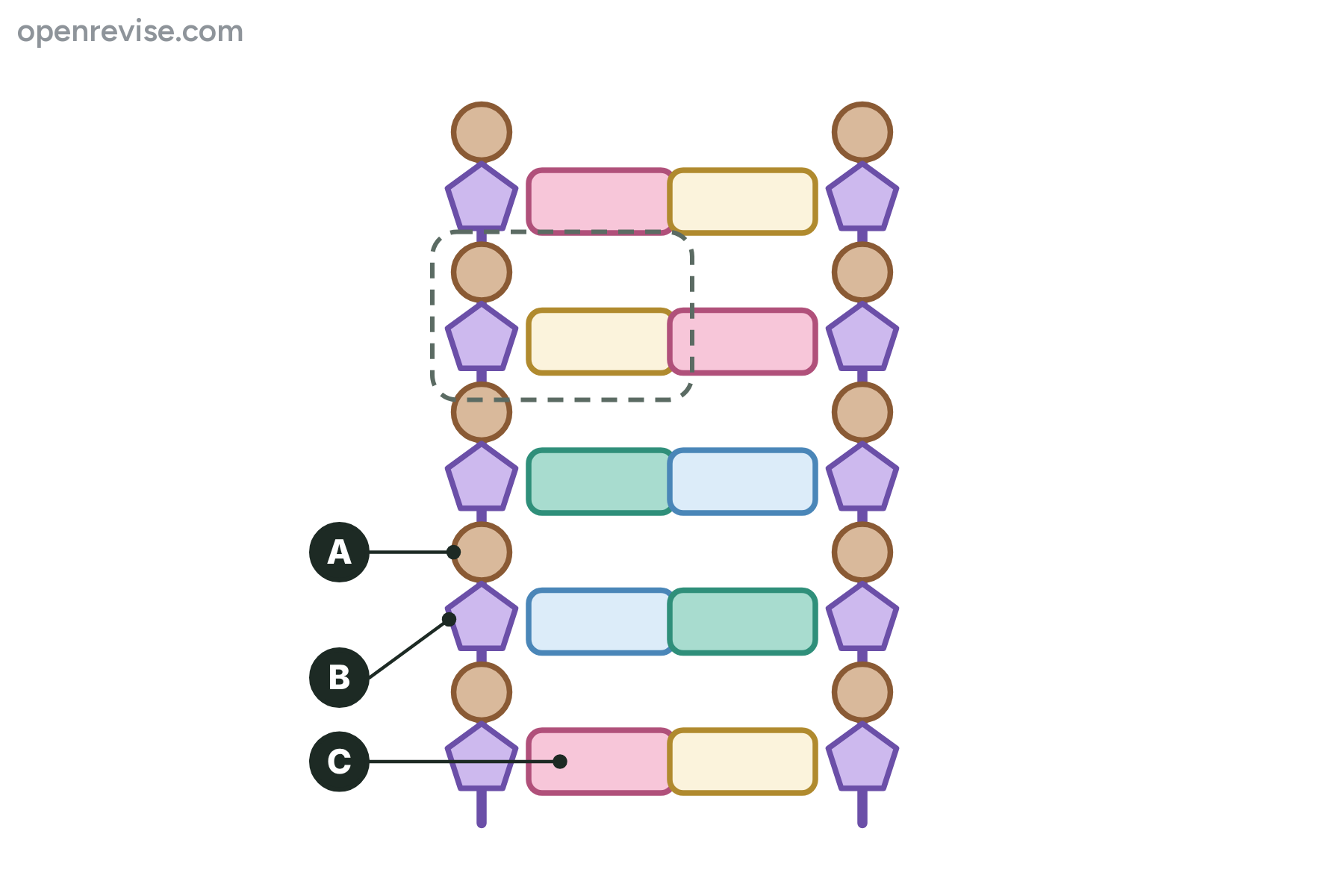
The diagram shows part of a DNA molecule. Name the parts labelled A, B and C.
Show answerHide answer
Model answer
A is a phosphate group. B is a sugar. C is a base.
Mark scheme
- A: phosphate (group) — 1 mark
- B: sugar — 1 mark
- C: base — 1 mark
-
4 Calculate [2 marks]
A gene has 1 800 bases. Every three bases code for one amino acid. Calculate the number of amino acids in the protein.
Show answerHide answer
Model answer
600 amino acids
Mark scheme
- \(1800 \div 3\) — 1 mark
- 600 — 1 mark
-
5 Explain [3 marks]
Explain how the order of bases in a gene controls the protein that is made.
Show answerHide answer
Model answer
A sequence of three bases is the code for one amino acid. The order of the bases therefore controls the order in which the amino acids are assembled. A different order of amino acids makes a different protein.
Mark scheme
- Three bases code for one amino acid — 1 mark
- The order of the bases controls the order of the amino acids — 1 mark
- The order of the amino acids decides which protein is made — 1 mark
-
6 Describe [4 marks]
Describe the structure of the DNA polymer.
Show answerHide answer
Model answer
DNA is a polymer made of repeating nucleotide units. Each nucleotide has a sugar, a phosphate group and one of four bases attached to the sugar. The long strands have alternating sugar and phosphate sections, with a base attached to each sugar. There are four different bases, A, C, G and T.
Mark scheme
- A polymer made from repeating nucleotides — 1 mark
- Each nucleotide is a sugar, phosphate and base — 1 mark
- Alternating sugar and phosphate sections in the strands — 1 mark
- Four different bases A, C, G and T — 1 mark
-
7 Give [3 marks]
One strand of a DNA molecule has the base sequence T T A G C. Give the base sequence of the complementary strand and state the two pairing rules you used.
Show answerHide answer
Model answer
The complementary strand is A A T C G. A is always linked to T, and C is always linked to G.
Mark scheme
- A A T C G — 1 mark
- T is linked to A — 1 mark
- C is linked to G — 1 mark
Quick check
-
1
How many different bases are found in DNA?
Show answerHide answer
C: Four
DNA contains four bases: A, C, G and T.
-
2
Which two parts alternate along the backbone of a DNA strand?
Show answerHide answer
B: Sugars and phosphate groups
The long strands consist of alternating sugar and phosphate sections.
-
3
To which part of a nucleotide is the base attached?
Show answerHide answer
D: The sugar
Each nucleotide has a sugar and a phosphate group, and the base is attached to the sugar.
-
4
How many bases code for one amino acid?
Show answerHide answer
A: Three
A sequence of three bases is the code for a particular amino acid.
-
5
A gene is 1 500 bases long. About how many amino acids will its protein have?
Show answerHide answer
C: 500
Three bases code for one amino acid, so 1 500 divided by 3 is 500.
-
6
What do the four different nucleotides in DNA differ in?
Show answerHide answer
B: Their base
They have the same sugar and phosphate group, and differ only in the base.
-
7
In the complementary strands of DNA, which base is always linked to C?
Show answerHide answer
A: G
C is always linked to G on the opposite strand.
-
8
One strand of DNA reads A C C G T. What is the complementary strand?
Show answerHide answer
D: T G G C A
A pairs with T, C with G, C with G, G with C and T with A, which gives T G G C A.