Flashcards · Biology · DNA and the Genome
The Structure of DNA
-
What type of molecule is DNA?
A polymer made from nucleotides.
-
How many different nucleotides are in DNA?
Four.
-
What are the three parts of a nucleotide?
A sugar, a phosphate group and a base.
-
What are the four bases in DNA?
A, C, G and T.
-
What makes the four nucleotides different from each other?
The base attached to the sugar.
-
What forms the backbone of a DNA strand?
Alternating sugar and phosphate sections.
-
Where is the base attached?
To the sugar.
-
How many bases code for one amino acid?
Three.
-
What does the order of bases in a gene control?
The order in which amino acids are assembled to make a protein.
-
A gene has 600 bases. About how many amino acids does it code for?
200, because 600 divided by 3 is 200.
-
Is knowing the DNA structure diagram from memory needed for the exam?
No. You must be able to interpret a diagram of DNA, not reproduce it.
-
Which base is linked to C on the opposite strand? (Higher tier)
G.
-
Which base is linked to T on the opposite strand? (Higher tier)
A.
-
What is the complementary strand of A T C G? (Higher tier)
T A G C.
-
What is a nucleotide repeated many times called?
A DNA polymer.
-
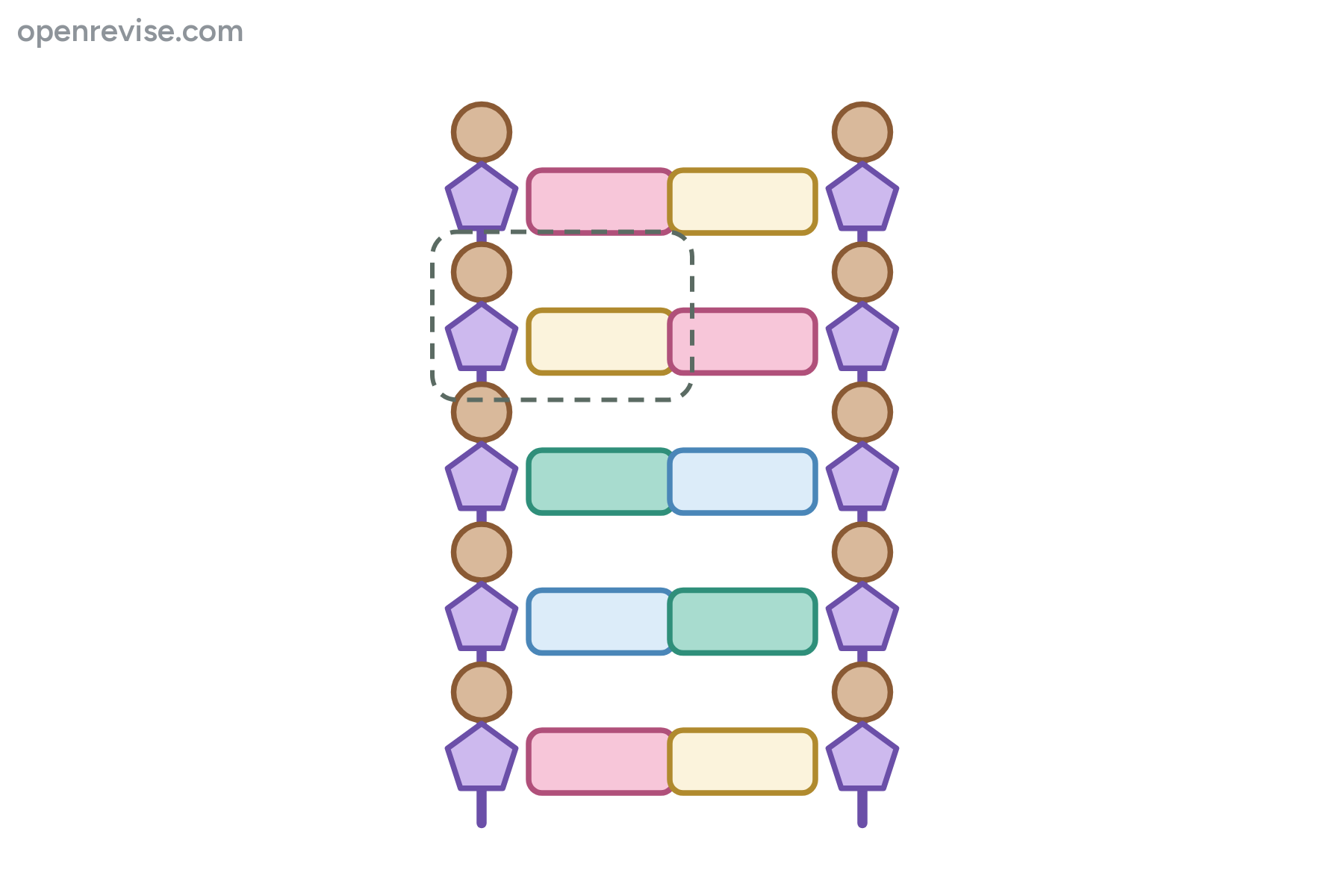 Name the parts of a nucleotide and the part that makes the code.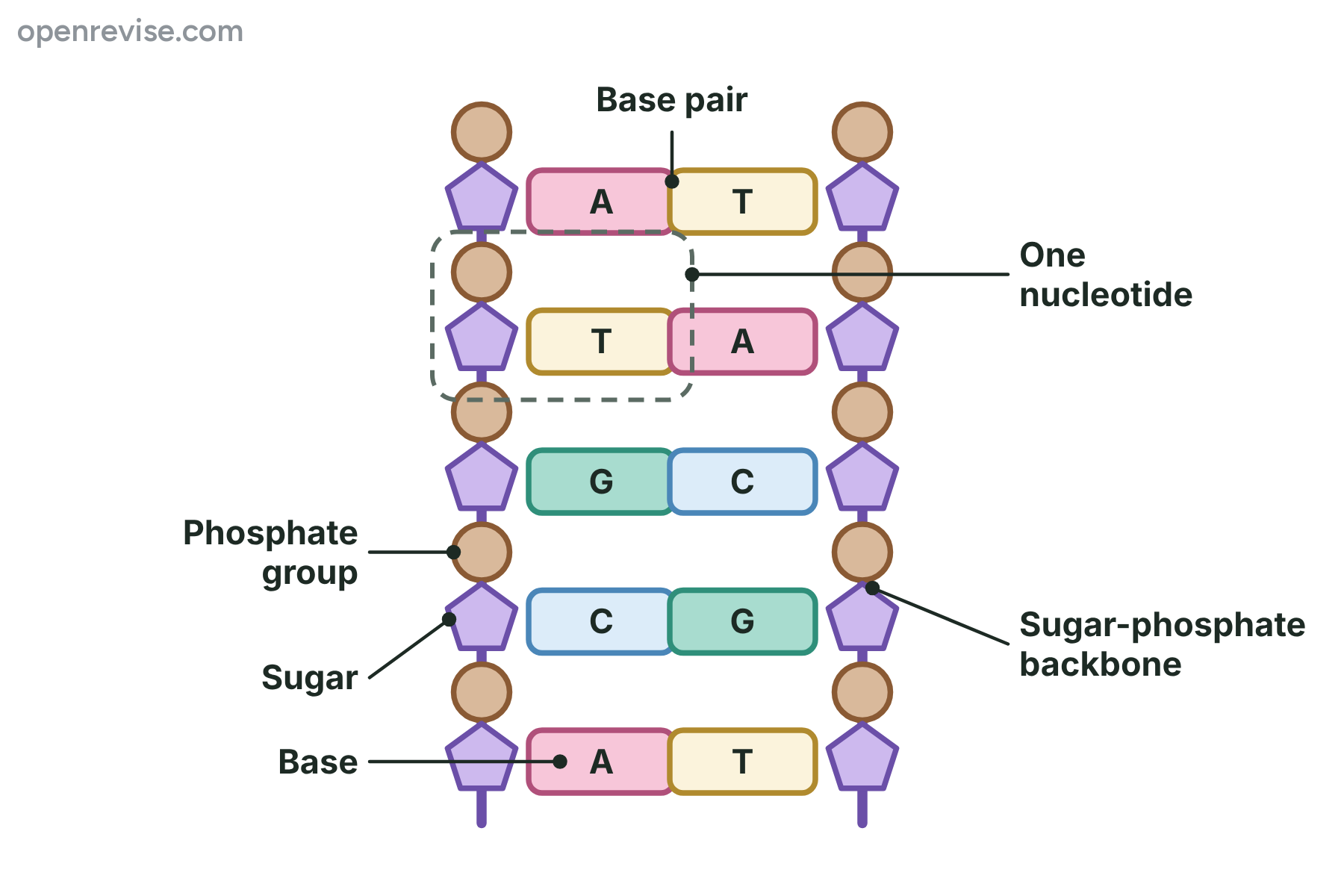
A nucleotide is a sugar, a phosphate group and a base. The base carries the code, and the order of the bases is the genetic code.