Exam questions · Biology · DNA and the Genome
Mutations and Non-coding DNA (Higher tier)
- 7 exam questions
- 20 marks
- 8 quick checks
-
1 State [1 mark]
What is a mutation?
Show answerHide answer
Model answer
A change in the base sequence of DNA.
Mark scheme
- A change in the base sequence (structure) of DNA — 1 mark
-
2 Explain [2 marks]
Most mutations do not change the way an organism looks or works. Give two reasons why.
Show answerHide answer
Model answer
Most mutations do not alter the protein, or only alter it slightly, so its function is not changed. Some happen in non-coding DNA, or the changed triplet codes for the same amino acid.
Mark scheme
- Protein not altered, or altered only slightly — 1 mark
- A further correct reason, such as the mutation being in non-coding DNA — 1 mark
-
3 Explain [4 marks]
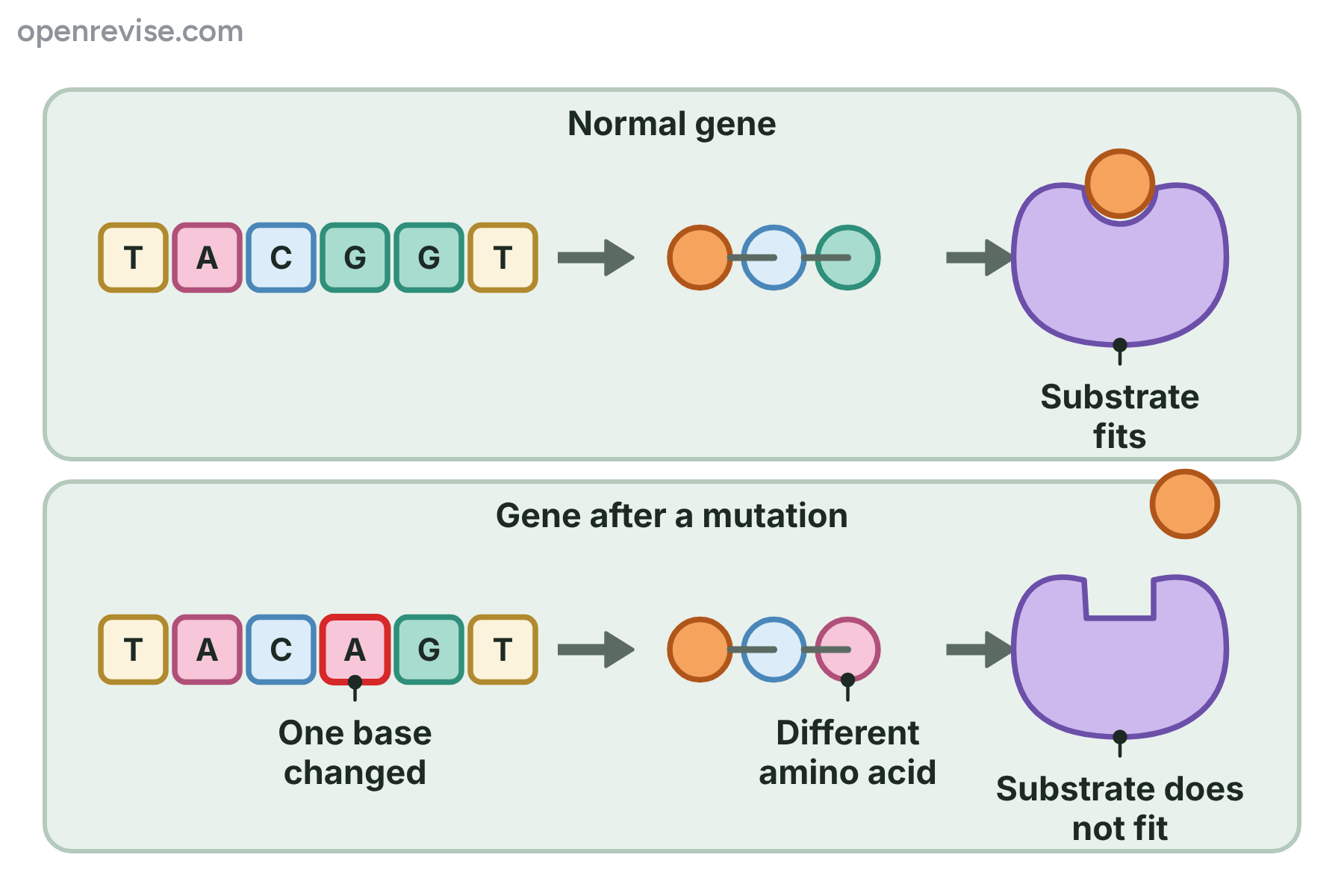
The diagram shows a normal gene and the same gene after a mutation. Explain how the mutation has stopped the enzyme working.
Show answerHide answer
Model answer
One base in the gene has changed, so the order of the amino acids is different. The different amino acid makes the protein fold into a different shape. The active site no longer fits the substrate, so the enzyme cannot catalyse the reaction.
Mark scheme
- One base has changed — 1 mark
- The amino acid sequence is different — 1 mark
- The enzyme has a different shape — 1 mark
- The substrate no longer fits the active site — 1 mark
-
4 Calculate [3 marks]
A gene has the base sequence CAT GGA TTC. The first base of the gene is deleted. Write the new sequence in groups of three and state how many of the original three triplets are now different.
Show answerHide answer
Model answer
ATG GAT TC. All three of the original triplets are different (the last group is also incomplete).
Mark scheme
- Deletion gives ATGGATTC — 1 mark
- Regrouped as ATG GAT TC — 1 mark
- All the triplets after the deletion are changed — 1 mark
-
5 Explain [3 marks]
A mutation in the gene for a structural protein can make the protein weaker. Explain how.
Show answerHide answer
Model answer
The mutation changes the sequence of bases, so the order of the amino acids is different. The protein may fold into a different shape. The altered shape can mean the protein loses its strength.
Mark scheme
- The base sequence changes so the amino acids change — 1 mark
- The protein folds into a different shape — 1 mark
- The altered shape makes the protein lose its strength — 1 mark
-
6 Describe [3 marks]
Not all parts of DNA code for proteins. Describe how variants in non-coding DNA can affect an organism.
Show answerHide answer
Model answer
Non-coding parts of DNA can switch genes on and off. A variation in a non-coding part can therefore alter how genes are expressed, so the amount of a protein that is made can change even though the protein itself is the same.
Mark scheme
- Non-coding DNA does not code for proteins — 1 mark
- It can switch genes on and off — 1 mark
- A variant alters how genes are expressed — 1 mark
-
7 Evaluate [4 marks]
Mutations occur continuously, yet most people are healthy. Explain why mutations do not always cause a problem, and why a few do.
Show answerHide answer
Model answer
Most mutations do not alter the protein, or only alter it slightly, so the function does not change. Many happen in non-coding DNA. A few mutations code for an altered protein with a different shape. An enzyme may then no longer fit its substrate, or a structural protein may lose strength, which can cause a problem.
Mark scheme
- Most mutations do not alter the protein or alter it slightly — 1 mark
- Some are in non-coding DNA — 1 mark
- A few give a protein with a different shape — 1 mark
- Enzyme and substrate no longer fit, or structural protein weaker — 1 mark
Quick check
-
1
How often do mutations occur?
Show answerHide answer
C: Continuously
Mutations occur continuously.
-
2
What do most mutations do to the protein that a gene codes for?
Show answerHide answer
A: Nothing, or only a slight change
Most mutations do not alter the protein, or alter it only slightly, so its function is unchanged.
-
3
What can happen to an enzyme made from a mutated gene?
Show answerHide answer
D: The substrate may no longer fit its active site
The enzyme may have a different shape, so the substrate no longer fits the active site.
-
4
Which mutation is most likely to change every amino acid after the mutation?
Show answerHide answer
B: Deleting one base
Inserting or deleting a base shifts the grouping of every triplet after it.
-
5
What can non-coding DNA do?
Show answerHide answer
A: Switch genes on and off
Non-coding parts of DNA can switch genes on and off.
-
6
A structural protein is changed by a mutation. What is a likely effect?
Show answerHide answer
C: It loses strength
A structural protein with an altered shape may lose its strength.
-
7
A gene reads ATG CCA GTT. A substitution changes the second triplet to CCG. How many triplets are changed?
Show answerHide answer
B: One
A substitution changes one base, so only the triplet containing that base is changed.
-
8
How can a variant in non-coding DNA affect an organism?
Show answerHide answer
D: It can alter how genes are expressed
It can alter how genes are expressed.