Biology · DNA and the Genome
Mutations and Non-coding DNA (Higher tier)
This lesson is for separate Biology and the Higher tier only: Combined Science students and Foundation tier students do not need it. It explains how mutations can change a protein, why most mutations have no effect and how variants in non-coding DNA can change how genes are expressed.
Learning Objectives
- 1(Higher tier) Explain how a change in the structure of DNA may result in a change in the protein synthesised by a gene.
- 2(Higher tier) Describe why most mutations do not alter the protein, or alter it only slightly, and why a few do.
- 3(Higher tier) Describe how a mutation can stop an enzyme fitting its substrate or weaken a structural protein.
- 4(Higher tier) Describe how genetic variants in non-coding DNA can alter how genes are expressed.
Retrieval practice
-
1
What is a gene?
Show answerHide answer
A small section of DNA on a chromosome that codes for a particular sequence of amino acids.
-
2
How many bases code for one amino acid?
Show answerHide answer
Three.
-
3
What is the active site of an enzyme?
Show answerHide answer
The part of the enzyme where the substrate fits and the reaction happens.
-
4
What is a mutation?
Show answerHide answer
A change in the DNA of an organism.
When the copying goes wrong
Mutations occur continuously, and every one of us carries some. They happen by chance when DNA is copied, and they are more likely after exposure to ionising radiation or certain chemicals. Most mutations do nothing at all. A few change a protein, and very rarely a mutation produces a protein that makes an organism better suited to its environment. This lesson explains why the effect depends so much on where the change is and what it does to the protein.
Types of mutation
A mutation is a change in the base sequence of DNA. Three simple changes are enough to explain the effects.
-
Substitution
One base is swapped for a different base. This changes one triplet, so at most one amino acid in the protein is different.
-
Insertion
An extra base is added. Every triplet after the insertion is read differently, so the amino acids after that point may all change.
-
Deletion
A base is lost. Again every triplet after that point is read differently, so a large part of the protein can change.
-
Random
Mutations occur by chance and continuously. Which base changes is not planned, and most changes are not useful.
The effect of a deletion (Higher tier)
A gene has the base sequence ATG CCA GTT ACG. The fourth base, C, is deleted. Write the new sequence in groups of three and say how many triplets are changed.
Show the solutionHide the solution
- 1 Write out the original sequence without gaps ATGCCAGTTACG
- 2 Delete the fourth base, C ATGCAGTTACG
- 3 Regroup in threes ATG CAG TTA CG
- 4 Compare with the original The first triplet is the same. Every triplet after the deletion is different
AnswerATG CAG TTA CG. The second and third triplets are changed, and the last group is incomplete, so all of the code after the deletion is altered.
How a mutation can change a protein
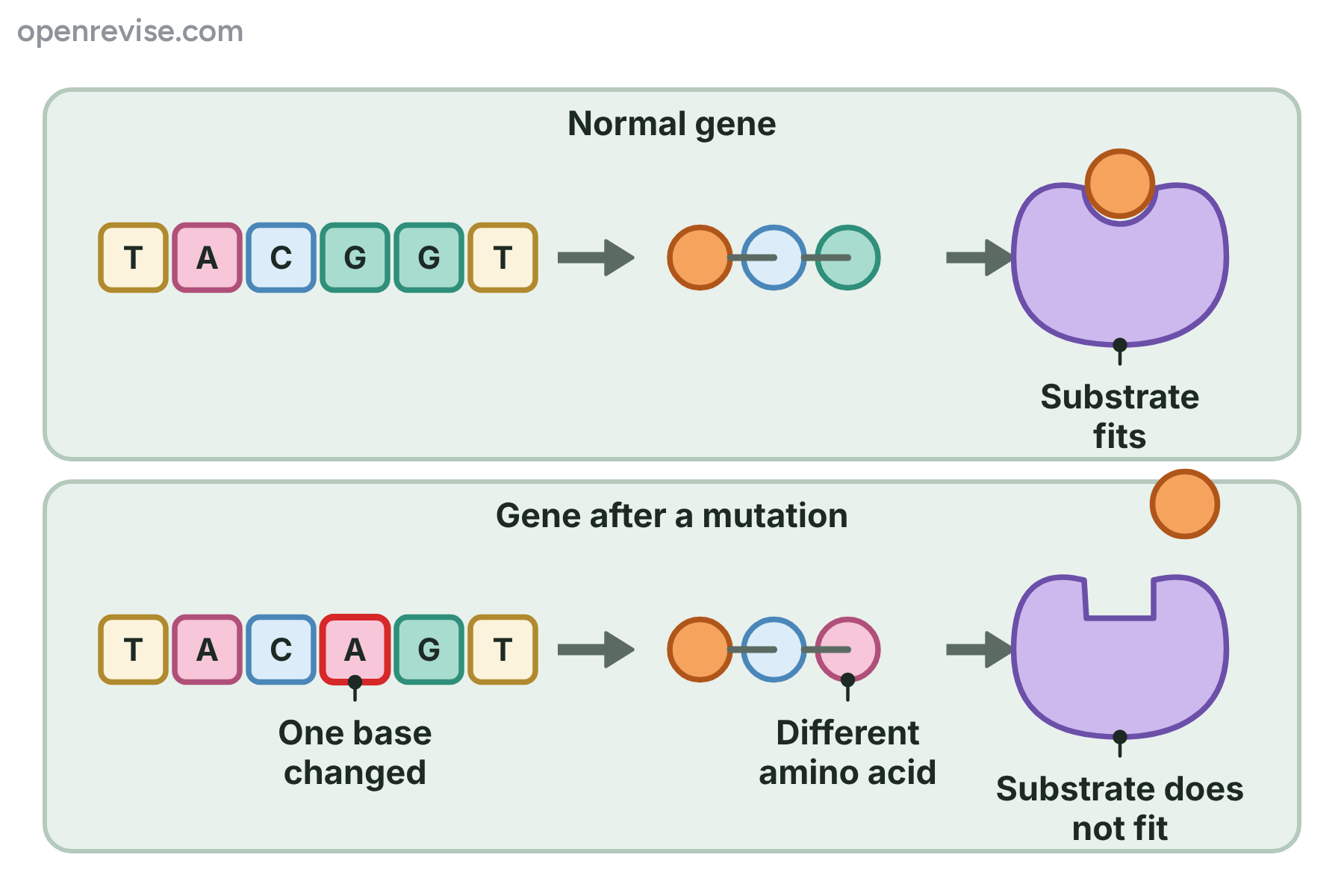
One changed base can change an amino acid, the shape of the protein and its job.
Most mutations do not matter, but a few do
What a mutation does depends on whether it changes the protein, and by how much.
-
Most mutations
Most do not alter the protein, or only alter it slightly, so its appearance or function is not changed. This can happen when the changed triplet still codes for the same amino acid, or when the change is in a part of the protein that does not matter much.
-
A few mutations
A few mutations code for an altered protein with a different shape.
-
Enzymes
An enzyme with a changed shape may no longer fit the substrate in its active site, so it cannot catalyse the reaction.
-
Structural proteins
A structural protein with a changed shape may lose its strength.
From a mutation to a different phenotype
A mutation changes the phenotype only if it changes the protein enough to change how it works.
-
1
The DNA changes
A mutation changes the sequence of bases in a gene.
-
2
The amino acids may change
One or more triplets are different, so the order of amino acids may be different.
-
3
The protein folds differently
A different amino acid order can give a different shape.
-
4
The protein works differently
An enzyme may not fit its substrate, or a structural protein may be weaker.
-
5
The phenotype may change
The organism may have a different characteristic, which may help it, harm it or make no difference.
Non-coding DNA
Not all parts of DNA code for proteins.
-
Non-coding DNA
Not all parts of DNA code for proteins. Some parts do not code for any amino acid sequence at all.
-
Switching genes on and off
Non-coding parts of DNA can switch genes on and off, so they control which proteins a cell makes and when.
-
Variants in non-coding DNA
A variation in a non-coding part can alter how genes are expressed, for example by making a gene switch on more or less often, even though the protein itself is unchanged.
-
Variants in coding DNA
A variant in coding DNA can alter the activity of a protein, as with the enzyme that no longer fits its substrate.
Where a genetic variant is
In coding DNA
- Changes the sequence of amino acids
- May alter the activity of the protein
- The protein itself is different
- Example: an enzyme that cannot bind its substrate
In non-coding DNA
- No change to the amino acids
- Alters how genes are expressed
- The same protein, made more or less often
- Example: a gene switched on at the wrong time
The big idea
Most mutations are harmless, a few change a protein for better or worse, and those in non-coding DNA can change how much of a protein is made.
Mutations
Mutations
-
Causes
- chance errors
- radiation
- chemicals
-
Types
- substitution
- insertion
- deletion
-
Effect on the protein
- none
- slightly different
- different shape
-
Enzymes
- substrate no longer fits the active site
-
Structural proteins
- lose strength
-
Non-coding DNA
- switches genes on and off
Summary and exam focus
- Mutations occur continuously, and most do not alter the protein or alter it only slightly.
- A few mutations code for an altered protein with a different shape.
- An enzyme may no longer fit the substrate in its active site, and a structural protein may lose its strength.
- Not all parts of DNA code for proteins, and non-coding parts can switch genes on and off.
- A variant in non-coding DNA can alter how genes are expressed.
Exam focus
Explain how a mutation in a gene for an enzyme could stop the enzyme working. (4 marks) (4 marks)
Follow the chain of cause and effect in order: the base sequence changes, so the amino acid sequence changes, so the protein folds into a different shape, so the active site no longer fits the substrate. Use the word substrate.
Key terms
The words this lesson expects you to use. Each one is linked from the first place it appears above.
- Mutation
- A change in the base sequence of DNA.
- Substitution
- A mutation in which one base is replaced by a different base.
- Insertion
- A mutation in which an extra base is added to the DNA.
- Deletion
- A mutation in which a base is lost from the DNA.
- Active site
- The part of an enzyme into which the substrate fits.
- Substrate
- The substance that an enzyme acts on.
- Non-coding DNA
- Parts of DNA that do not code for proteins and can switch genes on and off.
- Genetic variant
- A different version of a DNA sequence, which arose by mutation.
- Gene expression
- The switching on of a gene so that its protein is made.
You've finished the notes
Check your understanding
Test yourself while it is fresh. Start with the flashcards, then try the exam questions.
Something here looks wrong?
Tell us what and we will go and look. It goes to whoever writes these pages, nobody else, and we do not ask who you are — so there is nothing to sign and nothing comes back to you.