Exam questions · Biology · DNA and the Genome
Protein Synthesis (Higher tier)
- 7 exam questions
- 20 marks
- 8 quick checks
-
1 State [1 mark]
Name the structures in a cell on which proteins are made.
Show answerHide answer
Model answer
Ribosomes.
Mark scheme
- Ribosomes — 1 mark
-
2 Describe [3 marks]
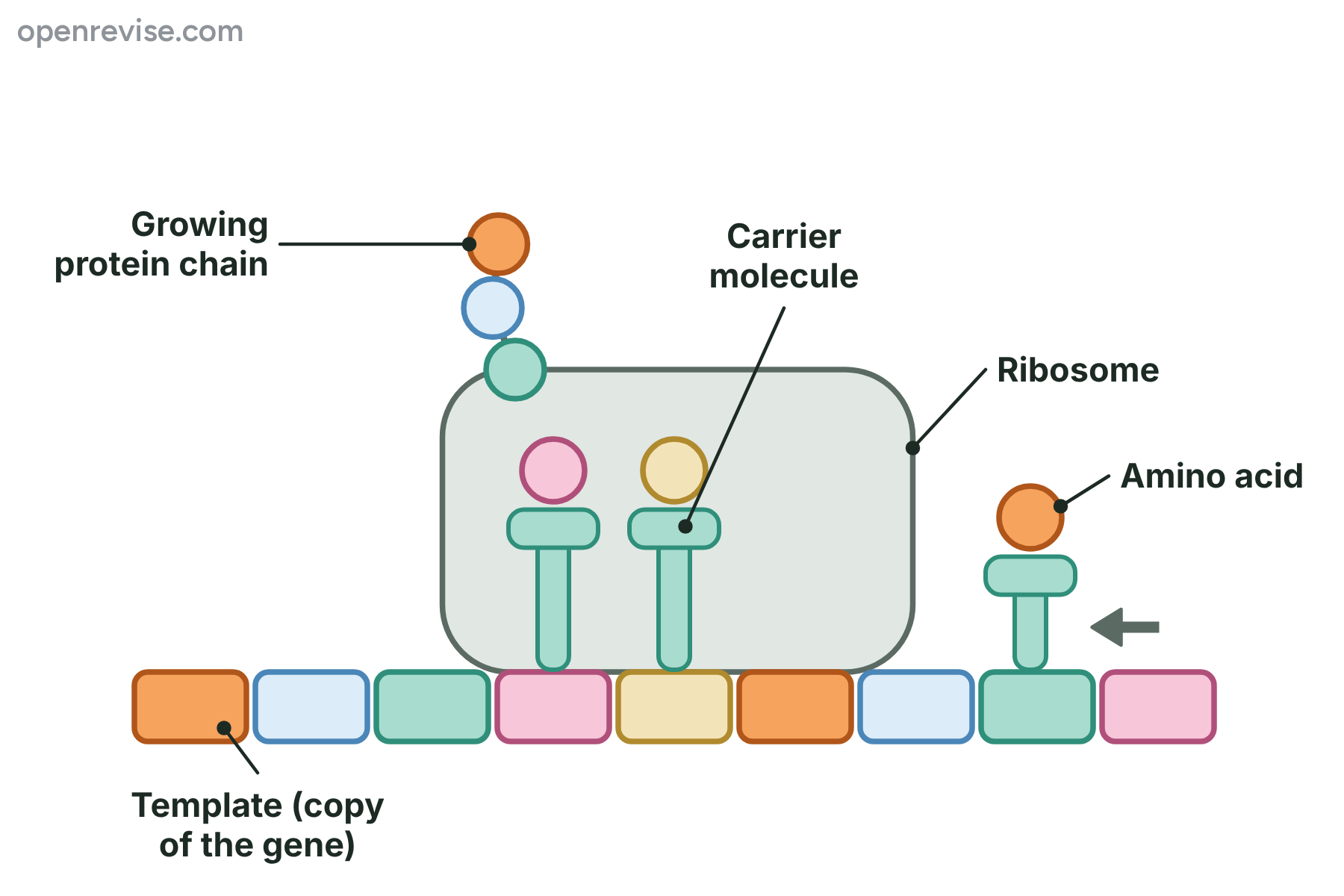
The diagram shows protein synthesis. Describe the job of the carrier molecules.
Show answerHide answer
Model answer
Each carrier molecule brings a specific amino acid to the ribosome. The amino acids are added to the growing protein chain in the correct order, as specified by the template.
Mark scheme
- Bring amino acids to the ribosome — 1 mark
- Each carrier brings a specific amino acid — 1 mark
- Added to the growing chain in the correct order — 1 mark
-
3 Explain [3 marks]
Explain how the order of bases in a gene affects the protein that is made.
Show answerHide answer
Model answer
The order of bases decides the order of the amino acids that the carrier molecules add to the chain. The order of the amino acids decides the shape into which the chain folds. A different base order can therefore make a different protein.
Mark scheme
- The base order decides the amino acid order — 1 mark
- The amino acid order decides the shape of the protein — 1 mark
- A different base order may make a different protein — 1 mark
-
4 Calculate [2 marks]
A gene has 2 100 bases. Three bases specify one amino acid. Calculate the number of amino acids in the protein.
Show answerHide answer
Model answer
700 amino acids
Mark scheme
- \(2100 \div 3\) — 1 mark
- 700 — 1 mark
-
5 Explain [3 marks]
Explain why a protein must fold into the correct shape.
Show answerHide answer
Model answer
When the chain is complete it folds into a unique shape. The shape enables the protein to do its job, for example as an enzyme, which has to fit its substrate, as a hormone or as a structural protein such as collagen. If the shape is wrong the protein may not work.
Mark scheme
- The chain folds into a unique shape — 1 mark
- The shape enables the protein to do its job — 1 mark
- An example such as an enzyme fitting its substrate — 1 mark
-
6 Describe [4 marks]
Describe how a protein is made on a ribosome.
Show answerHide answer
Model answer
The ribosome reads the template, which is a copy of the gene. Carrier molecules bring specific amino acids to the ribosome. The amino acids are added to the growing chain in the order set by the template. When the chain is complete it folds into a unique shape.
Mark scheme
- Ribosome reads a template — 1 mark
- Carrier molecules bring specific amino acids — 1 mark
- Amino acids added to the chain in the correct order — 1 mark
- The finished chain folds into a unique shape — 1 mark
-
7 Explain [4 marks]
Collagen is a structural protein. A change in the gene for collagen can make the bones weak. Explain how a change in a gene could make weak collagen.
Show answerHide answer
Model answer
A change in the DNA changes the order of the bases in the gene. This can change the order of the amino acids in the collagen chain. A different order of amino acids may make the chain fold into a different shape. The collagen is then not as strong, so the bones are weak.
Mark scheme
- The order of the bases in the gene changes — 1 mark
- The order of the amino acids changes — 1 mark
- The protein folds into a different shape — 1 mark
- The collagen is not as strong — 1 mark
Quick check
-
1
Where does protein synthesis happen in a cell?
Show answerHide answer
B: On ribosomes
Proteins are made on ribosomes.
-
2
What do carrier molecules do in protein synthesis?
Show answerHide answer
A: Bring specific amino acids to the ribosome
Each carrier molecule brings a specific amino acid to add to the growing chain.
-
3
What happens to a protein chain once it is complete?
Show answerHide answer
C: It folds into a unique shape
It folds up to form a unique shape.
-
4
What decides the order of amino acids in a protein?
Show answerHide answer
D: The order of bases in the gene
The order of the bases in the gene decides the order of the amino acids.
-
5
Why must a protein fold into the right shape?
Show answerHide answer
B: So that it can do its job
The shape lets the protein do its job, such as an enzyme fitting its substrate.
-
6
A gene has 900 bases. About how many amino acids does its protein have?
Show answerHide answer
A: 300
Three bases specify one amino acid, so 900 divided by 3 is 300.
-
7
Which of these is a structural protein?
Show answerHide answer
C: Collagen
Collagen is a structural protein found in skin, tendons and bones.
-
8
What can happen if the structure of the DNA in a gene changes?
Show answerHide answer
D: A different protein may be made
The order of the amino acids may change, so a different protein may be made.