Biology · DNA and the Genome
Protein Synthesis (Higher tier)
This lesson is for separate Biology and the Higher tier only: Combined Science students and Foundation tier students do not need it. It gives a simple description of protein synthesis on ribosomes and explains how the shape of a finished protein lets it do its job.
Learning Objectives
- 1(Higher tier) Recall a simple description of protein synthesis on ribosomes.
- 2(Higher tier) Explain simply how the structure of DNA affects the protein that is made.
- 3(Higher tier) Explain how the folded shape of a protein lets it work as an enzyme, a hormone or a structural protein.
- 4(Higher tier) Describe how a protein is built, one amino acid at a time, in the correct order.
Retrieval practice
-
1
How many bases code for one amino acid?
Show answerHide answer
Three.
-
2
What is a gene?
Show answerHide answer
A small section of DNA on a chromosome that codes for a particular sequence of amino acids.
-
3
What are the building blocks of proteins?
Show answerHide answer
Amino acids.
-
4
Name two kinds of job that proteins do in the body.
Show answerHide answer
For example, enzymes that speed up reactions and hormones that carry messages.
Making a protein from a gene
DNA stays safely in the nucleus, but proteins are made in the cytoplasm on tiny structures called ribosomes. So the instructions in a gene have to be passed on to a ribosome. At the ribosome the amino acids are joined in the order the gene specifies, and the finished chain folds into the shape the protein needs.
The steps of protein synthesis
You only need a simple description. You do not need the detailed structure of mRNA, carrier molecules, amino acids or proteins.
-
1
The code is copied
A copy of the gene, which acts as a template, carries the instructions from the DNA in the nucleus to a ribosome.
-
2
The ribosome reads the template
Proteins are synthesised on ribosomes, according to the template.
-
3
Carrier molecules deliver amino acids
Each carrier molecule brings a specific amino acid to add to the growing protein chain, in the order the template specifies.
-
4
The chain is assembled
The amino acids are joined together one at a time until the chain is complete.
-
5
The chain folds
When the protein chain is complete it folds up to form a unique shape.
Making a protein on a ribosome
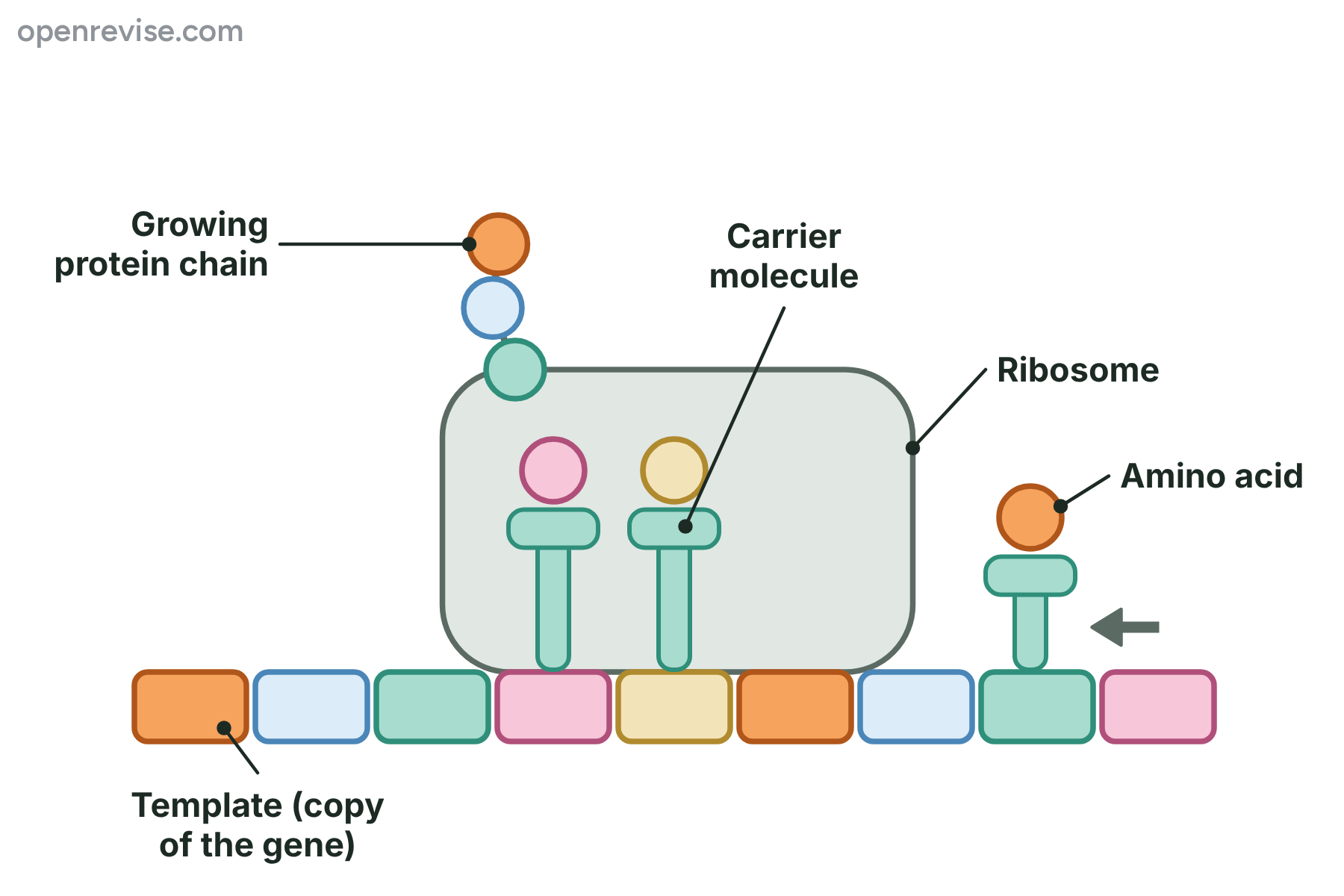
Carrier molecules bring the amino acids in the order the template specifies.
How the structure of DNA affects the protein
The base order in a gene is the instruction, so a change in the DNA can change the protein.
-
The base order
The order of the bases in a gene is copied to the template, and every three bases on it specify one amino acid.
-
The amino acid order
The order of the bases therefore decides the order of the amino acids in the protein chain.
-
A change in the DNA
If the structure of the DNA changes, for example one base is different, the amino acid order may change, and a different protein may be made.
-
Why this matters
A protein with a different sequence of amino acids can fold into a different shape and may not work in the same way.
Why the shape of a protein matters
When the chain is complete it folds into a unique shape, and the shape is what lets the protein do its job.
-
Enzymes
An enzyme has a shape that fits its substrate. If the shape is wrong, the enzyme cannot catalyse the reaction.
-
Hormones
A hormone has a shape that fits the receptors on its target cells, so only those cells respond to the message.
-
Structural proteins
Proteins such as collagen form structures in the body. Their shape makes them strong, so they can hold tissues such as skin and tendons together.
-
A unique shape
Each protein folds into its own unique shape, because the order of its amino acids is different from that of every other protein.
Case study
Collagen, a structural protein
Collagen is a protein found in skin, tendons, bones and cartilage. Three chains of amino acids twist round each other into a strong, rope-like shape, and many ropes are bundled together. Because the shape depends on the order of the amino acids, a change in the gene for collagen can make weak collagen. In the inherited condition osteogenesis imperfecta, for example, the bones break easily.
How many amino acids in the protein? (Higher tier)
A gene has 1 500 bases. Every three bases specify one amino acid. How many amino acids are in the protein that the gene codes for? (Ignore any start and stop signals.)
Show the solutionHide the solution
- 1 Use the rule Three bases specify one amino acid
- 2 Divide the bases by three \(1500 \div 3\)
- 3 Give the answer 500 amino acids
Answer500 amino acids
Gene, template and protein
In the nucleus
- DNA is stored in the chromosomes
- The gene holds the code
- A copy of the gene is made
- The DNA itself never leaves
In the cytoplasm
- The template arrives at a ribosome
- Carrier molecules bring the amino acids
- The protein chain is assembled
- The chain folds into its shape
The big idea
The order of the bases decides the order of the amino acids, the order of the amino acids decides the shape, and the shape decides what the protein can do.
Protein synthesis
Protein synthesis
-
Where
- on ribosomes in the cytoplasm
-
Template
- a copy of the gene
-
Carrier molecules
- bring specific amino acids
- correct order
-
Folding
- chain folds into a unique shape
-
Jobs
- enzymes
- hormones
- structural proteins such as collagen
Summary and exam focus
- Proteins are synthesised on ribosomes, according to a template copied from the gene.
- Carrier molecules bring specific amino acids to add to the growing chain in the correct order.
- A change in the structure of the DNA can change the order of the amino acids and so the protein that is made.
- When the chain is complete it folds up to form a unique shape.
- The shape lets the protein work as an enzyme, a hormone or a structural protein such as collagen.
Exam focus
Describe how a protein is made from the information in a gene. (4 marks) (4 marks)
Write the story in order using sequence words: first, then, next, finally. Mention the ribosome, the template, the carrier molecules and the correct order of the amino acids, and end with the chain folding into a unique shape.
Key terms
The words this lesson expects you to use. Each one is linked from the first place it appears above.
- Protein synthesis
- The making of a protein, on a ribosome, by joining amino acids in the order given by a gene.
- Ribosome
- A tiny structure in the cytoplasm where proteins are made.
- Template
- A copy of the gene that the ribosome reads to put amino acids in the right order.
- Carrier molecule
- A molecule that brings a specific amino acid to the ribosome.
- Amino acid
- A small molecule that is joined in a chain with others to make a protein.
- Enzyme
- A protein that speeds up a chemical reaction.
- Hormone
- A protein or other chemical messenger carried in the blood.
- Collagen
- A structural protein that forms strong fibres in skin, tendons and bones.
You've finished the notes
Check your understanding
Test yourself while it is fresh. Start with the flashcards, then try the exam questions.
Something here looks wrong?
Tell us what and we will go and look. It goes to whoever writes these pages, nobody else, and we do not ask who you are — so there is nothing to sign and nothing comes back to you.