Exam questions · Biology · Evidence for Evolution and Classification
Fossils and the Fossil Record
- 7 exam questions
- 20 marks
- 8 quick checks
-
1 State [1 mark]
What is a fossil?
Show answerHide answer
Model answer
The remains of an organism from millions of years ago, found in rock.
Mark scheme
- Remains of an organism from millions of years ago, found in rocks — 1 mark
-
2 Name [3 marks]
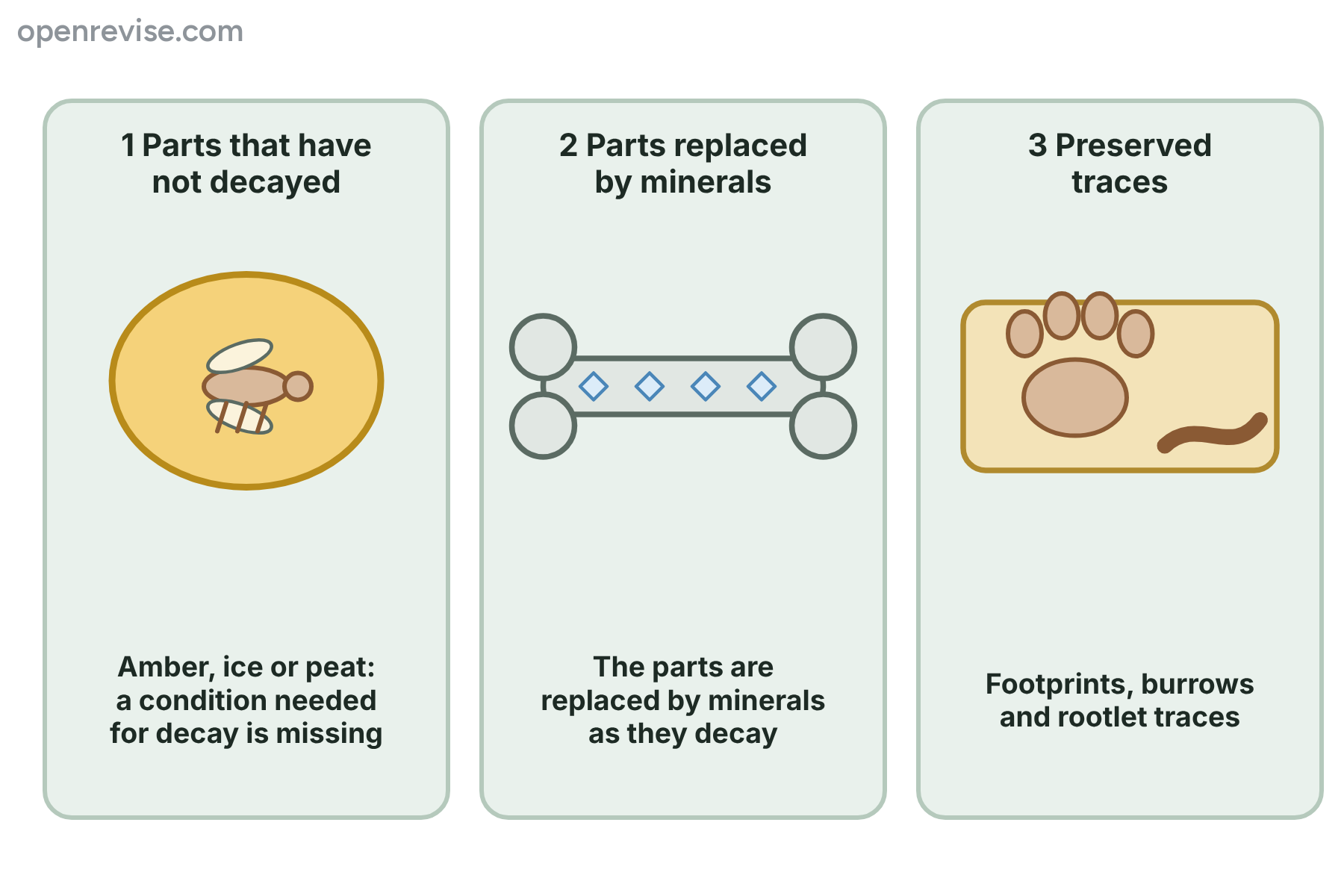
The diagram shows three ways in which fossils form. Describe what is happening in each of the three ways.
Show answerHide answer
Model answer
In 1 the parts of the organism have not decayed because a condition needed for decay, such as oxygen or warmth, is missing. In 2 the parts of the organism have been replaced by minerals as they decayed. In 3 only a trace of the organism, such as a footprint, burrow or rootlet, has been preserved.
Mark scheme
- Parts not decayed because a condition for decay is absent — 1 mark
- Parts replaced by minerals as they decay — 1 mark
- Preserved traces such as footprints or burrows — 1 mark
-
3 Give [2 marks]
Give two conditions that are needed for decay and say how the absence of one of them could preserve an organism as a fossil.
Show answerHide answer
Model answer
Any two of: warmth, moisture, oxygen. If one is missing, for example if there is no oxygen in a peat bog or the temperature is too low in ice, decay microorganisms cannot work, so the parts of the organism are preserved.
Mark scheme
- Two correct conditions for decay — 1 mark
- The absence of one prevents decay so the organism is preserved — 1 mark
-
4 Explain [4 marks]
Explain why the fossil record is incomplete.
Show answerHide answer
Model answer
Many early forms of life were soft-bodied, so they left few traces. The traces that were left have mainly been destroyed by geological activity, such as the folding and erosion of rocks. Fossils form only in particular conditions, so most organisms decay without leaving a fossil. Many fossils have also not been found.
Mark scheme
- Soft-bodied organisms left few traces — 1 mark
- Traces destroyed by geological activity — 1 mark
- Fossils form only in particular conditions — 1 mark
- Many fossils are not yet found — 1 mark
-
5 Calculate [3 marks]
A scientist finds fossils of 12 species in an older rock layer and 21 species in a younger layer. Calculate the percentage increase in the number of species.
Show answerHide answer
Model answer
75%. The increase is \(21 - 12 = 9\), and \(\frac{9}{12} \times 100 = 75\%\).
Mark scheme
- \(21 - 12 = 9\) — 1 mark
- \(\frac{9}{12} \times 100\) — 1 mark
- 75% — 1 mark
-
6 Explain [3 marks]
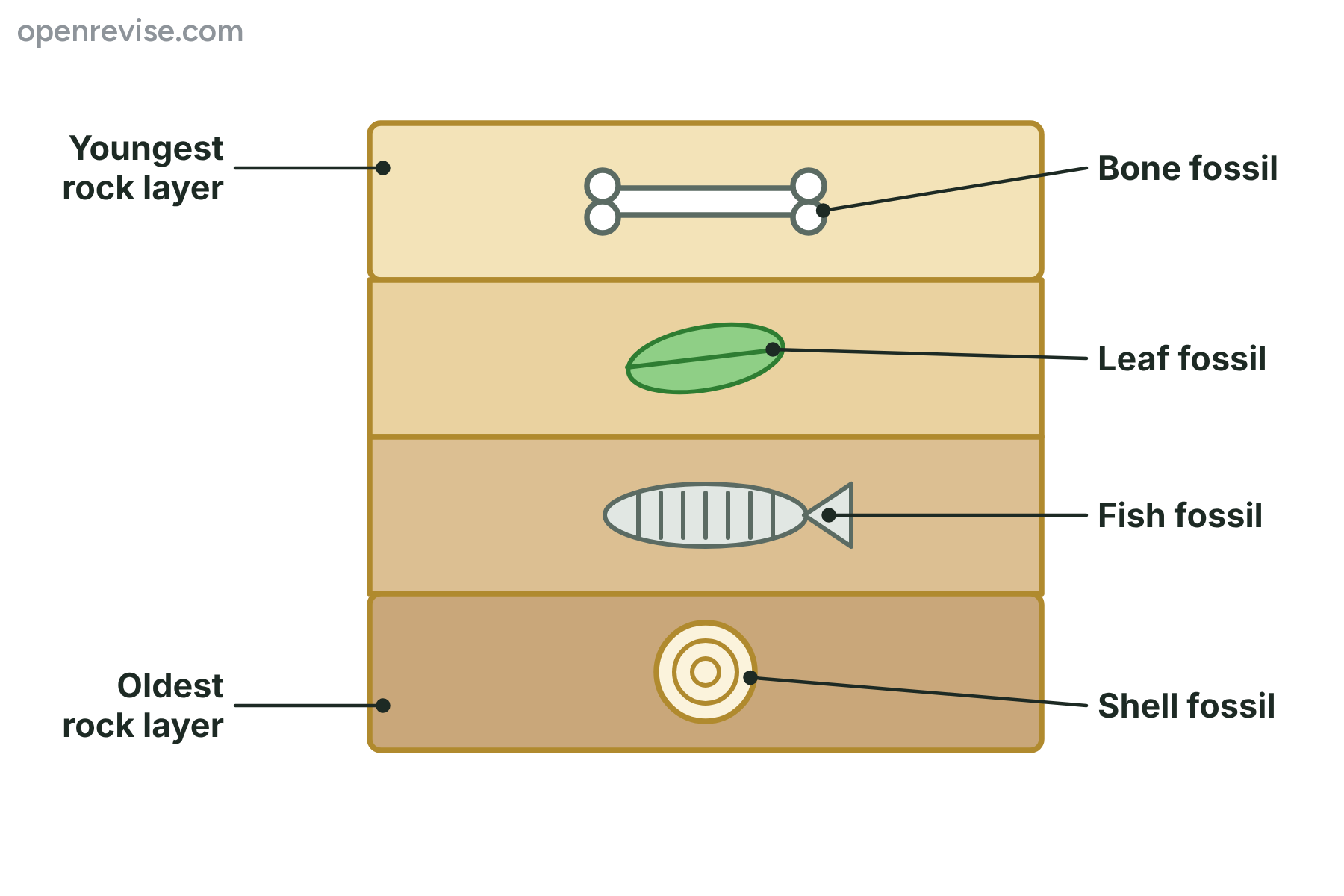
The diagram shows fossils in four layers of undisturbed rock. Explain which fossil is likely to be of the oldest organism, and how scientists use fossils like these to learn about evolution.
Show answerHide answer
Model answer
The shell fossil is likely to be the oldest, because it is in the bottom layer, and in undisturbed rock the deepest layers are the oldest. By comparing fossils from layers of different ages, scientists can see how much or how little organisms have changed over time.
Mark scheme
- Shell, because it is in the oldest (bottom) layer — 1 mark
- Deeper layers are older — 1 mark
- Compare fossils of different ages to see how organisms have changed — 1 mark
-
7 Evaluate [4 marks]
Archaeopteryx had feathers and wings like a bird but also teeth and a long bony tail like a reptile. Evaluate how far this fossil is evidence for evolution.
Show answerHide answer
Model answer
The fossil has features of two groups, which suggests that birds evolved from reptile-like ancestors, so it supports the theory that species change over time. However, it is only one fossil, and the fossil record is incomplete, because few organisms form fossils, so scientists cannot be certain of the whole sequence. Other evidence, such as antibiotic resistance in bacteria, is needed alongside it.
Mark scheme
- Features of both birds and reptiles suggest a link between groups — 1 mark
- Supports the idea that species change over time — 1 mark
- One fossil only and the record is incomplete — 1 mark
- Other evidence needed to be certain — 1 mark
Quick check
-
1
What is a fossil?
Show answerHide answer
B: The remains of an organism from millions of years ago
Fossils are the remains of organisms from millions of years ago, found in rocks.
-
2
Which of these is NOT a way in which fossils form?
Show answerHide answer
D: Living cells grown in a laboratory
Fossils form by the absence of decay, by replacement by minerals and as preserved traces, but not from living organisms that have been kept in a laboratory.
-
3
Which of these is a trace fossil?
Show answerHide answer
A: A footprint
Footprints, burrows and rootlet traces are trace fossils.
-
4
Why have few fossils of early soft-bodied organisms been found?
Show answerHide answer
C: They left few traces that survived
Soft-bodied organisms left few traces, and geological activity destroyed most of them.
-
5
In undisturbed layers of rock, where are the oldest fossils?
Show answerHide answer
D: At the bottom
The deeper layers of rock were laid down first, so they are the oldest.
-
6
What does a fossil of Archaeopteryx show?
Show answerHide answer
B: A group of animals with features of both birds and reptiles
It had features of both reptiles and birds, so it is evidence that one group may have evolved from the other.
-
7
Why can scientists not be certain about how life began on Earth?
Show answerHide answer
A: The traces of early life were mostly destroyed
Early life was soft-bodied and the few traces that formed were mainly destroyed by geological activity.
-
8
Which condition could prevent decay and so help a fossil form?
Show answerHide answer
C: No oxygen
With no oxygen, as in a peat bog, decay microorganisms cannot work.