Flashcards · Biology · Evidence for Evolution and Classification
Fossils and the Fossil Record
-
What is a fossil?
The remains of an organism from millions of years ago, found in rocks.
-
Name the three ways in which fossils form.
Parts not decayed, parts replaced by minerals, and preserved traces.
-
Why might an organism not decay?
One or more of the conditions needed for decay is absent.
-
Give an example of a place where decay is prevented.
Amber, ice or a peat bog.
-
What replaces the parts of an organism in some fossils?
Minerals.
-
Give three examples of trace fossils.
Footprints, burrows and rootlet traces.
-
Why have early soft-bodied organisms left few fossils?
They have no hard parts, so they decayed without leaving traces.
-
What destroyed many early fossils?
Geological activity.
-
Why can scientists not be sure how life began?
The traces of the earliest soft-bodied organisms were mostly destroyed.
-
What can fossils show about how organisms have changed?
How much or how little they have changed.
-
In undisturbed rock layers, which fossils are older?
Those in the deeper layers.
-
What kind of fossil is Archaeopteryx?
A fossil with features of both birds and reptiles.
-
Is the fossil record complete?
No. Most organisms never form fossils.
-
What type of rock usually contains fossils?
Sedimentary rock.
-
What other evidence supports Darwin's theory, besides fossils?
Genes passing on characteristics, and antibiotic resistance in bacteria.
-
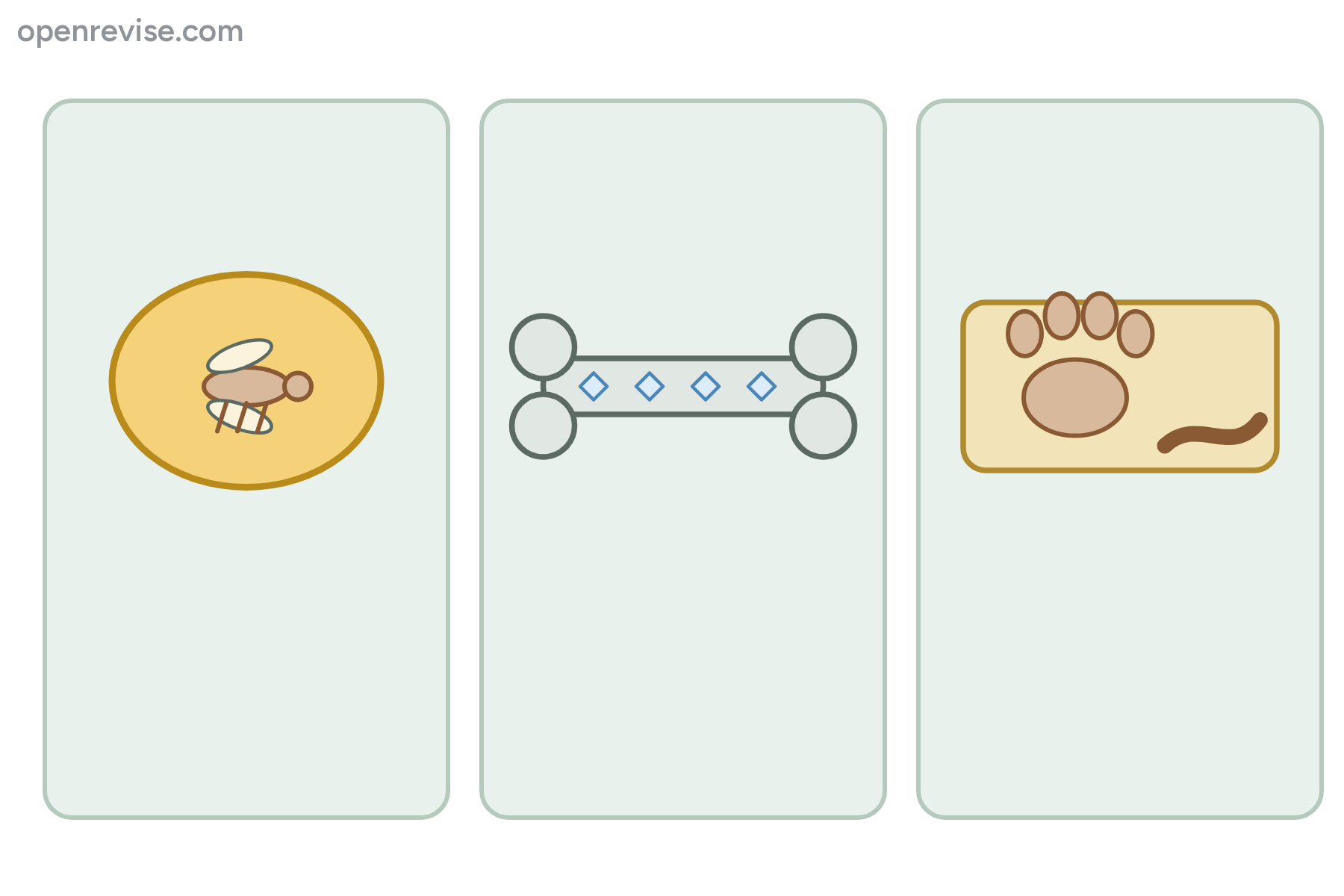 Name the three ways in which fossils form and give an example of each. (Look at the blank diagram.)
 1 Parts that have not decayed, such as an insect in amber. 2 Parts replaced by minerals, such as a bone. 3 Preserved traces, such as footprints and burrows.