Biology · Evidence for Evolution and Classification
Fossils and the Fossil Record
How do we know that life on Earth has changed over millions of years? This lesson is for both Combined Science and separate Biology. It explains what fossils are, three ways in which they form, why the fossil record is incomplete, and what fossils tell us about evolution.
Learning Objectives
- 1Describe fossils as the remains of organisms from millions of years ago, found in rocks.
- 2Describe the three ways in which fossils may be formed.
- 3Explain why the fossil record is incomplete, and why scientists cannot be certain how life began on Earth.
- 4Extract and interpret information from charts, graphs and tables about fossils, and explain how fossils provide evidence for evolution.
Retrieval practice
-
1
What is evolution?
Show answerHide answer
A change in the inherited characteristics of a population over time, through natural selection.
-
2
What is natural selection?
Show answerHide answer
The process in which individuals best suited to their environment survive and breed, passing on their alleles.
-
3
What is a species?
Show answerHide answer
A group of organisms that can interbreed to produce fertile offspring.
-
4
Why do organisms decay?
Show answerHide answer
Microorganisms break down the dead material, if conditions such as warmth, moisture and oxygen are right.
Evidence in the rocks
The theory of evolution by natural selection is now widely accepted. Evidence for Darwin's theory is now available, because it has been shown that characteristics are passed on to offspring in genes. There is further evidence in the fossil record, which is the set of all the fossils that have been found, and in what we know about how resistance to antibiotics evolves in bacteria. This lesson looks at fossils.
What fossils are
Fossils are the remains of organisms from millions of years ago, which are found in rocks.
-
Remains
A fossil may be a part of an organism itself, the shape it left in rock or a trace that it made. It is not the whole living organism.
-
In rocks
Fossils are found in sedimentary rock, which forms when layers of mud, sand and other material settle and are squashed into rock over millions of years.
-
Older at the bottom
In layers of undisturbed rock, the deeper layers are older, so fossils in deeper rocks are of older organisms.
-
A record
Together, the fossils form a record of the organisms that lived on Earth in the past.
Three ways in which fossils form
Dead organisms normally decay, so fossils are formed only under special conditions.
-
Parts that have not decayed
Fossils may be formed from parts of organisms that have not decayed because one or more of the conditions needed for decay are absent. Examples are insects trapped in amber (no microorganisms), mammoths in ice (too cold) and bodies in peat bogs (no oxygen).
-
Replacement by minerals
Fossils form when parts of the organism are replaced by minerals as they decay. Hard parts such as bones, teeth and shells are often replaced, atom by atom, by minerals from water that seeps through the rock.
-
Preserved traces
Fossils may be preserved traces of organisms, such as footprints, burrows and rootlet traces, which show where an organism lived and moved.
How fossils form
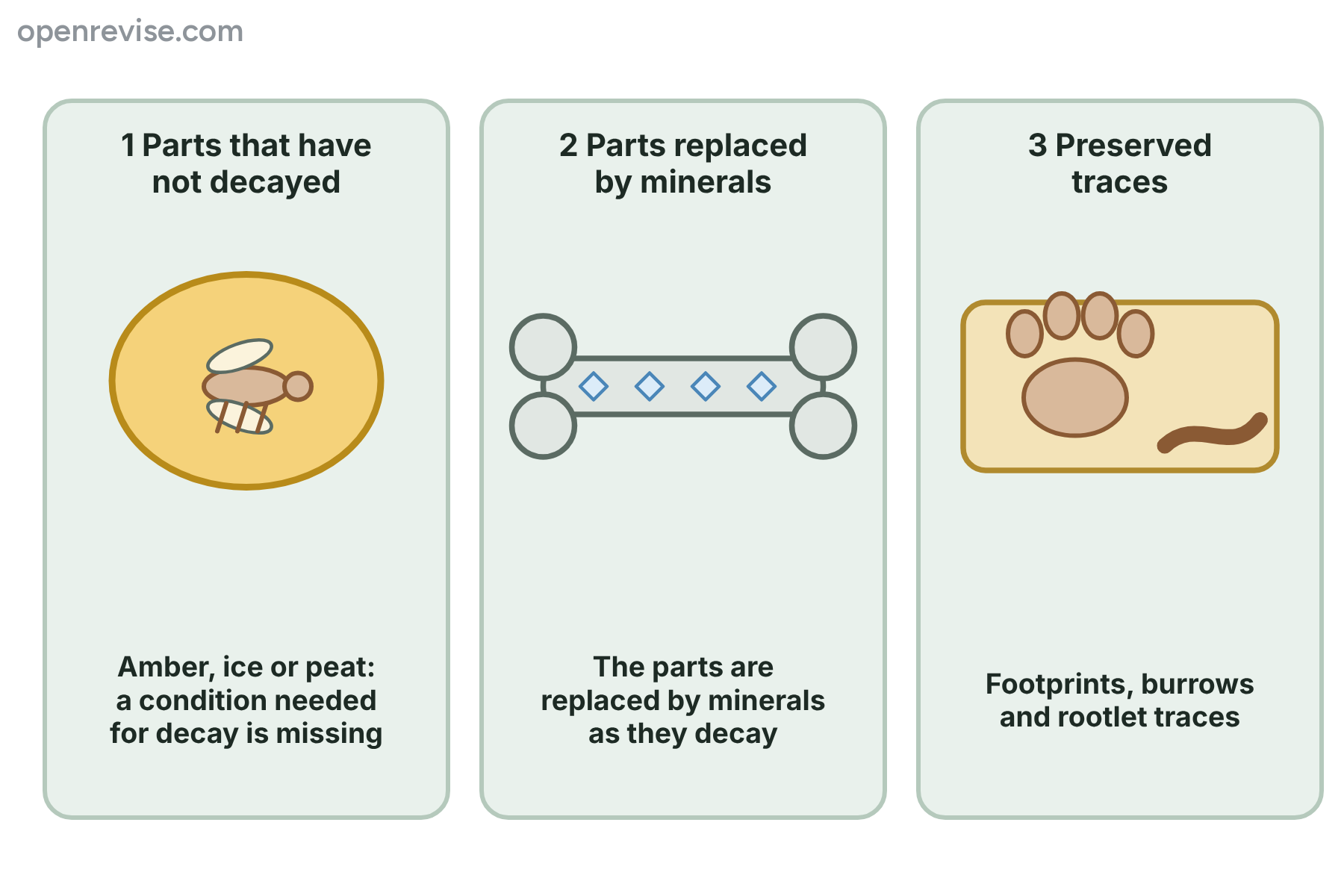
Most fossils are formed in one of these three ways.
Why the fossil record is incomplete
There are far fewer fossils than organisms that have ever lived.
-
Soft bodies
Many early forms of life were soft-bodied, so they have left few traces behind. Soft tissues decay quickly, before they can be preserved.
-
Geological activity
What traces there were have been mainly destroyed by geological activity, such as the folding, heating and erosion of rocks, and earthquakes.
-
Conditions for fossilising
Fossils form only in particular conditions, so most dead organisms decay without leaving a trace.
-
Not all found
Many fossils are still buried or have never been found, because they are in rocks that are hard to reach.
What fossils tell us
By comparing fossils from different rock layers, scientists can see how organisms have changed.
-
How much they have changed
We can learn from fossils how much or how little different organisms have changed as life developed on Earth.
-
Extinct organisms
Fossils show us organisms that no longer exist, such as trilobites and dinosaurs.
-
Links between groups
Some fossils have features of two groups. Archaeopteryx, about 150 million years old, had feathers like a bird and teeth and a long bony tail like a reptile.
-
How life began
Because the earliest forms of life were soft-bodied, scientists cannot be certain about how life began on Earth.
Fossils in layers of rock
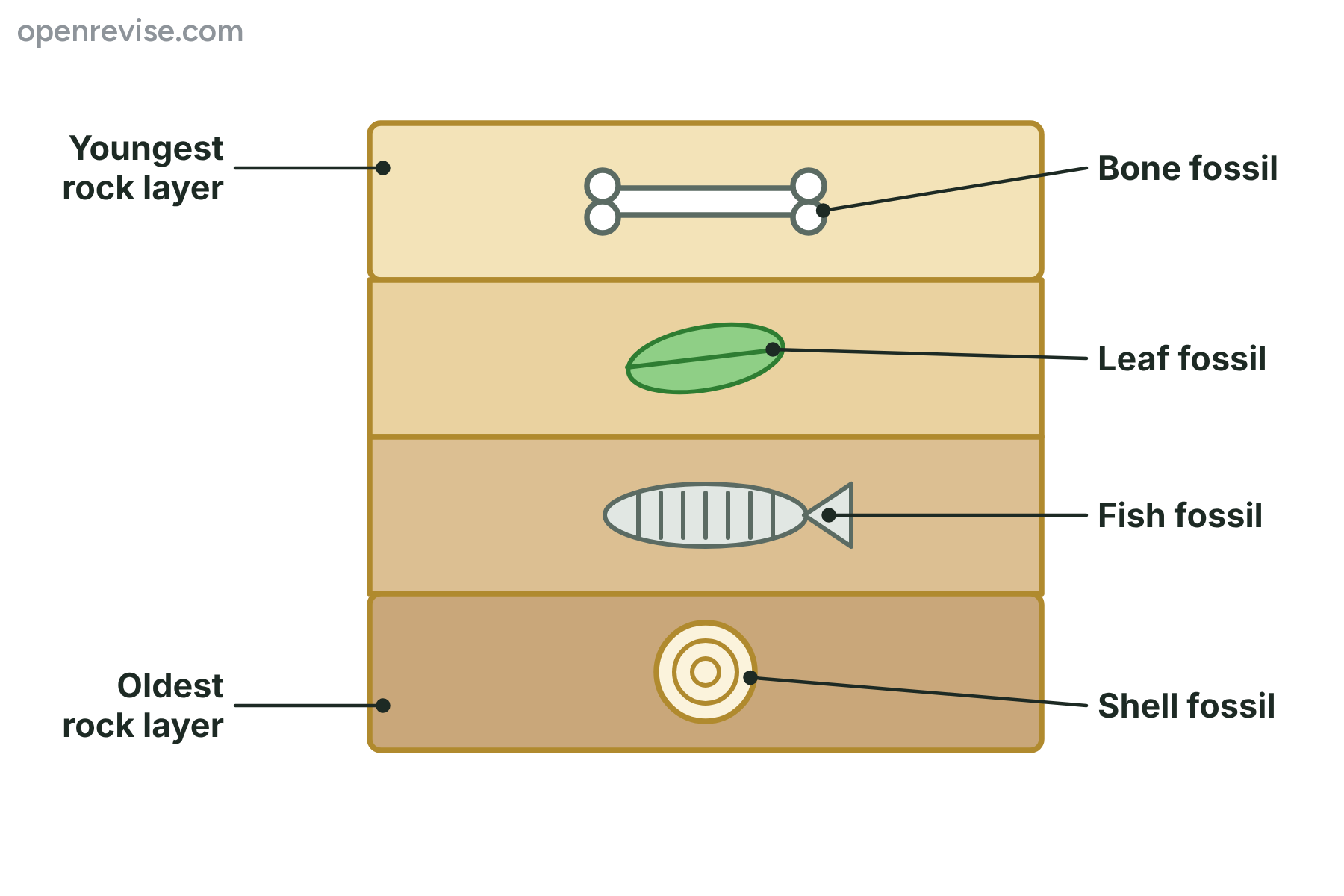
Deeper rock layers are older, so the fossils in them are older too.
Interpreting fossil data
Scientists found fossils of 8 different species in an older layer of rock and 14 different species in a younger layer above it. Calculate the percentage increase in the number of species.
Show the solutionHide the solution
- 1 Find the increase \(14 - 8 = 6\) species
- 2 Divide by the starting value \(\frac{6}{8} = 0.75\)
- 3 Turn it into a percentage \(0.75 \times 100 = 75\%\)
- 4 Interpret it There were more species in the younger layer, so the variety of life increased
AnswerThe number of species increased by 75%.
Case study
Archaeopteryx
In 1861 workers in a quarry in Germany found the fossil of a creature that had feathers and wings like a bird but also teeth, claws on its wings and a long bony tail like a reptile. Named Archaeopteryx, it lived about 150 million years ago. Scientists see it as evidence that birds evolved from reptile-like ancestors, and it was discovered only two years after Darwin published his theory.
The big idea
Fossils show us how organisms have changed over millions of years, but the record is incomplete because most organisms never become fossils.
Fossils
Fossils
-
Definition
- remains of organisms from millions of years ago
- found in rocks
-
Formation
- not decayed
- replaced by minerals
- preserved traces
-
Incomplete record
- soft bodies
- geological activity
- rare conditions
-
Evidence
- how much organisms have changed
- extinct species
- links between groups
-
Layers
- older at the bottom
Summary and exam focus
- Fossils are the remains of organisms from millions of years ago, found in rocks.
- Fossils may form from parts that have not decayed, when parts are replaced by minerals as they decay, or as preserved traces such as footprints, burrows and rootlet traces.
- Many early forms of life were soft-bodied and left few traces, and geological activity destroyed most of those traces.
- This is why scientists cannot be certain about how life began on Earth.
- We can learn from fossils how much or how little different organisms have changed as life developed.
Exam focus
Explain why the fossil record of early life on Earth is incomplete, and why scientists cannot be certain about how life began. (4 marks) (4 marks)
Give two clear reasons and link each to the evidence: many early organisms were soft-bodied and left few traces, and what traces there were have been mainly destroyed by geological activity. Then state the conclusion about how life began.
Key terms
The words this lesson expects you to use. Each one is linked from the first place it appears above.
- Fossil
- The remains of an organism from millions of years ago, found in rock.
- Fossil record
- All the fossils that have been found, which shows how life has changed.
- Decay
- The breakdown of dead material by microorganisms.
- Mineral
- A natural solid chemical, such as one that replaces the hard parts of an organism to form a fossil.
- Trace fossil
- A preserved sign of an organism, such as a footprint, burrow or rootlet trace.
- Amber
- Hardened tree resin that can trap and preserve small organisms.
- Soft-bodied
- Having no hard parts such as bones or shells.
- Sedimentary rock
- Rock formed from layers of sediment that have been squashed together.
You've finished the notes
Check your understanding
Test yourself while it is fresh. Start with the flashcards, then try the exam questions.
Something here looks wrong?
Tell us what and we will go and look. It goes to whoever writes these pages, nobody else, and we do not ask who you are — so there is nothing to sign and nothing comes back to you.