Exam questions · Biology · Evidence for Evolution and Classification
The Three-domain System and Evolutionary Trees
- 7 exam questions
- 21 marks
- 8 quick checks
-
1 Name [3 marks]
Name the three domains in the three-domain system of classification.
Show answerHide answer
Model answer
Archaea, Bacteria and Eukaryota.
Mark scheme
- Archaea — 1 mark
- Bacteria — 1 mark
- Eukaryota — 1 mark
-
2 Explain [3 marks]
Explain why new models of classification were proposed after the Linnaean system.
Show answerHide answer
Model answer
Microscopes improved, so scientists could see the internal structures of cells. Scientists also understood biochemical processes better and could use chemical analysis to compare organisms. This new evidence did not always fit the old groups, so new models were needed.
Mark scheme
- Improved microscopes showed internal structures — 1 mark
- Better understanding of biochemistry and chemical analysis — 1 mark
- New evidence did not fit old groups, so new models were proposed — 1 mark
-
3 Describe [2 marks]
Describe two differences between the Linnaean system and the three-domain system of classification.
Show answerHide answer
Model answer
The Linnaean system was developed by Linnaeus and is based on the structure and characteristics of organisms. The three-domain system was developed by Woese, and is based on evidence from chemical analysis.
Mark scheme
- Linnaeus and structure and characteristics — 1 mark
- Woese and chemical analysis — 1 mark
-
4 Name [3 marks]
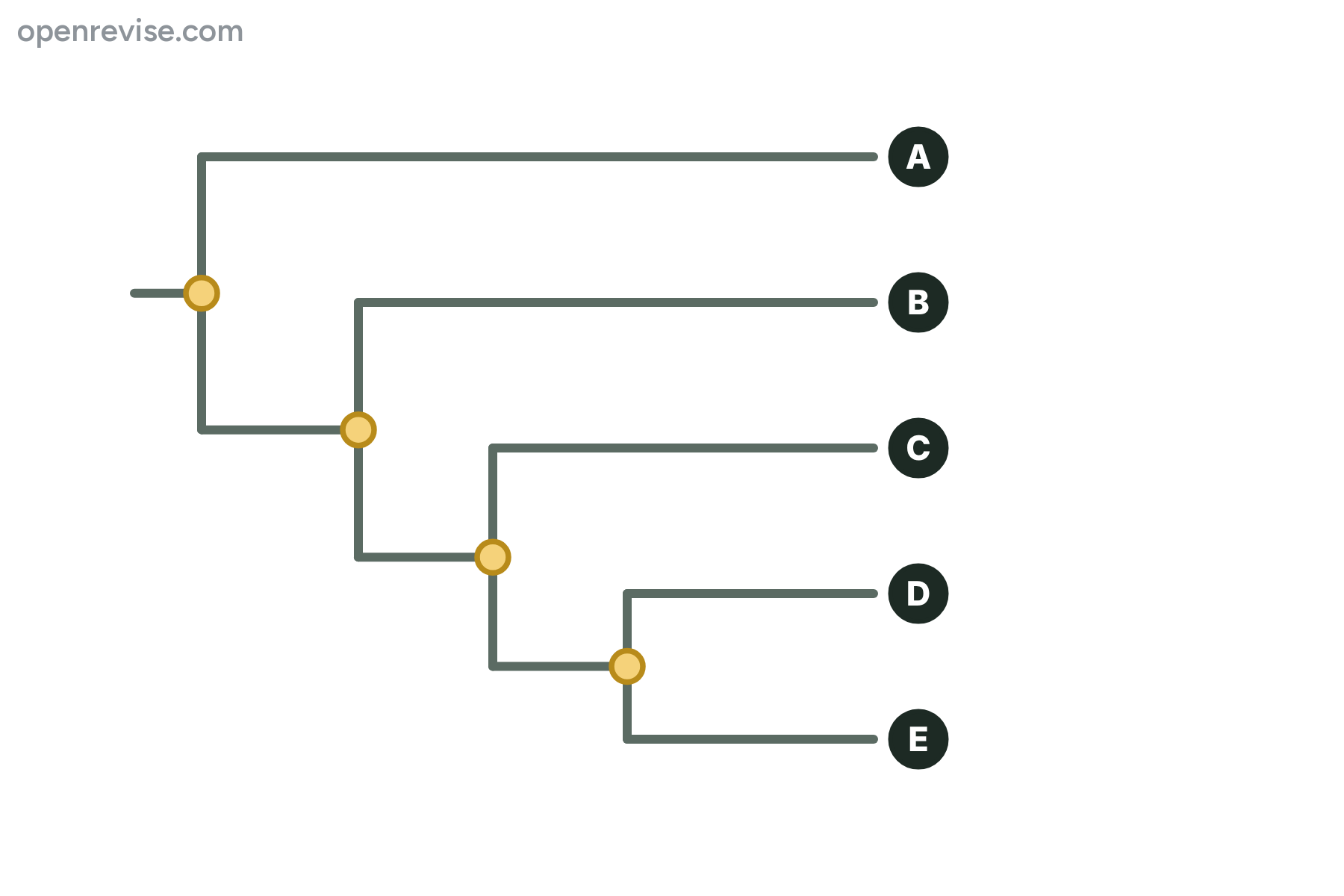
The diagram shows an evolutionary tree. Which two organisms, marked A to E, are the most closely related, and which of A to C is the most closely related to them? Explain your answer.
Show answerHide answer
Model answer
D and E are the most closely related, because their branches join at the most recent branch point, so they share the most recent common ancestor. C is the closest relative of D and E, because its branch joins theirs at the next branch point back.
Mark scheme
- D and E — 1 mark
- Their branches meet at the most recent branch point (common ancestor) — 1 mark
- C is next closest — 1 mark
-
5 Explain [3 marks]
Scientists use both classification data and fossil data to produce evolutionary trees. Explain why both are needed.
Show answerHide answer
Model answer
Classification data from living organisms, such as DNA and structure, allows scientists to work out the relationships of the organisms alive today. Extinct organisms cannot be studied directly, so fossil data are needed to place them on the tree. Together they give a fuller picture.
Mark scheme
- Classification data for living organisms — 1 mark
- Fossil data are needed for extinct organisms — 1 mark
- Together they give a fuller picture of relationships — 1 mark
-
6 Describe [3 marks]
Describe the three domains of the Woese system, giving one example of an organism in each.
Show answerHide answer
Model answer
Archaea are primitive bacteria, usually living in extreme environments, for example in hot springs. Bacteria are the true bacteria, for example the bacteria that cause disease. Eukaryota include protists, fungi, plants and animals, for example humans.
Mark scheme
- Archaea, with extreme environments or an example — 1 mark
- Bacteria, true bacteria with an example — 1 mark
- Eukaryota with protists, fungi, plants and animals — 1 mark
-
7 Evaluate [4 marks]
A student says, "Classification systems are facts, so they never change." Evaluate this statement.
Show answerHide answer
Model answer
The statement is not correct. Classification systems are models, which scientists change as new evidence becomes available. For example, better microscopes and chemical analysis led to the three-domain system, which replaced earlier models. New fossils and DNA evidence may lead to further changes. This is how scientific methods and theories develop over time.
Mark scheme
- Classification is a model, not a fact — 1 mark
- Changes when new evidence is found — 1 mark
- An example such as the three-domain system — 1 mark
- Further changes are possible, as theories develop over time — 1 mark
Quick check
-
1
Who developed the three-domain system?
Show answerHide answer
D: Carl Woese
Carl Woese developed the three-domain system.
-
2
Which is one of the three domains?
Show answerHide answer
B: Archaea
The domains are Archaea, Bacteria and Eukaryota.
-
3
Which organisms are in the domain Eukaryota?
Show answerHide answer
A: Protists, fungi, plants and animals
Protists, fungi, plants and animals are all eukaryotes.
-
4
What are Archaea?
Show answerHide answer
C: Primitive bacteria in extreme environments
Archaea are primitive bacteria usually living in extreme environments.
-
5
What evidence led to the three-domain system?
Show answerHide answer
B: Chemical analysis
Evidence from chemical analysis, such as comparing DNA and RNA sequences.
-
6
What does an evolutionary tree show?
Show answerHide answer
D: How organisms are thought to be related
It shows how scientists believe organisms are related.
-
7
On an evolutionary tree, which pair of organisms is most closely related?
Show answerHide answer
A: The pair whose branches meet at the most recent branch point
The pair whose branches meet at the most recent common ancestor.
-
8
What data are used to make evolutionary trees?
Show answerHide answer
C: Classification data and fossil data
Current classification data for living organisms and fossil data for extinct organisms.