Exam questions · Biology · Hormonal Coordination in Humans
Kidney Failure, Dialysis and Transplants
- 7 exam questions
- 22 marks
- 8 quick checks
-
1 State [2 marks]
State two treatments for kidney failure.
Show answerHide answer
Model answer
Dialysis (using a machine) and a kidney transplant.
Mark scheme
- Dialysis — 1 mark
- Kidney transplant — 1 mark
-
2 Name [3 marks]
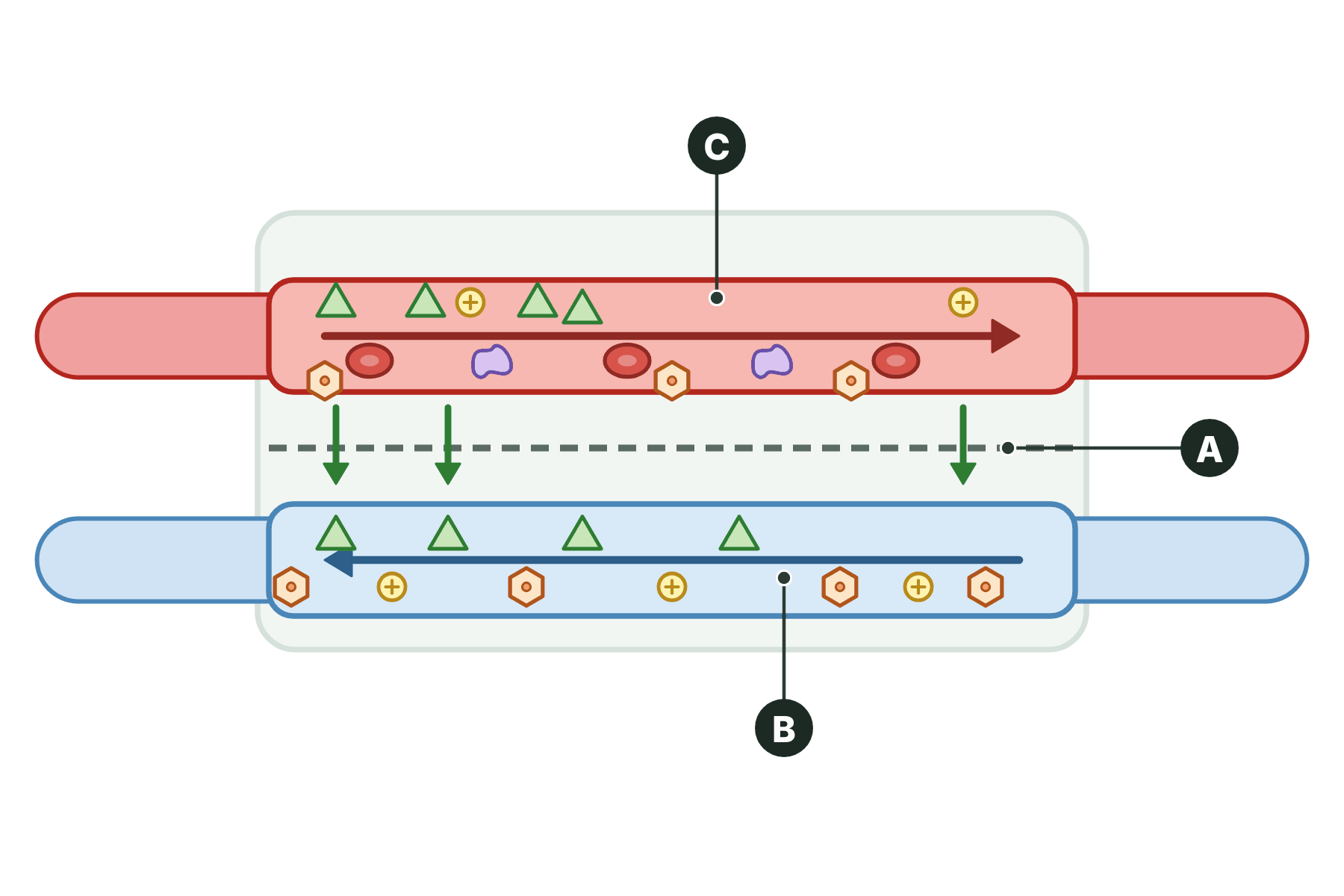
Figure 1 shows a dialysis machine. Name the parts shown at A, B and C.
Show answerHide answer
Model answer
A is the partially permeable membrane. B is the dialysis fluid. C is the blood.
Mark scheme
- A: partially permeable membrane — 1 mark
- B: dialysis fluid — 1 mark
- C: blood — 1 mark
-
3 Describe [4 marks]
Describe how a dialysis machine removes urea from the blood of a patient.
Show answerHide answer
Model answer
The patient's blood flows on one side of a partially permeable membrane, and dialysis fluid flows on the other side. The dialysis fluid has no urea, so urea diffuses from the blood through the membrane into the fluid. Blood cells and proteins are too big to cross, so they stay in the blood. The cleaned blood returns to the patient.
Mark scheme
- Blood on one side of a partially permeable membrane, dialysis fluid on the other — 1 mark
- Urea diffuses from the blood into the dialysis fluid — 1 mark
- Blood cells and proteins cannot cross — 1 mark
- The cleaned blood returns to the patient — 1 mark
-
4 Explain [3 marks]
The dialysis fluid contains the same concentration of glucose as normal blood. Explain why.
Show answerHide answer
Model answer
If the concentrations of glucose are the same on both sides of the membrane, there is no net diffusion of glucose. The patient therefore does not lose glucose from the blood, as they would if there were none in the fluid.
Mark scheme
- Same concentration on both sides, so no net movement of glucose — 1 mark
- The patient does not lose glucose — 1 mark
- It would diffuse out if there were none in the fluid — 1 mark
-
5 Explain [3 marks]
Explain why the dialysis fluid is kept flowing past the membrane instead of staying still.
Show answerHide answer
Model answer
The flow carries the urea away, so the concentration of urea in the fluid stays low. This keeps a steep concentration gradient across the membrane, so urea keeps diffusing out of the blood.
Mark scheme
- Flow carries the urea away — 1 mark
- The urea concentration in the fluid stays low — 1 mark
- A steep concentration gradient keeps urea diffusing out — 1 mark
-
6 Evaluate [4 marks]
Evaluate the advantages and disadvantages of treating kidney failure by dialysis and by a kidney transplant.
Show answerHide answer
Model answer
Dialysis is available straight away and keeps the patient alive while they wait for a donor. However, it has to be repeated several times a week and restricts the patient's life. A transplant provides a working kidney and frees the patient from dialysis, but there are few donors, the kidney may be rejected, and the patient needs drugs for life, which increase the risk of infection.
Mark scheme
- Dialysis: advantage, such as available at once — 1 mark
- Dialysis: disadvantage, such as repeated often — 1 mark
- Transplant: advantage, such as no need for dialysis — 1 mark
- Transplant: disadvantage, such as few donors / rejection / drugs — 1 mark
-
7 Explain [3 marks]
Explain why a patient who has had a kidney transplant has to take drugs for the rest of their life.
Show answerHide answer
Model answer
The patient's immune system may recognise the new kidney as foreign and attack it, which is rejection. The drugs reduce the activity of the immune system, so the kidney is less likely to be rejected. They have to be taken for life because the risk does not go away.
Mark scheme
- The immune system may attack the new kidney — 1 mark
- The drugs reduce the activity of the immune system — 1 mark
- The risk of rejection continues — 1 mark
Quick check
-
1
What does a dialysis machine remove from the blood?
Show answerHide answer
C: Urea
Dialysis removes urea and excess ions from the blood.
-
2
What separates the blood from the dialysis fluid?
Show answerHide answer
A: A partially permeable membrane
A partially permeable membrane lets small molecules through but not blood cells or proteins.
-
3
How does urea move from the blood into the dialysis fluid?
Show answerHide answer
D: By diffusion
Urea diffuses from a higher concentration in the blood to a lower concentration in the fluid.
-
4
What is rejection?
Show answerHide answer
B: The immune system attacking the new organ
Rejection is the attack of the immune system on a transplanted organ.
-
5
Why do transplant patients take immunosuppressant drugs?
Show answerHide answer
C: To reduce the risk of rejection
The drugs reduce the activity of the immune system, so the new kidney is less likely to be rejected.
-
6
Which is an advantage of dialysis over a transplant?
Show answerHide answer
A: It is available straight away
Dialysis is available straight away, but a transplant needs a matching donor.
-
7
Which is a disadvantage of a kidney transplant?
Show answerHide answer
D: There are not enough donor kidneys
There are not enough donors, and the kidney may be rejected.
-
8
Why do blood cells stay in the blood in a dialysis machine?
Show answerHide answer
B: They are too big to cross the membrane
Blood cells are too big to pass through the partially permeable membrane.