Biology · Hormonal Coordination in Humans
Kidney Failure, Dialysis and Transplants
If the kidneys fail, waste builds up in the blood and the water balance is lost, and the person may die. This lesson is for separate Biology. It covers the two treatments for kidney failure, kidney dialysis and a kidney transplant, how dialysis works, and how to evaluate treating organ failure with a machine or with a transplant.
Learning Objectives
- 1Describe the basic principles of kidney dialysis and how it works.
- 2Describe a kidney transplant as a treatment for kidney failure.
- 3Evaluate the advantages and disadvantages of treating organ failure by a mechanical device or by a transplant.
Retrieval practice
-
1
What do the kidneys remove from the blood?
Show answerHide answer
Urea, and any excess water and ions.
-
2
What is diffusion?
Show answerHide answer
The net movement of particles from a region of higher concentration to a region of lower concentration.
-
3
What is a partially permeable membrane?
Show answerHide answer
A membrane that lets some substances pass through but not others.
-
4
What does the immune system do?
Show answerHide answer
It attacks foreign cells, such as pathogens.
When the kidneys fail
Healthy kidneys filter about a litre of blood every minute. If both kidneys fail, urea and excess ions build up in the blood, and the body can no longer keep its water balance. Without treatment the person dies. There are two treatments: a machine that does the job of the kidneys, called dialysis, or a new kidney from a donor, called a transplant.
Kidney dialysis
Dialysis uses a machine to clean the blood of a person whose kidneys have failed.
-
The blood
Blood from the patient flows through the machine, on one side of a partially permeable membrane.
-
The dialysis fluid
On the other side of the membrane flows a dialysis fluid. It has the same concentration of glucose and useful ions as normal blood.
-
Diffusion
Urea and excess ions diffuse from the blood through the membrane into the dialysis fluid, because there is none in the fluid at the start.
-
What stays
Blood cells and proteins are too big to cross the membrane, and the glucose stays in the blood because its concentration is the same on both sides.
-
Fresh fluid
The dialysis fluid keeps flowing past, so the concentration of urea in it stays low and the urea keeps diffusing out.
-
Back to the patient
The cleaned blood returns to the patient.
A dialysis machine
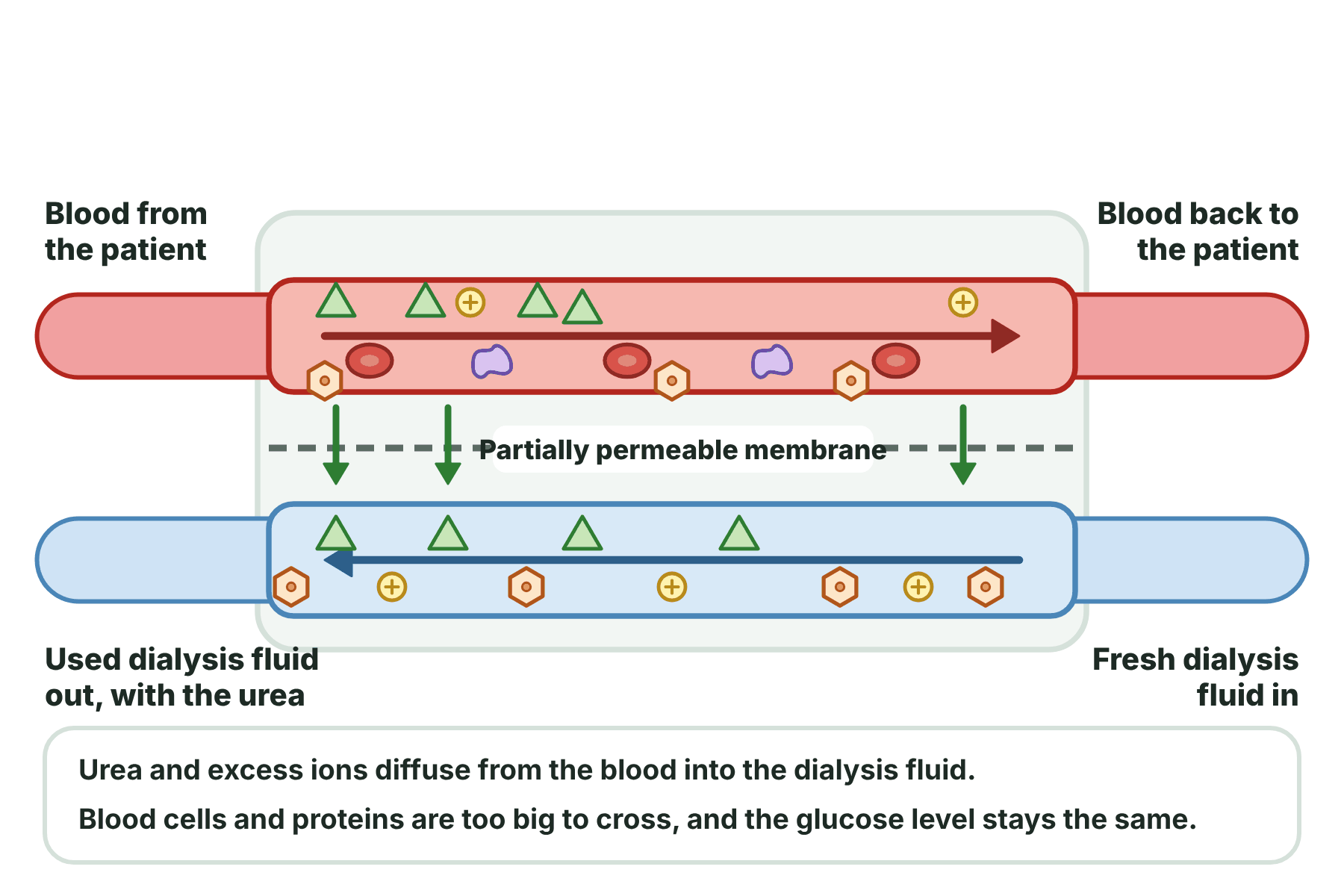
Urea diffuses out of the blood through the membrane into the dialysis fluid.
A dialysis session
A patient usually has dialysis several times a week, and each session takes a few hours.
-
1
Connect
The patient is connected to the machine, and blood flows out of the body.
-
2
Clean
The blood passes along the membrane, and urea and excess ions diffuse into the dialysis fluid.
-
3
Return
The cleaned blood is returned to the patient.
-
4
Repeat
The treatment has to be repeated regularly, because the urea builds up again between sessions.
-
5
Adjust
The dialysis fluid is made with the right concentrations so that the patient does not lose glucose or useful ions.
Kidney transplants
A transplant replaces a failed kidney with a healthy one from a donor.
-
The donor
The new kidney may come from a person who has died, or from a living person, because a person can live with one kidney.
-
The match
The donor and the patient are tissue-typed, so that the new kidney is as similar as possible to the patient's own tissue.
-
Rejection
The patient's immune system may recognise the kidney as foreign, and attack it. This is called rejection.
-
Drugs
The patient takes drugs called immunosuppressants for the rest of their life, to reduce the risk of rejection. These drugs make the patient more likely to get infections.
-
Waiting
There are not enough donors for everyone who needs a kidney, so patients may wait for years, often on dialysis.
Dialysis and a transplant
Dialysis
- Available straight away
- No need to wait for a donor
- Takes hours, several times a week
- Restricts diet, fluid and daily life
- Does not cure the kidney failure
Kidney transplant
- A donor kidney is needed, and there is a long wait
- A major operation
- Risk of rejection
- Drugs needed for life
- Patient can live a more normal life
Evaluating the two treatments
To evaluate a treatment, weigh up its advantages and disadvantages for the patient and for the health service.
-
Dialysis: advantages
It can be started at once, and it keeps the patient alive while they wait for a donor kidney.
-
Dialysis: disadvantages
It takes many hours every week, needs a strict diet and limits on drink, does not work as well as a healthy kidney, and is expensive over many years.
-
Transplant: advantages
A healthy kidney does the whole job, so the patient is free from dialysis and the long-term cost to the health service is lower.
-
Transplant: disadvantages
Few donors, a risk of rejection, drugs for life, and a major operation with risks.
-
The decision
The best treatment depends on the patient, such as their age and health, and on whether a matching kidney is available.
Case study
Waiting for a kidney
A patient with kidney failure has dialysis three times a week for four hours, and has to limit what they eat and drink. Their name is on the waiting list for a kidney, and they may wait for years. When a matching kidney is found, they have an operation, and then take immunosuppressant drugs for life. After the transplant they no longer need dialysis, but they have to take care to avoid infections.
The big idea
In dialysis, urea and excess ions diffuse out of the blood through a partially permeable membrane, and a transplant gives a working kidney but needs a donor and drugs against rejection.
Treating kidney failure
Treating kidney failure
-
Dialysis
- machine cleans the blood across a membrane
-
How it works
- urea diffuses out
- glucose level kept the same
-
Transplant
- a donor kidney replaces the failed one
-
Problems
- donors are few
- rejection
- immunosuppressant drugs
-
Evaluate
- advantages and disadvantages for the patient
Summary and exam focus
- Kidney failure can be treated by dialysis or by an organ transplant.
- In dialysis the blood flows past a partially permeable membrane, with dialysis fluid on the other side.
- Urea and excess ions diffuse out of the blood into the dialysis fluid, while blood cells, proteins and glucose stay.
- A transplanted kidney may be rejected by the immune system, so the patient takes drugs for life.
- Dialysis is available at once but is repeated often, and a transplant needs a donor.
Exam focus
Evaluate the advantages and disadvantages of treating kidney failure by dialysis and by a kidney transplant. (4 marks) (4 marks)
Give at least one advantage and one disadvantage for each treatment, and end with a judgement. For example: dialysis is available straight away but is needed several times a week, and a transplant frees the patient from dialysis but needs a donor and drugs for life.
Key terms
The words this lesson expects you to use. Each one is linked from the first place it appears above.
- Kidney failure
- The kidneys can no longer remove urea or control the water and ion balance.
- Dialysis
- A treatment that uses a machine to remove urea and excess ions from the blood.
- Dialysis fluid
- The fluid on the other side of the membrane, with the same glucose and useful ions as normal blood.
- Partially permeable membrane
- A membrane that lets some substances through but not others.
- Transplant
- An operation that replaces a failed organ with a healthy organ from a donor.
- Donor
- A person who gives an organ to another person.
- Rejection
- The attack by the immune system on a transplanted organ.
- Immunosuppressant
- A drug that reduces the activity of the immune system.
You've finished the notes
Check your understanding
Test yourself while it is fresh. Start with the flashcards, then try the exam questions.
Something here looks wrong?
Tell us what and we will go and look. It goes to whoever writes these pages, nobody else, and we do not ask who you are — so there is nothing to sign and nothing comes back to you.