Exam questions · Biology
Hormonal Coordination in Humans
- 45 exam questions
- 136 marks
- 46 quick checks
Hormones and the Endocrine System
Just this lesson-
1 State [2 marks]
State what is meant by an endocrine gland and a hormone.
Show answerHide answer
Model answer
An endocrine gland releases its hormone into the blood. A hormone is a chemical messenger carried in the blood.
Mark scheme
- Endocrine gland releases hormones into the blood — 1 mark
- Hormone: chemical messenger carried in the blood — 1 mark
-
2 Name [3 marks]
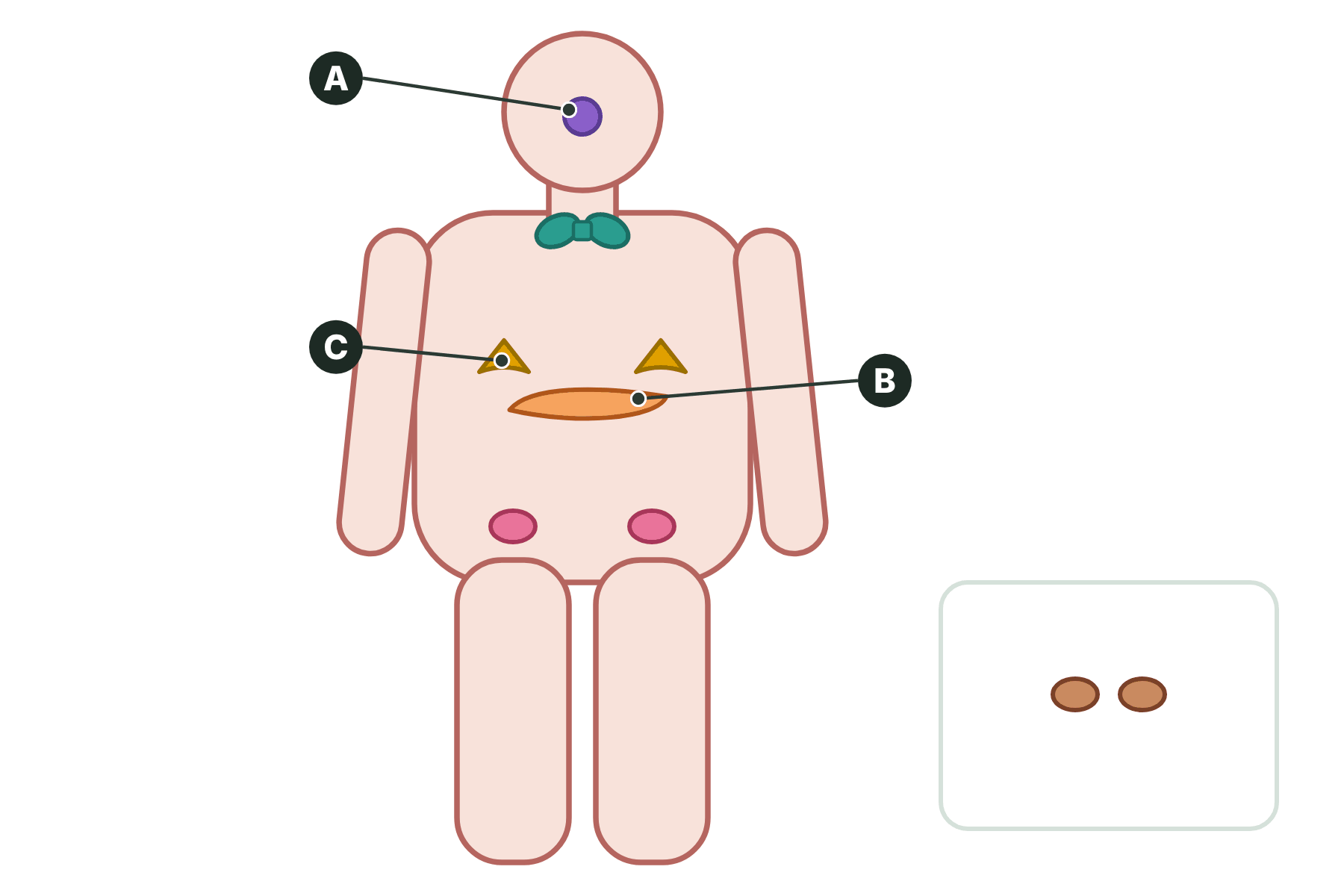
Figure 1 shows some endocrine glands. Name the glands shown at A, B and C.
Show answerHide answer
Model answer
A is the pituitary gland. B is the pancreas. C is an adrenal gland.
Mark scheme
- A: pituitary gland — 1 mark
- B: pancreas — 1 mark
- C: adrenal gland — 1 mark
-
3 Compare [4 marks]
Compare nervous control with hormonal control.
Show answerHide answer
Model answer
Nervous control uses electrical impulses but hormonal control uses chemicals in the blood. Nervous control is faster than hormonal control. The effect of nervous control is short-lived but hormones have a longer-lasting effect. Nerves act on a precise place whereas hormones act on target organs anywhere in the body.
Mark scheme
- Impulses against chemicals in the blood — 1 mark
- Nervous is faster — 1 mark
- Hormonal effect lasts longer — 1 mark
- Precise place against target organs — 1 mark
-
4 Explain [3 marks]
Explain why a hormone only affects some organs, even though it is carried to all parts of the body in the blood.
Show answerHide answer
Model answer
The hormone reaches every organ in the blood. Only its target organs have receptors that fit the hormone. Other organs do not have the receptors, so they do not respond.
Mark scheme
- Carried to all organs in the blood — 1 mark
- Only target organs have the receptors — 1 mark
- Other organs do not respond — 1 mark
Quick check
-
1
What carries hormones around the body?
Show answerHide answer
C: The blood
Hormones are released into the blood and carried to their target organs.
-
2
Which gland is called the master gland?
Show answerHide answer
A: The pituitary gland
The pituitary gland releases hormones that control other glands.
-
3
Which gland is found in the neck?
Show answerHide answer
D: The thyroid gland
The thyroid gland is in the neck.
-
4
How does hormonal control compare with nervous control?
Show answerHide answer
B: Slower and longer-lasting
Hormonal control is slower, and the effects last longer.
-
5
What is a target organ?
Show answerHide answer
C: An organ with receptors for a hormone
A target organ has receptors that fit a particular hormone.
-
6
Which hormone is released by the testes?
Show answerHide answer
A: Testosterone
The testes release testosterone.
Blood Glucose and Diabetes
Just this lesson-
1 State [2 marks]
State the organ that releases insulin and the organ that stores glycogen.
Show answerHide answer
Model answer
The pancreas releases insulin. The liver stores glycogen.
Mark scheme
- Pancreas — 1 mark
- Liver — 1 mark
-
2 Name [3 marks]
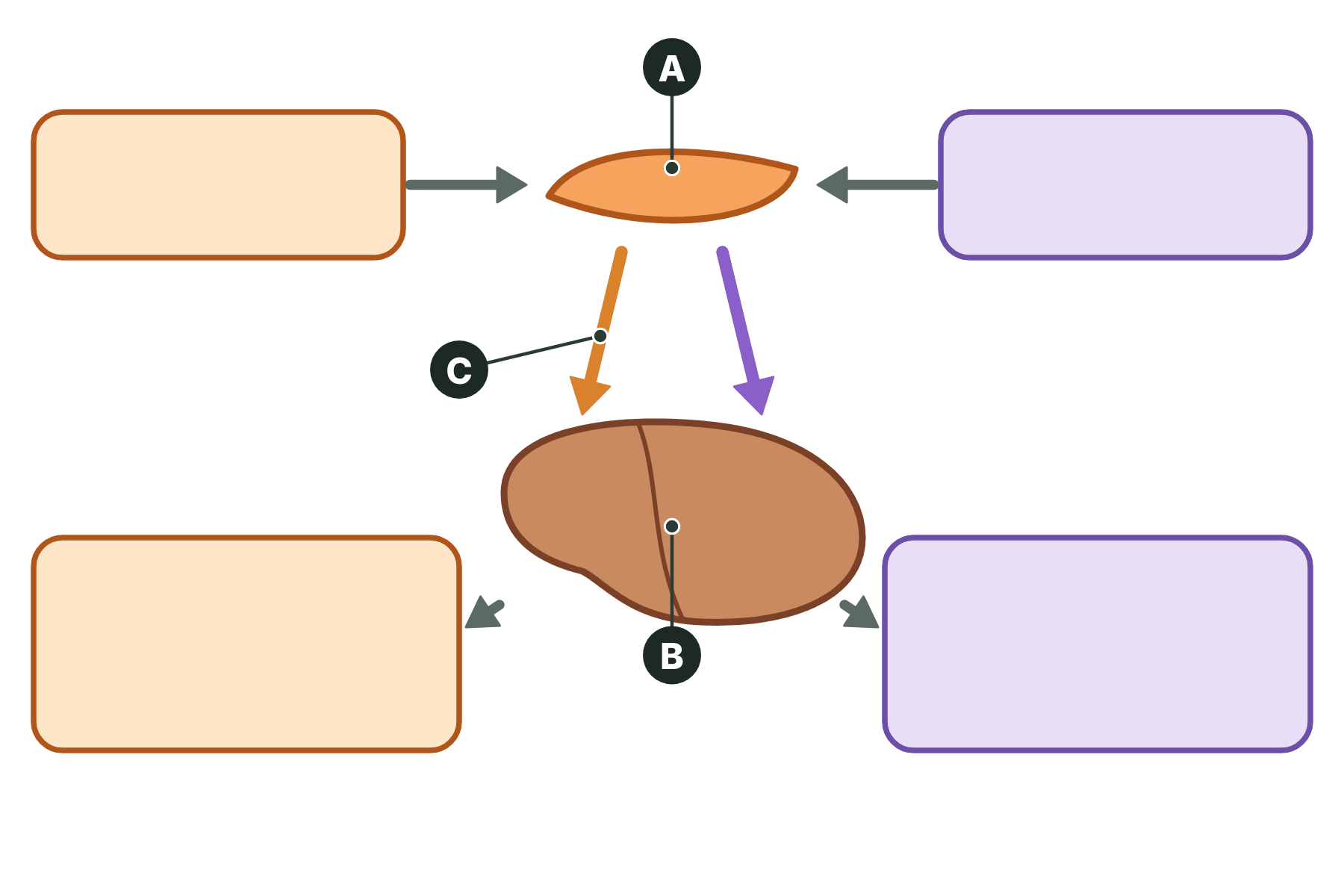
Figure 1 shows how the blood glucose concentration is controlled. Name the parts shown at A, B and C.
Show answerHide answer
Model answer
A is the pancreas. B is the liver. C is a hormone, insulin (or glucagon).
Mark scheme
- A: pancreas — 1 mark
- B: liver — 1 mark
- C: insulin — 1 mark
-
3 Explain [4 marks]
Explain how the body responds when the blood glucose concentration rises after a meal.
Show answerHide answer
Model answer
The pancreas detects the rise in blood glucose. The pancreas releases insulin into the blood. The insulin makes the liver take up glucose and convert it to glycogen. The blood glucose concentration falls back to normal.
Mark scheme
- Pancreas detects the rise — 1 mark
- Insulin released — 1 mark
- Liver takes up glucose and stores it as glycogen — 1 mark
- Blood glucose falls — 1 mark
-
4 Compare [3 marks]
Compare type 1 diabetes with type 2 diabetes.
Show answerHide answer
Model answer
In type 1 diabetes the pancreas does not make enough insulin, but in type 2 diabetes the cells stop responding to insulin. Type 1 is treated with insulin injections, but type 2 is treated with diet and exercise. Type 2 is linked to obesity.
Mark scheme
- Type 1: not enough insulin; type 2: cells do not respond — 1 mark
- Type 1: insulin injections; type 2: diet and exercise — 1 mark
- Type 2 linked to obesity — 1 mark
-
5 Describe [3 marks]
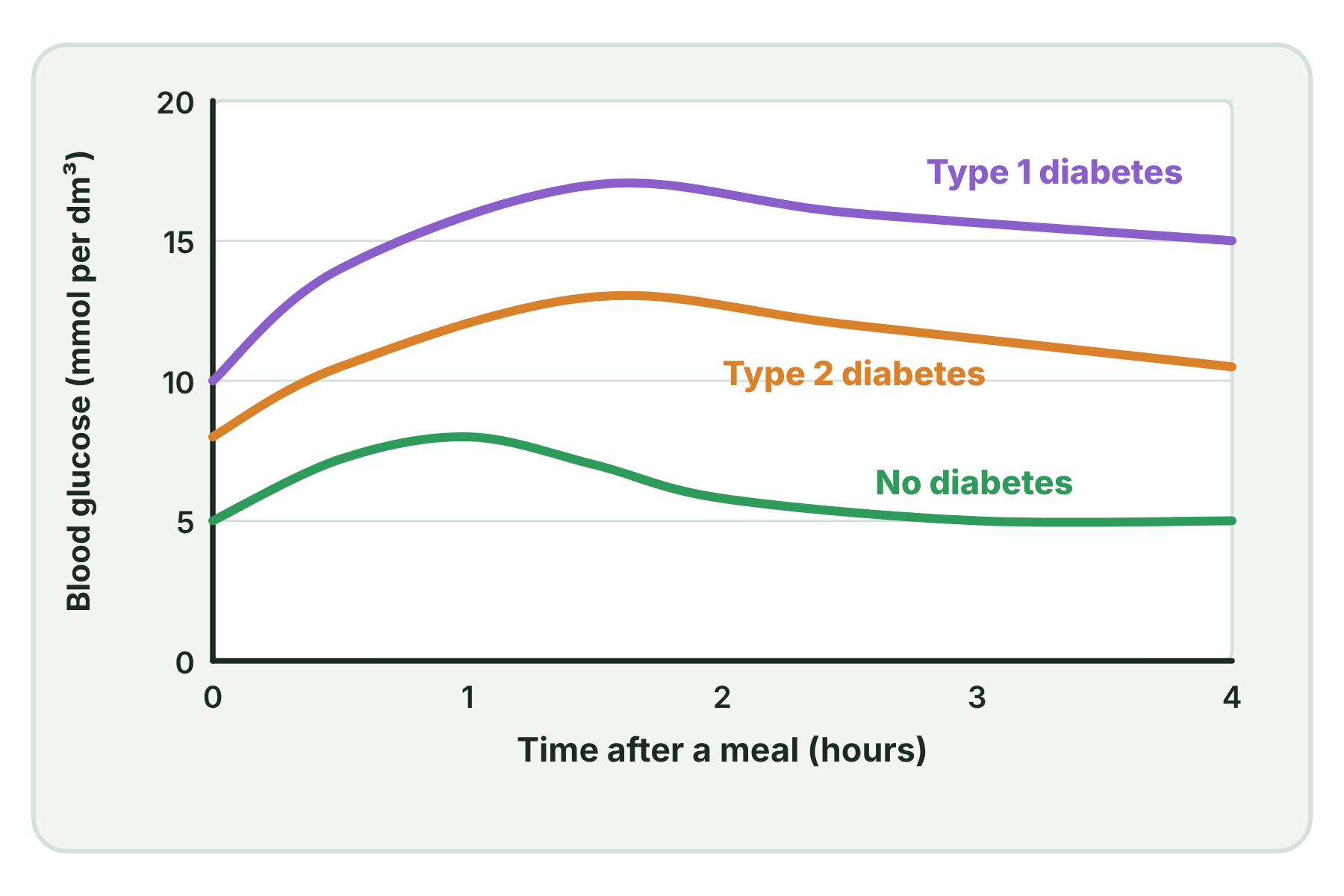
Figure 2 shows the blood glucose concentration of a person without diabetes and of two people with diabetes after a meal. Describe the differences between the person without diabetes and the person with type 1 diabetes.
Show answerHide answer
Model answer
The person without diabetes starts at about 5 and rises to about 8, then returns to about 5 within 3 hours. The person with type 1 starts higher, at about 10, rises to about 17 and stays above 14. The concentration does not return to normal.
Mark scheme
- Without diabetes: peak about 8 — 1 mark
- Without diabetes returns to about 5 — 1 mark
- Type 1 starts higher, peaks higher and stays high — 1 mark
-
6 Explain [3 marks]
Explain why a person with type 1 diabetes needs to inject insulin but a person with type 2 diabetes may not.
Show answerHide answer
Model answer
In type 1 diabetes the pancreas does not make enough insulin, so it must be injected. In type 2 diabetes the pancreas makes insulin but the cells do not respond to it. Diet and exercise can make cells respond better, so injections may not be needed.
Mark scheme
- Type 1: pancreas does not make enough insulin — 1 mark
- Type 2: cells do not respond to insulin — 1 mark
- Diet and exercise can help in type 2 — 1 mark
-
7 Explain [4 marks]
Explain how insulin and glucagon work together to keep the blood glucose concentration constant.
Show answerHide answer
Model answer
When the blood glucose is too high the pancreas releases insulin, which makes the liver store glucose as glycogen, so the concentration falls. When the blood glucose is too low the pancreas releases glucagon, which makes the liver convert glycogen to glucose, so the concentration rises. They have opposite effects, so this is negative feedback.
Mark scheme
- High glucose: insulin, liver stores glycogen, concentration falls — 1 mark
- Low glucose: glucagon, liver releases glucose, concentration rises — 1 mark
- Opposite effects — 1 mark
- Negative feedback keeps the concentration constant — 1 mark
-
8 Evaluate [4 marks]
A study finds that type 2 diabetes is more common in countries where more people are obese. A newspaper says that the study proves that obesity causes type 2 diabetes. Evaluate this claim, and suggest one recommendation for people at risk.
Show answerHide answer
Model answer
The study shows a link between obesity and type 2 diabetes, but a link does not prove that one causes the other, because other factors such as diet or exercise could cause both. However, the link is supported by other evidence on how cells respond to insulin. People at risk should eat a healthy diet, take more exercise and keep a healthy body mass.
Mark scheme
- A link or correlation is shown — 1 mark
- A link does not prove cause, as other factors could be involved — 1 mark
- Evidence from other studies supports the link — 1 mark
- A sensible recommendation, such as diet, exercise or a healthy body mass — 1 mark
Quick check
-
1
Which hormone lowers the blood glucose concentration?
Show answerHide answer
B: Insulin
Insulin lowers the blood glucose concentration.
-
2
In which form does the liver store glucose?
Show answerHide answer
D: Glycogen
The liver stores glucose as glycogen.
-
3
Which organ makes insulin?
Show answerHide answer
A: The pancreas
The pancreas makes insulin.
-
4
What is the cause of type 1 diabetes?
Show answerHide answer
C: The pancreas does not make enough insulin
In type 1 diabetes the pancreas does not make enough insulin.
-
5
Which type of diabetes is linked to obesity?
Show answerHide answer
B: Type 2
Type 2 diabetes is linked to obesity and lack of exercise.
-
6
How is type 1 diabetes usually treated?
Show answerHide answer
D: With insulin injections
Type 1 diabetes is treated with insulin injections.
-
7
What does glucagon make the liver do?
Show answerHide answer
A: Release glucose
Glucagon makes the liver convert glycogen to glucose.
-
8
When is glucagon released?
Show answerHide answer
C: When blood glucose is too low
Glucagon is released when the blood glucose concentration is too low.
Water and Nitrogen Balance
Just this lesson-
1 State [2 marks]
State two substances that are lost from the body in sweat.
Show answerHide answer
Model answer
Any two of: water, ions, urea.
Mark scheme
- Substance 1 — 1 mark
- Substance 2 — 1 mark
-
2 Explain [3 marks]
Explain why the water content of the blood needs to be controlled.
Show answerHide answer
Model answer
If the blood is too dilute, water enters the cells by osmosis, so they may swell and burst. If it is too concentrated, water leaves the cells by osmosis and they shrink. In both cases the cells do not function efficiently.
Mark scheme
- Too dilute: water enters the cells — 1 mark
- Too concentrated: water leaves the cells — 1 mark
- Cells do not function efficiently — 1 mark
-
3 Name [3 marks]
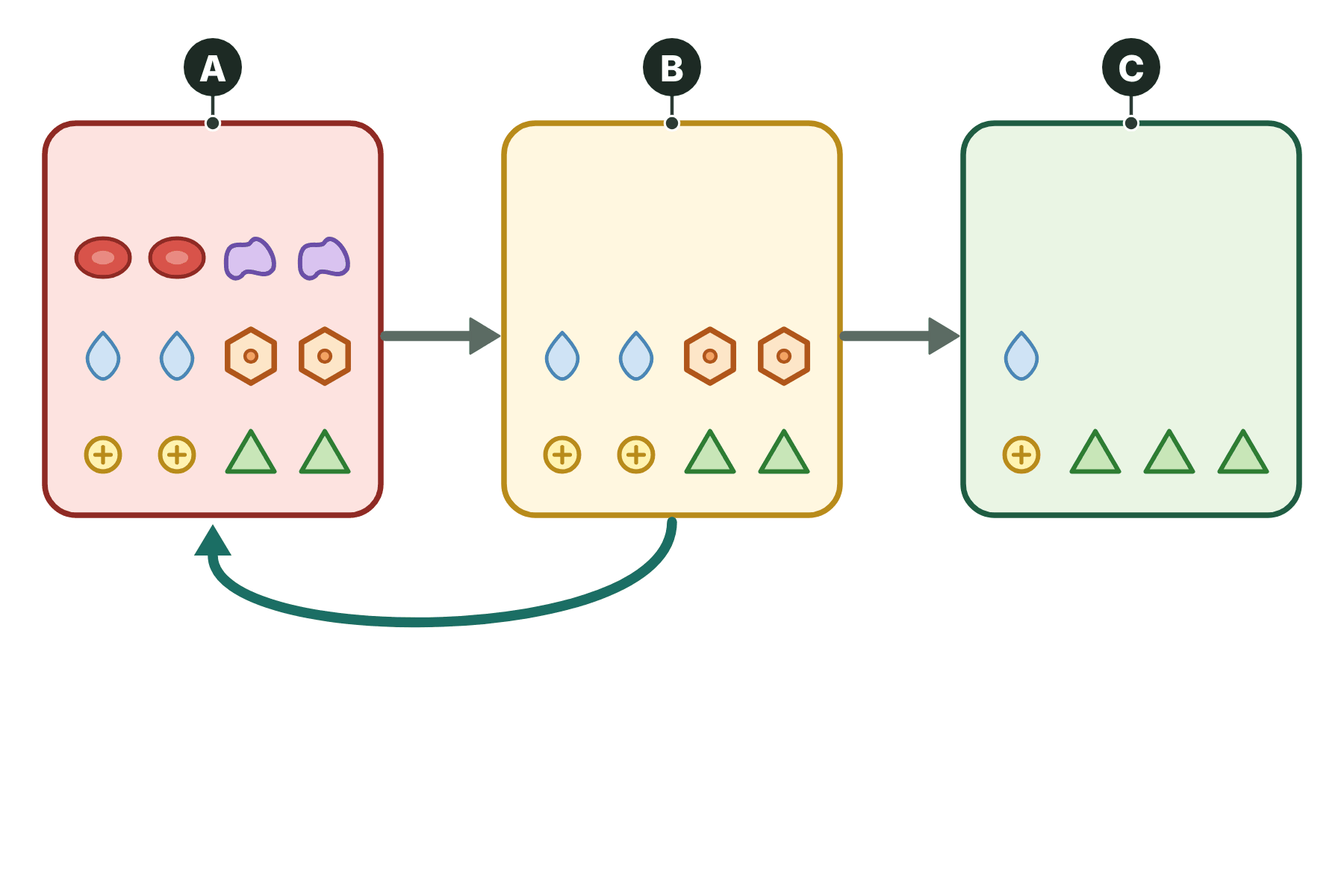
Figure 1 shows how urine is made. Name the liquids shown at A, B and C.
Show answerHide answer
Model answer
A is the blood. B is the filtrate. C is the urine.
Mark scheme
- A: blood — 1 mark
- B: filtrate — 1 mark
- C: urine — 1 mark
-
4 Describe [4 marks]
Describe how the kidneys produce urine.
Show answerHide answer
Model answer
The blood is filtered, so small molecules such as water, glucose, ions and urea leave the blood. Blood cells and proteins are too big and stay in the blood. Useful substances are selectively reabsorbed back into the blood: all of the glucose, some ions and some water. The urea, excess ions and excess water leave the body as urine.
Mark scheme
- Filtration of small molecules from the blood — 1 mark
- Blood cells and proteins stay in the blood — 1 mark
- Selective reabsorption of glucose, some ions and some water — 1 mark
- Urea, excess ions and water leave in the urine — 1 mark
-
5 Explain [3 marks]
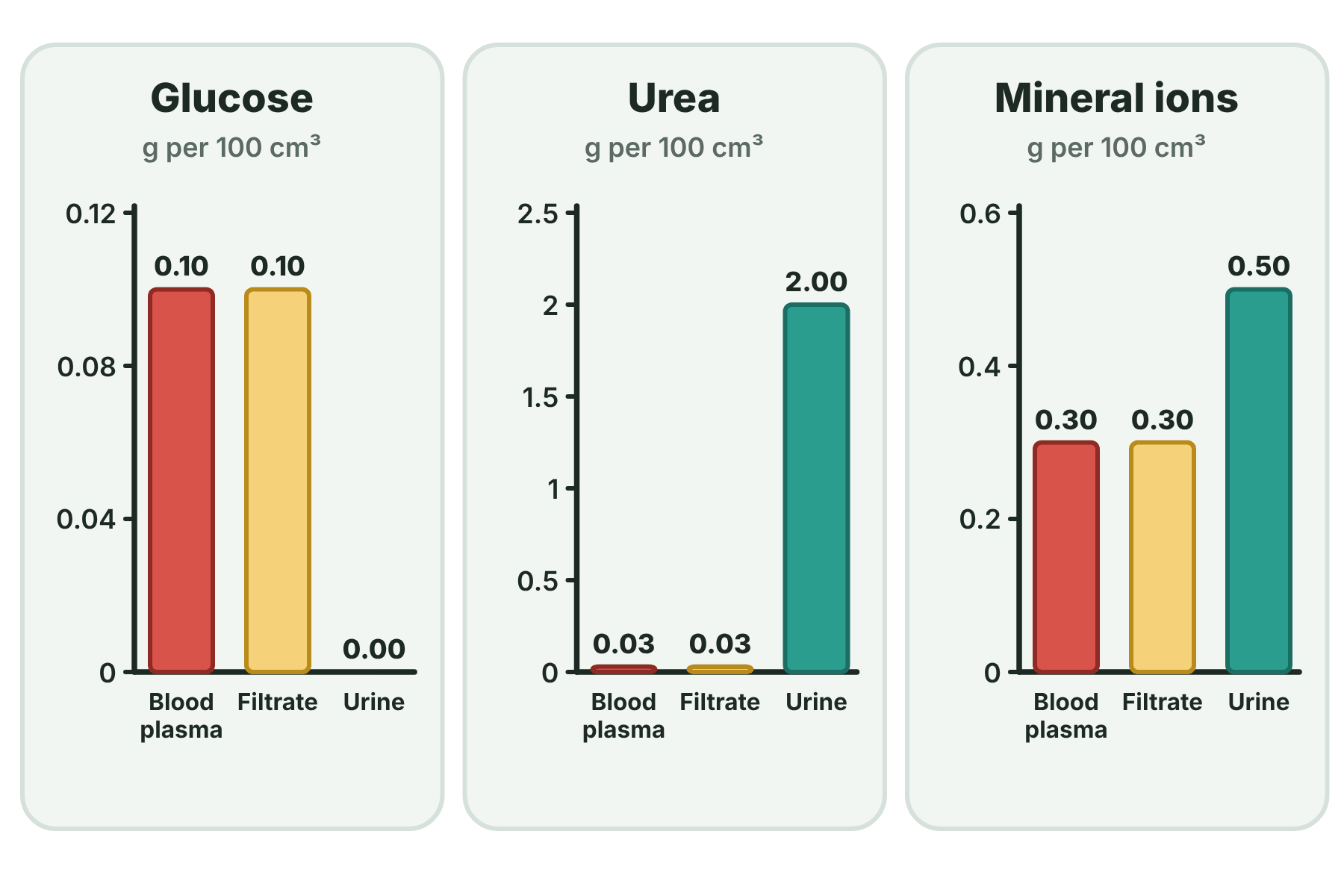
Figure 2 shows the concentrations of three substances in the blood plasma, in the filtrate and in the urine. Explain why there is glucose in the filtrate but none in the urine, and why the urea is more concentrated in the urine.
Show answerHide answer
Model answer
Glucose is a small molecule, so it is filtered out of the blood into the filtrate. All of the glucose is then reabsorbed into the blood by selective reabsorption, so none is left in the urine. The urea is not reabsorbed, and some of the water is, so the urea is more concentrated in the urine.
Mark scheme
- Glucose is filtered out of the blood into the filtrate — 1 mark
- All of the glucose is reabsorbed, so none is in the urine — 1 mark
- Urea is not reabsorbed but water is, so the urea is concentrated — 1 mark
-
6 Calculate [2 marks]
Use Figure 2 to calculate how many times more concentrated the mineral ions are in the urine than in the blood plasma. Give your answer to 2 significant figures.
Show answerHide answer
Model answer
1.7 times
Mark scheme
- \(0.50 \div 0.30\) — 1 mark
- 1.7 — 1 mark
-
7 Explain [3 marks]
Explain why the liver deaminates excess amino acids and then converts the ammonia into urea.
Show answerHide answer
Model answer
The body cannot store excess amino acids, so they have to be excreted safely. In the liver they are deaminated, which forms ammonia. Ammonia is toxic, so the liver immediately converts it to urea, which can be carried in the blood to the kidneys and excreted in the urine.
Mark scheme
- Excess amino acids cannot be stored and must be excreted — 1 mark
- Deamination forms ammonia, which is toxic — 1 mark
- Ammonia is converted to urea, which is removed in the urine — 1 mark
-
8 Explain [4 marks]
A person runs a marathon on a hot day and sweats a lot. Explain how ADH changes the amount of urine that the person produces.
Show answerHide answer
Model answer
The person loses water in sweat, so the blood becomes more concentrated. The pituitary gland releases more ADH. ADH makes the kidney tubules more permeable to water, so more water is reabsorbed into the blood. The person produces a small volume of concentrated urine.
Mark scheme
- Blood becomes more concentrated — 1 mark
- Pituitary releases more ADH — 1 mark
- Kidney tubules more permeable, so more water is reabsorbed — 1 mark
- Small volume of concentrated urine — 1 mark
-
9 Explain [3 marks]
Explain how negative feedback keeps the water level of the blood constant.
Show answerHide answer
Model answer
If the water level falls, more ADH is released and more water is reabsorbed, which raises the water level. If the water level rises, less ADH is released and less water is reabsorbed, which lowers it. Each change causes a response that reverses the change.
Mark scheme
- Low water level: more ADH, more water reabsorbed — 1 mark
- High water level: less ADH, less water reabsorbed — 1 mark
- The response reverses the change — 1 mark
Quick check
-
1
How does water leave the body through the lungs?
Show answerHide answer
B: In the breath
Water leaves in the air that you breathe out.
-
2
Which substances are lost in sweat?
Show answerHide answer
D: Water, ions and urea
Water, ions and urea are all lost from the skin in sweat.
-
3
What are the two stages in the making of urine?
Show answerHide answer
A: Filtration and selective reabsorption
The blood is filtered and then useful substances are selectively reabsorbed.
-
4
Which substance is all reabsorbed in the kidney?
Show answerHide answer
C: Glucose
All of the glucose is reabsorbed, so there is none in the urine.
-
5
Why are blood cells not found in the filtrate?
Show answerHide answer
B: They are too big to be filtered
Blood cells are too big to be filtered out of the blood.
-
6
What happens to a red blood cell in a very dilute solution?
Show answerHide answer
A: It swells and may burst
Water enters by osmosis, so the cell swells and may burst.
-
7
Where are excess amino acids deaminated?
Show answerHide answer
D: In the liver
Excess amino acids are deaminated in the liver.
-
8
What does ADH do to the kidney tubules?
Show answerHide answer
C: Makes them more permeable to water
ADH makes the kidney tubules more permeable to water, so more water is reabsorbed.
Kidney Failure, Dialysis and Transplants
Just this lesson-
1 State [2 marks]
State two treatments for kidney failure.
Show answerHide answer
Model answer
Dialysis (using a machine) and a kidney transplant.
Mark scheme
- Dialysis — 1 mark
- Kidney transplant — 1 mark
-
2 Name [3 marks]
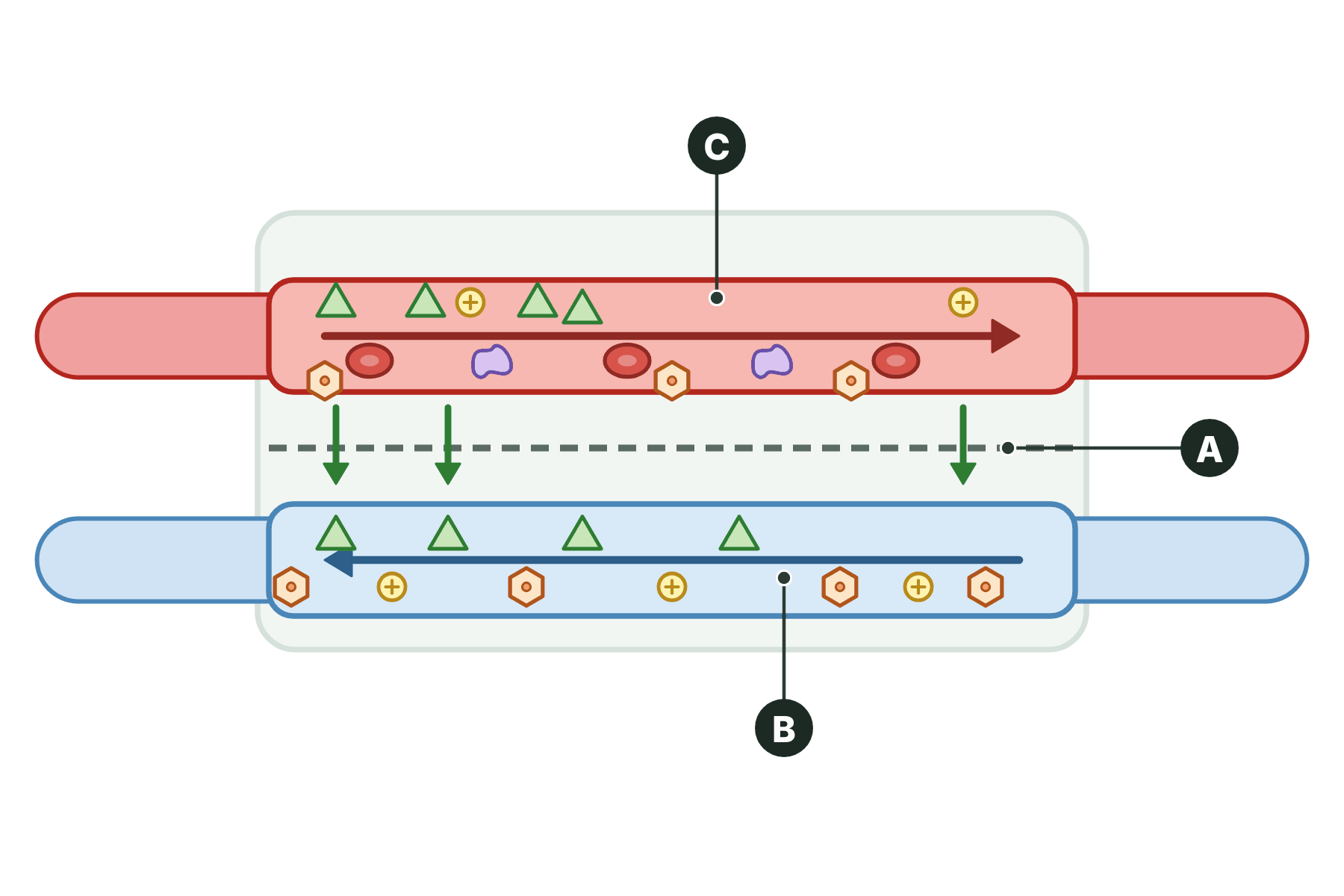
Figure 1 shows a dialysis machine. Name the parts shown at A, B and C.
Show answerHide answer
Model answer
A is the partially permeable membrane. B is the dialysis fluid. C is the blood.
Mark scheme
- A: partially permeable membrane — 1 mark
- B: dialysis fluid — 1 mark
- C: blood — 1 mark
-
3 Describe [4 marks]
Describe how a dialysis machine removes urea from the blood of a patient.
Show answerHide answer
Model answer
The patient's blood flows on one side of a partially permeable membrane, and dialysis fluid flows on the other side. The dialysis fluid has no urea, so urea diffuses from the blood through the membrane into the fluid. Blood cells and proteins are too big to cross, so they stay in the blood. The cleaned blood returns to the patient.
Mark scheme
- Blood on one side of a partially permeable membrane, dialysis fluid on the other — 1 mark
- Urea diffuses from the blood into the dialysis fluid — 1 mark
- Blood cells and proteins cannot cross — 1 mark
- The cleaned blood returns to the patient — 1 mark
-
4 Explain [3 marks]
The dialysis fluid contains the same concentration of glucose as normal blood. Explain why.
Show answerHide answer
Model answer
If the concentrations of glucose are the same on both sides of the membrane, there is no net diffusion of glucose. The patient therefore does not lose glucose from the blood, as they would if there were none in the fluid.
Mark scheme
- Same concentration on both sides, so no net movement of glucose — 1 mark
- The patient does not lose glucose — 1 mark
- It would diffuse out if there were none in the fluid — 1 mark
-
5 Explain [3 marks]
Explain why the dialysis fluid is kept flowing past the membrane instead of staying still.
Show answerHide answer
Model answer
The flow carries the urea away, so the concentration of urea in the fluid stays low. This keeps a steep concentration gradient across the membrane, so urea keeps diffusing out of the blood.
Mark scheme
- Flow carries the urea away — 1 mark
- The urea concentration in the fluid stays low — 1 mark
- A steep concentration gradient keeps urea diffusing out — 1 mark
-
6 Evaluate [4 marks]
Evaluate the advantages and disadvantages of treating kidney failure by dialysis and by a kidney transplant.
Show answerHide answer
Model answer
Dialysis is available straight away and keeps the patient alive while they wait for a donor. However, it has to be repeated several times a week and restricts the patient's life. A transplant provides a working kidney and frees the patient from dialysis, but there are few donors, the kidney may be rejected, and the patient needs drugs for life, which increase the risk of infection.
Mark scheme
- Dialysis: advantage, such as available at once — 1 mark
- Dialysis: disadvantage, such as repeated often — 1 mark
- Transplant: advantage, such as no need for dialysis — 1 mark
- Transplant: disadvantage, such as few donors / rejection / drugs — 1 mark
-
7 Explain [3 marks]
Explain why a patient who has had a kidney transplant has to take drugs for the rest of their life.
Show answerHide answer
Model answer
The patient's immune system may recognise the new kidney as foreign and attack it, which is rejection. The drugs reduce the activity of the immune system, so the kidney is less likely to be rejected. They have to be taken for life because the risk does not go away.
Mark scheme
- The immune system may attack the new kidney — 1 mark
- The drugs reduce the activity of the immune system — 1 mark
- The risk of rejection continues — 1 mark
Quick check
-
1
What does a dialysis machine remove from the blood?
Show answerHide answer
C: Urea
Dialysis removes urea and excess ions from the blood.
-
2
What separates the blood from the dialysis fluid?
Show answerHide answer
A: A partially permeable membrane
A partially permeable membrane lets small molecules through but not blood cells or proteins.
-
3
How does urea move from the blood into the dialysis fluid?
Show answerHide answer
D: By diffusion
Urea diffuses from a higher concentration in the blood to a lower concentration in the fluid.
-
4
What is rejection?
Show answerHide answer
B: The immune system attacking the new organ
Rejection is the attack of the immune system on a transplanted organ.
-
5
Why do transplant patients take immunosuppressant drugs?
Show answerHide answer
C: To reduce the risk of rejection
The drugs reduce the activity of the immune system, so the new kidney is less likely to be rejected.
-
6
Which is an advantage of dialysis over a transplant?
Show answerHide answer
A: It is available straight away
Dialysis is available straight away, but a transplant needs a matching donor.
-
7
Which is a disadvantage of a kidney transplant?
Show answerHide answer
D: There are not enough donor kidneys
There are not enough donors, and the kidney may be rejected.
-
8
Why do blood cells stay in the blood in a dialysis machine?
Show answerHide answer
B: They are too big to cross the membrane
Blood cells are too big to pass through the partially permeable membrane.
Hormones in Human Reproduction
Just this lesson-
1 State [2 marks]
State the roles of oestrogen and progesterone in the menstrual cycle.
Show answerHide answer
Model answer
Oestrogen and progesterone are both involved in maintaining the lining of the uterus.
Mark scheme
- Oestrogen is involved in maintaining the lining — 1 mark
- Progesterone is involved in maintaining the lining — 1 mark
-
2 Name [3 marks]
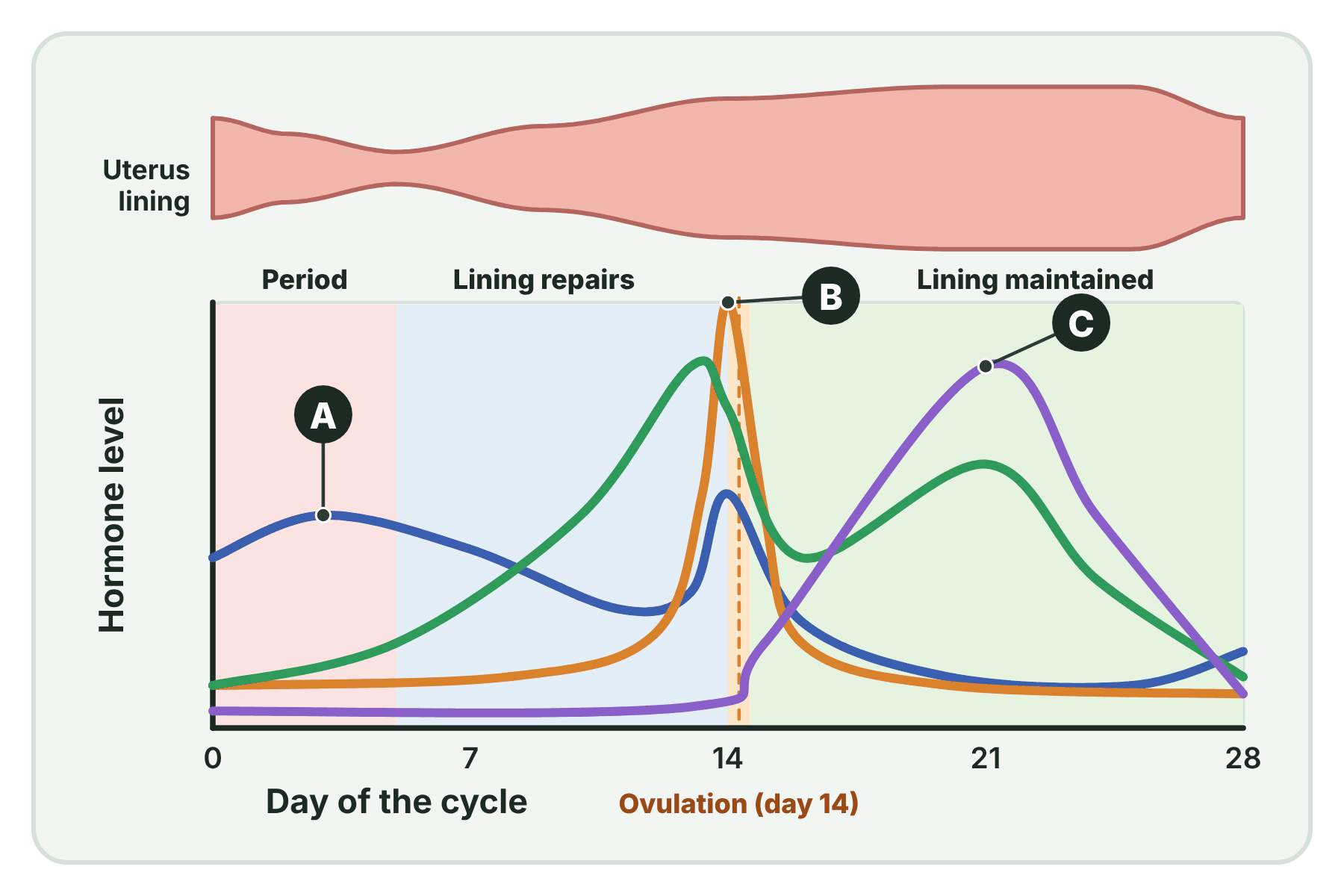
Figure 1 shows the levels of four hormones during the menstrual cycle. Name the hormones shown by the curves A, B and C.
Show answerHide answer
Model answer
A is FSH. B is LH. C is progesterone.
Mark scheme
- A: FSH — 1 mark
- B: LH — 1 mark
- C: progesterone — 1 mark
-
3 Describe [3 marks]
Describe what happens to the lining of the uterus during the menstrual cycle.
Show answerHide answer
Model answer
The lining breaks down on days 1 to 5, which is the period. It repairs and thickens between day 5 and day 14. It is maintained from day 14 to day 28 unless the woman becomes pregnant.
Mark scheme
- Breaks down in days 1 to 5 — 1 mark
- Repairs and thickens to day 14 — 1 mark
- Maintained until day 28 — 1 mark
-
4 Explain [2 marks]
The level of LH peaks on day 14. Explain what the peak causes.
Show answerHide answer
Model answer
The surge of LH causes ovulation, which is the release of a mature egg from the ovary.
Mark scheme
- Causes ovulation — 1 mark
- The release of a mature egg from the ovary — 1 mark
-
5 Explain [3 marks]
Explain why the lining of the uterus breaks down at the end of the cycle if the woman is not pregnant.
Show answerHide answer
Model answer
After ovulation progesterone maintains the lining. If there is no pregnancy, the progesterone level falls. The lining is no longer maintained, so it breaks down.
Mark scheme
- Progesterone maintains the lining — 1 mark
- If there is no pregnancy the progesterone level falls — 1 mark
- The lining breaks down — 1 mark
-
6 Explain [4 marks]
Explain how FSH, oestrogen and LH interact to cause ovulation.
Show answerHide answer
Model answer
FSH makes an egg mature and stimulates the ovary to release oestrogen. The oestrogen level rises and stops the release of more FSH, so only one egg matures. A high oestrogen level also stimulates the pituitary gland to release a surge of LH. The LH causes ovulation.
Mark scheme
- FSH matures the egg and stimulates oestrogen — 1 mark
- Oestrogen stops further FSH release — 1 mark
- High oestrogen stimulates the LH surge — 1 mark
- LH causes ovulation — 1 mark
-
7 Explain [3 marks]
Explain the part played by progesterone after ovulation.
Show answerHide answer
Model answer
Progesterone is released by the empty follicle after ovulation. It maintains the lining of the uterus, ready for an embryo. It also stops the pituitary releasing FSH and LH, so no other eggs mature.
Mark scheme
- Released after ovulation — 1 mark
- Maintains the lining — 1 mark
- Stops FSH and LH release so no new egg matures — 1 mark
-
8 State [3 marks]
State the roles of FSH, LH and testosterone in human reproduction.
Show answerHide answer
Model answer
FSH causes an egg to mature in the ovary. LH stimulates the release of the egg. Testosterone is the main male reproductive hormone, which stimulates sperm production.
Mark scheme
- FSH causes the maturation of an egg — 1 mark
- LH stimulates the release of the egg — 1 mark
- Testosterone stimulates sperm production — 1 mark
-
9 Describe [2 marks]
Describe two changes that reproductive hormones cause in a person at puberty.
Show answerHide answer
Model answer
Any two of: eggs begin to mature and are released about every 28 days (females), sperm production starts (males), the secondary sex characteristics develop, such as breasts or facial hair.
Mark scheme
- Change 1 — 1 mark
- Change 2 — 1 mark
Quick check
-
1
Which hormone causes ovulation?
Show answerHide answer
B: LH
A surge of LH causes ovulation.
-
2
Which hormone makes an egg mature in an ovary?
Show answerHide answer
A: FSH
FSH makes an egg mature in a follicle.
-
3
Which hormone maintains the lining of the uterus after ovulation?
Show answerHide answer
D: Progesterone
Progesterone maintains the lining.
-
4
On which day of a 28-day cycle does ovulation usually happen?
Show answerHide answer
C: Day 14
Ovulation usually happens on about day 14.
-
5
Which gland releases FSH and LH?
Show answerHide answer
B: The pituitary gland
The pituitary gland releases FSH and LH.
-
6
Which hormone is released by the testes?
Show answerHide answer
A: Testosterone
The testes release testosterone.
-
7
What does a rise in oestrogen do to FSH?
Show answerHide answer
C: It stops further FSH release
A rising oestrogen level stops the pituitary releasing more FSH.
-
8
What causes the lining of the uterus to break down at the end of a cycle?
Show answerHide answer
D: A fall in progesterone
The level of progesterone falls, so the lining is no longer maintained.
Contraception and Fertility Treatment
Just this lesson-
1 State [2 marks]
State two hormones that are in the combined contraceptive pill.
Show answerHide answer
Model answer
Oestrogen and progesterone.
Mark scheme
- Oestrogen — 1 mark
- Progesterone — 1 mark
-
2 Explain [3 marks]
Explain how the combined contraceptive pill prevents pregnancy.
Show answerHide answer
Model answer
The pill contains oestrogen and progesterone, which keep the level of these hormones high. This stops the pituitary gland releasing FSH. Without FSH no egg matures in the ovary, so there is no egg to be fertilised.
Mark scheme
- Contains oestrogen and progesterone — 1 mark
- Stops FSH release — 1 mark
- No egg matures — 1 mark
-
3 Evaluate [4 marks]
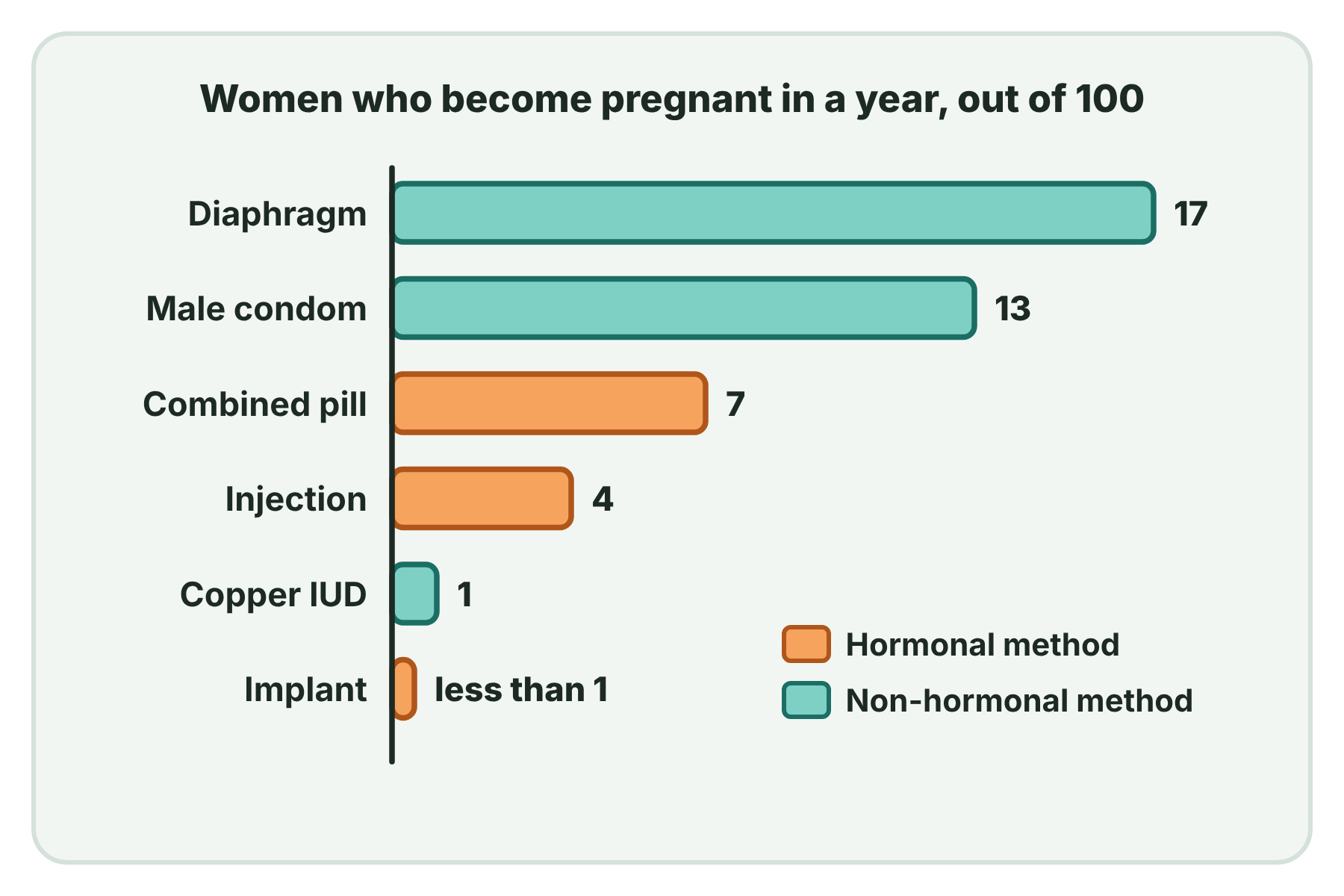
Figure 1 shows how many women out of 100 become pregnant in a year when using each method of contraception. Use the data in Figure 1 to evaluate the use of the male condom and the implant as methods of contraception.
Show answerHide answer
Model answer
The implant is much more effective, because fewer than 1 woman in 100 gets pregnant in a year, compared with 13 in 100 for the condom. The implant lasts for years and does not depend on remembering. However, the condom is the only one that protects against sexually transmitted infections, and the implant may have hormonal side effects.
Mark scheme
- Implant more effective, using the data — 1 mark
- Implant does not depend on remembering — 1 mark
- Condom protects against infection — 1 mark
- Implant may have side effects — 1 mark
-
4 Describe [3 marks]
Describe three non-hormonal methods of contraception.
Show answerHide answer
Model answer
Any three of: condoms, a diaphragm with spermicide, an IUD, abstaining at fertile times, sterilisation.
Mark scheme
- Any three methods — 3 marks
-
5 Explain [2 marks]
Explain why a progesterone injection can be more effective than the combined pill in real use.
Show answerHide answer
Model answer
The injection lasts for weeks, so it does not need to be remembered every day. The pill is often forgotten, which makes it less effective.
Mark scheme
- The injection is not taken daily — 1 mark
- The pill may be forgotten — 1 mark
-
6 Describe [4 marks]
Describe the main stages of in vitro fertilisation (IVF).
Show answerHide answer
Model answer
The woman is given FSH and LH so that several eggs mature. The eggs are collected from the ovaries. They are mixed with sperm in a dish, where they are fertilised. The embryos grow for a few days, and one or two are put into the uterus.
Mark scheme
- FSH and LH to mature eggs — 1 mark
- Eggs collected — 1 mark
- Fertilised with sperm in a dish — 1 mark
- Embryos put into the uterus — 1 mark
-
7 Evaluate [4 marks]
Evaluate the use of IVF to treat infertility.
Show answerHide answer
Model answer
IVF can give a baby to couples who cannot conceive in any other way. However, many cycles do not work, and the success rate falls with age. The hormones may have side effects, and more than one embryo can lead to multiple births, which carry more risk. It is stressful and expensive, and some people have ethical objections to unused embryos being destroyed.
Mark scheme
- Gives a baby to couples who cannot conceive — 1 mark
- Low success rate — 1 mark
- Health risks, such as multiple births — 1 mark
- Cost, stress or ethical issues — 1 mark
-
8 Explain [2 marks]
Explain why issues around contraception cannot be answered by science alone.
Show answerHide answer
Model answer
Science can show how effective each method is and how it works. However, whether a person should use contraception, and which method, depends on beliefs, culture, religion and personal values, which science cannot decide.
Mark scheme
- Science can show how well methods work — 1 mark
- Decisions also depend on beliefs / values / religion — 1 mark
Quick check
-
1
Which two hormones are in the combined pill?
Show answerHide answer
C: Oestrogen and progesterone
The combined pill contains oestrogen and progesterone.
-
2
Which method of contraception also protects against sexually transmitted infections?
Show answerHide answer
B: The condom
Only the condom provides a barrier to infection.
-
3
How does the combined pill stop an egg maturing?
Show answerHide answer
A: It stops FSH release
It stops the pituitary releasing FSH.
-
4
Which of these is a permanent method of contraception?
Show answerHide answer
D: Sterilisation
Sterilisation is permanent.
-
5
In the chart, which method has the fewest pregnancies in a year?
Show answerHide answer
C: The implant
The implant has fewer than 1 pregnancy per 100 women in a year.
-
6
Why is the daily pill less effective in real use than the implant?
Show answerHide answer
B: It can be forgotten
The pill can be forgotten, but the implant needs no daily action.
-
7
Which hormones can be given to a woman who does not ovulate?
Show answerHide answer
A: FSH and LH
FSH and LH stimulate eggs to mature and be released.
-
8
Where does fertilisation happen in IVF?
Show answerHide answer
D: In a laboratory dish
In IVF the egg is fertilised by sperm in a laboratory dish.