Exam questions · Biology · Hormonal Coordination in Humans
Water and Nitrogen Balance
- 9 exam questions
- 27 marks
- 8 quick checks
-
1 State [2 marks]
State two substances that are lost from the body in sweat.
Show answerHide answer
Model answer
Any two of: water, ions, urea.
Mark scheme
- Substance 1 — 1 mark
- Substance 2 — 1 mark
-
2 Explain [3 marks]
Explain why the water content of the blood needs to be controlled.
Show answerHide answer
Model answer
If the blood is too dilute, water enters the cells by osmosis, so they may swell and burst. If it is too concentrated, water leaves the cells by osmosis and they shrink. In both cases the cells do not function efficiently.
Mark scheme
- Too dilute: water enters the cells — 1 mark
- Too concentrated: water leaves the cells — 1 mark
- Cells do not function efficiently — 1 mark
-
3 Name [3 marks]
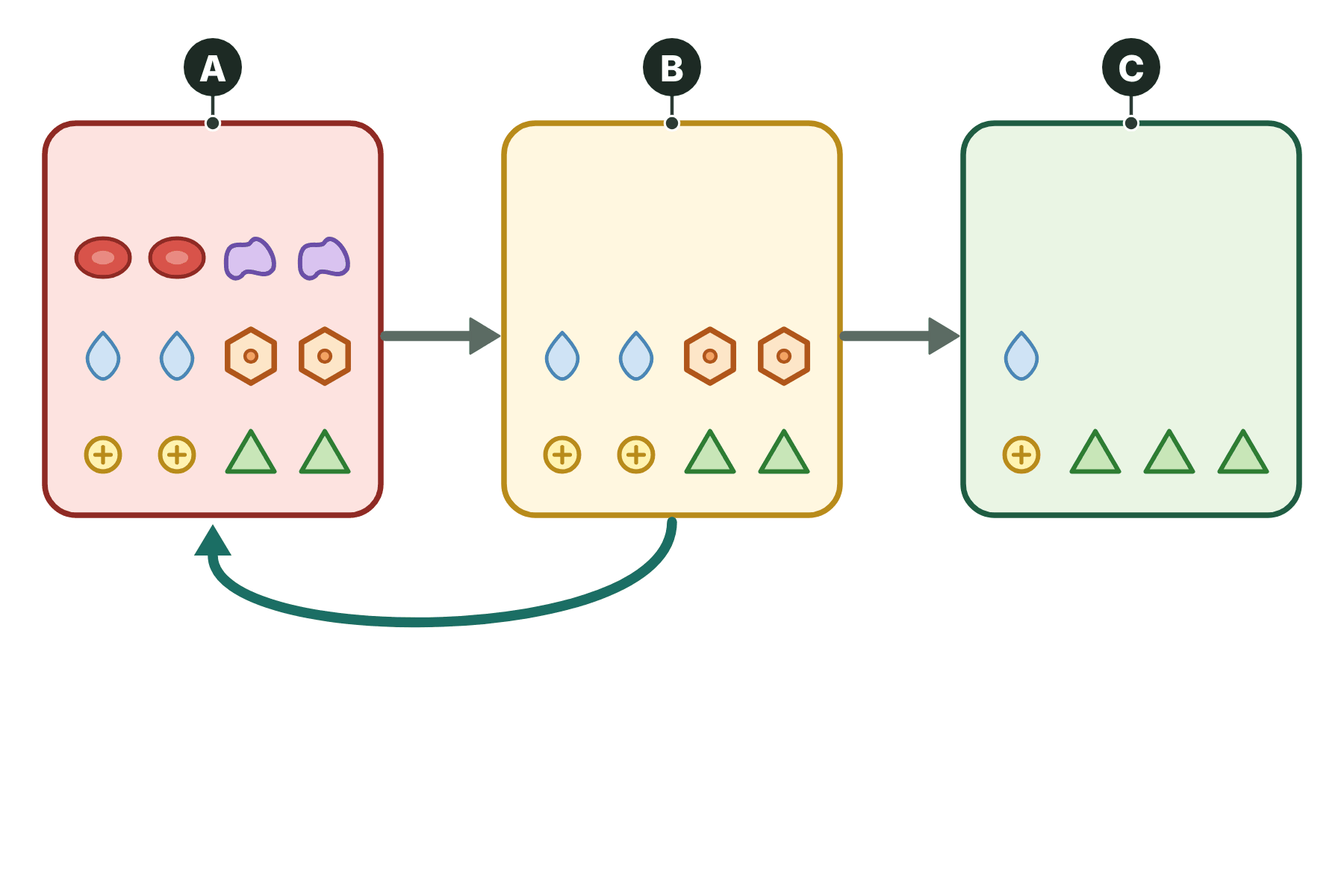
Figure 1 shows how urine is made. Name the liquids shown at A, B and C.
Show answerHide answer
Model answer
A is the blood. B is the filtrate. C is the urine.
Mark scheme
- A: blood — 1 mark
- B: filtrate — 1 mark
- C: urine — 1 mark
-
4 Describe [4 marks]
Describe how the kidneys produce urine.
Show answerHide answer
Model answer
The blood is filtered, so small molecules such as water, glucose, ions and urea leave the blood. Blood cells and proteins are too big and stay in the blood. Useful substances are selectively reabsorbed back into the blood: all of the glucose, some ions and some water. The urea, excess ions and excess water leave the body as urine.
Mark scheme
- Filtration of small molecules from the blood — 1 mark
- Blood cells and proteins stay in the blood — 1 mark
- Selective reabsorption of glucose, some ions and some water — 1 mark
- Urea, excess ions and water leave in the urine — 1 mark
-
5 Explain [3 marks]
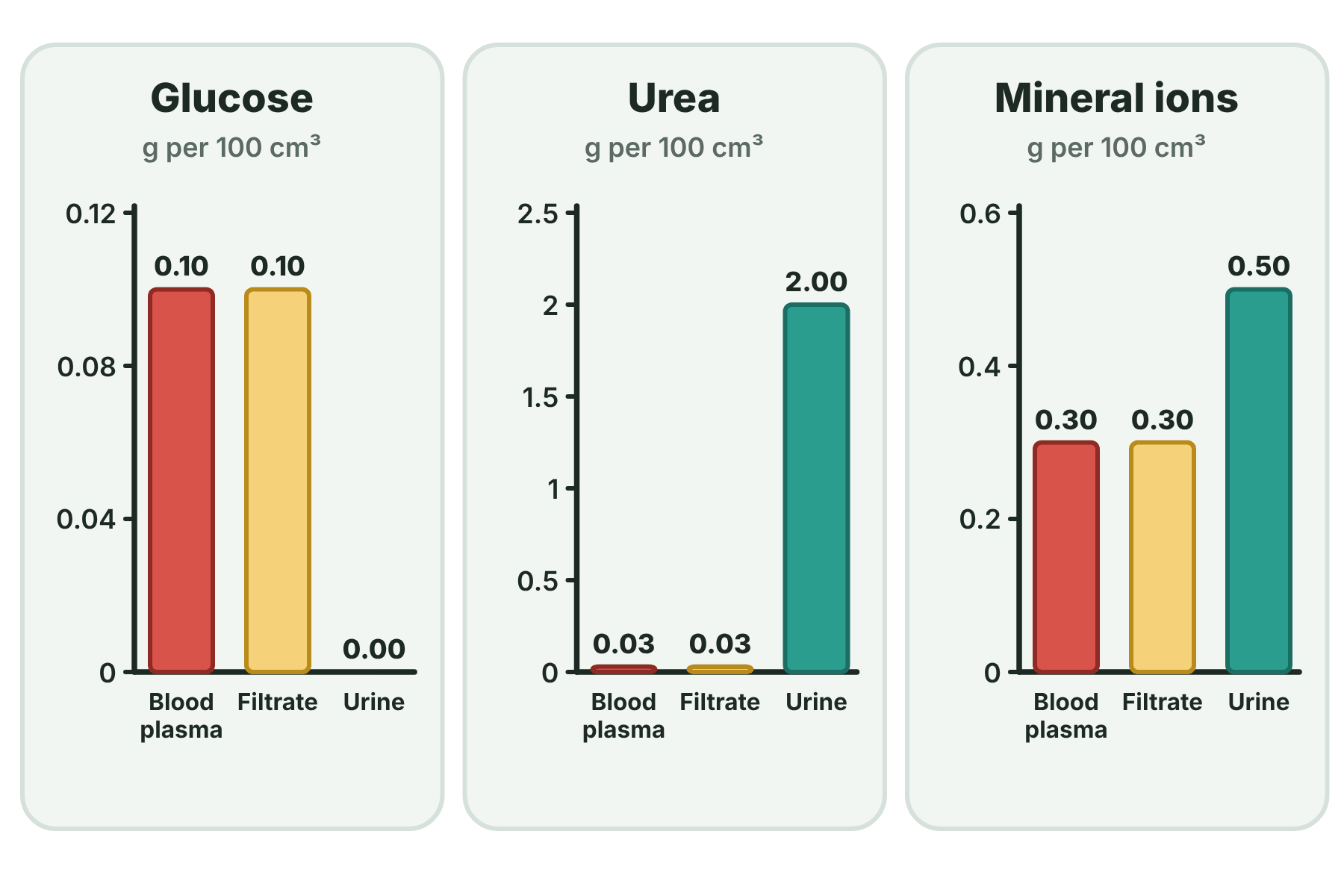
Figure 2 shows the concentrations of three substances in the blood plasma, in the filtrate and in the urine. Explain why there is glucose in the filtrate but none in the urine, and why the urea is more concentrated in the urine.
Show answerHide answer
Model answer
Glucose is a small molecule, so it is filtered out of the blood into the filtrate. All of the glucose is then reabsorbed into the blood by selective reabsorption, so none is left in the urine. The urea is not reabsorbed, and some of the water is, so the urea is more concentrated in the urine.
Mark scheme
- Glucose is filtered out of the blood into the filtrate — 1 mark
- All of the glucose is reabsorbed, so none is in the urine — 1 mark
- Urea is not reabsorbed but water is, so the urea is concentrated — 1 mark
-
6 Calculate [2 marks]
Use Figure 2 to calculate how many times more concentrated the mineral ions are in the urine than in the blood plasma. Give your answer to 2 significant figures.
Show answerHide answer
Model answer
1.7 times
Mark scheme
- \(0.50 \div 0.30\) — 1 mark
- 1.7 — 1 mark
-
7 Explain [3 marks]
Explain why the liver deaminates excess amino acids and then converts the ammonia into urea.
Show answerHide answer
Model answer
The body cannot store excess amino acids, so they have to be excreted safely. In the liver they are deaminated, which forms ammonia. Ammonia is toxic, so the liver immediately converts it to urea, which can be carried in the blood to the kidneys and excreted in the urine.
Mark scheme
- Excess amino acids cannot be stored and must be excreted — 1 mark
- Deamination forms ammonia, which is toxic — 1 mark
- Ammonia is converted to urea, which is removed in the urine — 1 mark
-
8 Explain [4 marks]
A person runs a marathon on a hot day and sweats a lot. Explain how ADH changes the amount of urine that the person produces.
Show answerHide answer
Model answer
The person loses water in sweat, so the blood becomes more concentrated. The pituitary gland releases more ADH. ADH makes the kidney tubules more permeable to water, so more water is reabsorbed into the blood. The person produces a small volume of concentrated urine.
Mark scheme
- Blood becomes more concentrated — 1 mark
- Pituitary releases more ADH — 1 mark
- Kidney tubules more permeable, so more water is reabsorbed — 1 mark
- Small volume of concentrated urine — 1 mark
-
9 Explain [3 marks]
Explain how negative feedback keeps the water level of the blood constant.
Show answerHide answer
Model answer
If the water level falls, more ADH is released and more water is reabsorbed, which raises the water level. If the water level rises, less ADH is released and less water is reabsorbed, which lowers it. Each change causes a response that reverses the change.
Mark scheme
- Low water level: more ADH, more water reabsorbed — 1 mark
- High water level: less ADH, less water reabsorbed — 1 mark
- The response reverses the change — 1 mark
Quick check
-
1
How does water leave the body through the lungs?
Show answerHide answer
B: In the breath
Water leaves in the air that you breathe out.
-
2
Which substances are lost in sweat?
Show answerHide answer
D: Water, ions and urea
Water, ions and urea are all lost from the skin in sweat.
-
3
What are the two stages in the making of urine?
Show answerHide answer
A: Filtration and selective reabsorption
The blood is filtered and then useful substances are selectively reabsorbed.
-
4
Which substance is all reabsorbed in the kidney?
Show answerHide answer
C: Glucose
All of the glucose is reabsorbed, so there is none in the urine.
-
5
Why are blood cells not found in the filtrate?
Show answerHide answer
B: They are too big to be filtered
Blood cells are too big to be filtered out of the blood.
-
6
What happens to a red blood cell in a very dilute solution?
Show answerHide answer
A: It swells and may burst
Water enters by osmosis, so the cell swells and may burst.
-
7
Where are excess amino acids deaminated?
Show answerHide answer
D: In the liver
Excess amino acids are deaminated in the liver.
-
8
What does ADH do to the kidney tubules?
Show answerHide answer
C: Makes them more permeable to water
ADH makes the kidney tubules more permeable to water, so more water is reabsorbed.