Biology · Hormonal Coordination in Humans
Water and Nitrogen Balance
Your cells work properly only if the amount of water and the amount of dissolved ions around them stay in balance, and waste urea has to be removed. This lesson is for separate Biology. It covers how water, ions and urea are lost, how the kidneys make urine by filtration and selective reabsorption, and for Higher tier students how the liver makes urea and how ADH controls the water level.
Learning Objectives
- 1Explain the effect on cells of osmotic changes in body fluids.
- 2Describe how water, ions and urea are lost from the body, and which losses are not controlled.
- 3Describe the function of the kidneys in maintaining the water balance of the body: filtration of the blood and selective reabsorption.
- 4Translate tables and bar charts of glucose, ions and urea before and after filtration.
- 5(Higher tier) Explain how excess amino acids are deaminated in the liver to form ammonia, which is converted to urea.
- 6(Higher tier) Describe the effect of ADH on the permeability of the kidney tubules, and explain how the water level is controlled by negative feedback.
Retrieval practice
-
1
What is osmosis?
Show answerHide answer
The movement of water from a dilute solution to a concentrated solution through a partially permeable membrane.
-
2
What is homeostasis?
Show answerHide answer
The regulation of the internal conditions of a cell or organism to maintain optimum conditions for function.
-
3
What are amino acids?
Show answerHide answer
The small molecules that proteins are made from.
-
4
What is a hormone?
Show answerHide answer
A chemical messenger carried in the blood.
Balancing water and waste
Every day you take in water by drinking and eating, and you lose water, ions and waste. Some of the losses cannot be controlled, so the body has to adjust the one that can: the amount of water and ions that leave in the urine. The kidneys also remove urea, a waste substance made from excess protein. Without this balancing act, your cells would swell or shrink and the waste would build up.
Why the water balance matters
If the body cells lose or gain too much water by osmosis, they do not function efficiently.
-
Too much water
If the blood becomes too dilute, water moves into the cells by osmosis. Animal cells have no cell wall, so they swell and may burst.
-
Too little water
If the blood becomes too concentrated, water leaves the cells by osmosis. The cells shrink and cannot work properly.
-
Balance
The kidneys keep the water and ion content of the blood and tissue fluid in balance, so that the cells stay normal.
A red blood cell in three solutions
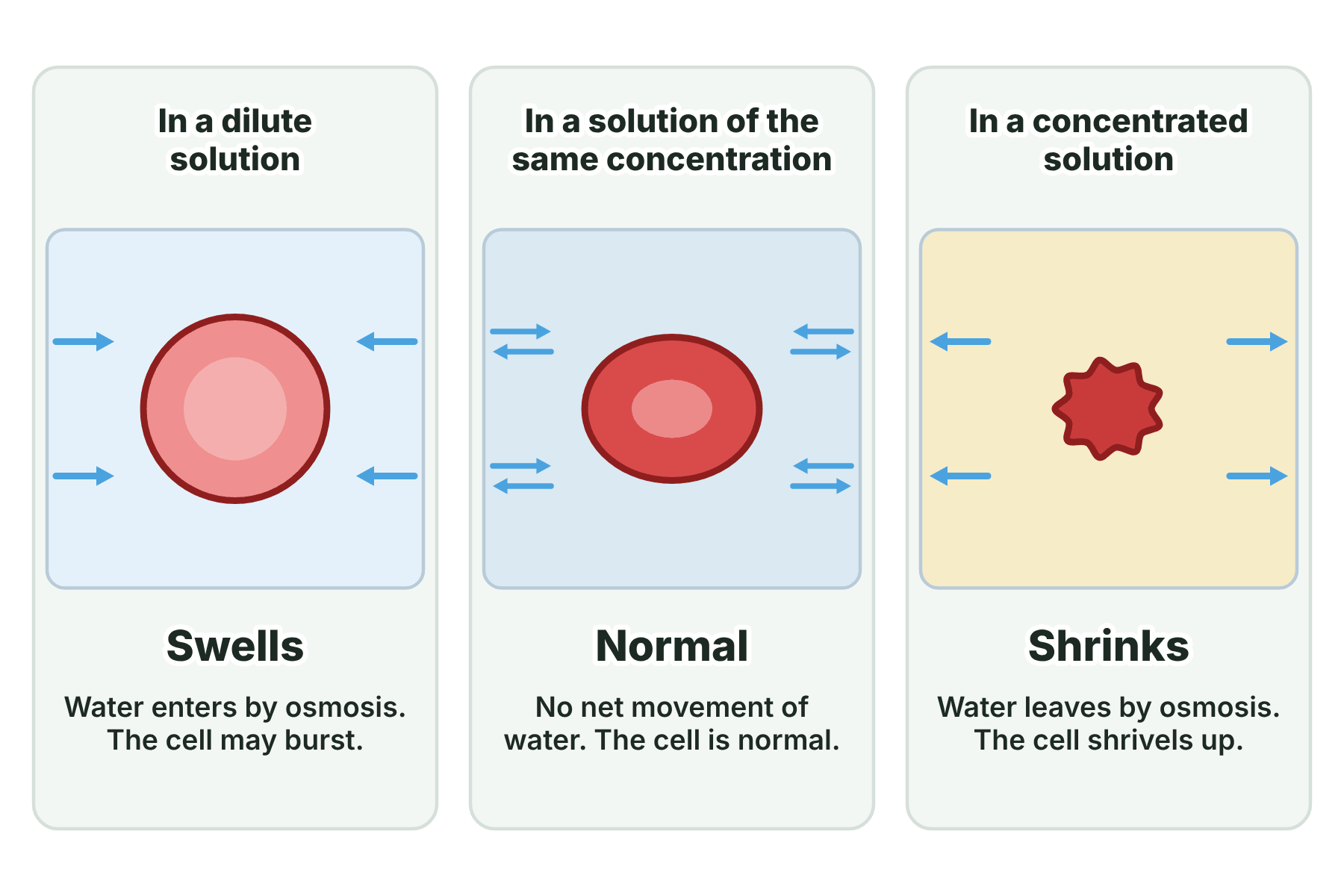
With no cell wall, an animal cell can burst in a dilute solution.
How water, ions and urea are lost
The body loses water, ions and urea in three ways, and only one of them can be controlled.
-
Lungs
Water leaves the body in the air that you breathe out.
-
Skin
Water, ions and urea are lost from the skin in sweat.
-
No control
There is no control over the loss of water, ions or urea by the lungs or the skin.
-
Kidneys
Excess water, ions and urea are removed by the kidneys in the urine. This is the loss that the body can adjust.
Where the losses happen
Lungs and skin
- Water leaves in the breath
- Water, ions and urea leave in sweat
- No control over the loss
- Depends on breathing and sweating
Kidneys
- Excess water, ions and urea leave in the urine
- The loss is controlled
- Keeps the water and ion balance
- Removes the urea
How the kidneys make urine
The kidneys produce urine by filtration of the blood and selective reabsorption of the useful substances. You do not need to know the structure of the kidney or of a nephron.
-
Filtration
Blood is filtered as it passes through the kidneys. Small molecules, such as water, glucose, ions and urea, are forced out of the blood into the filtrate. Blood cells and large proteins are too big and stay in the blood.
-
Selective reabsorption
Useful substances are taken back into the blood. All of the glucose is reabsorbed, and so are some of the ions and some of the water.
-
Urine
What is left, the urea, the excess ions and the excess water, leaves the body as urine.
-
Adjusting the balance
The amount of water and ions reabsorbed depends on what the body needs, so the volume and the concentration of the urine change.
Making urine
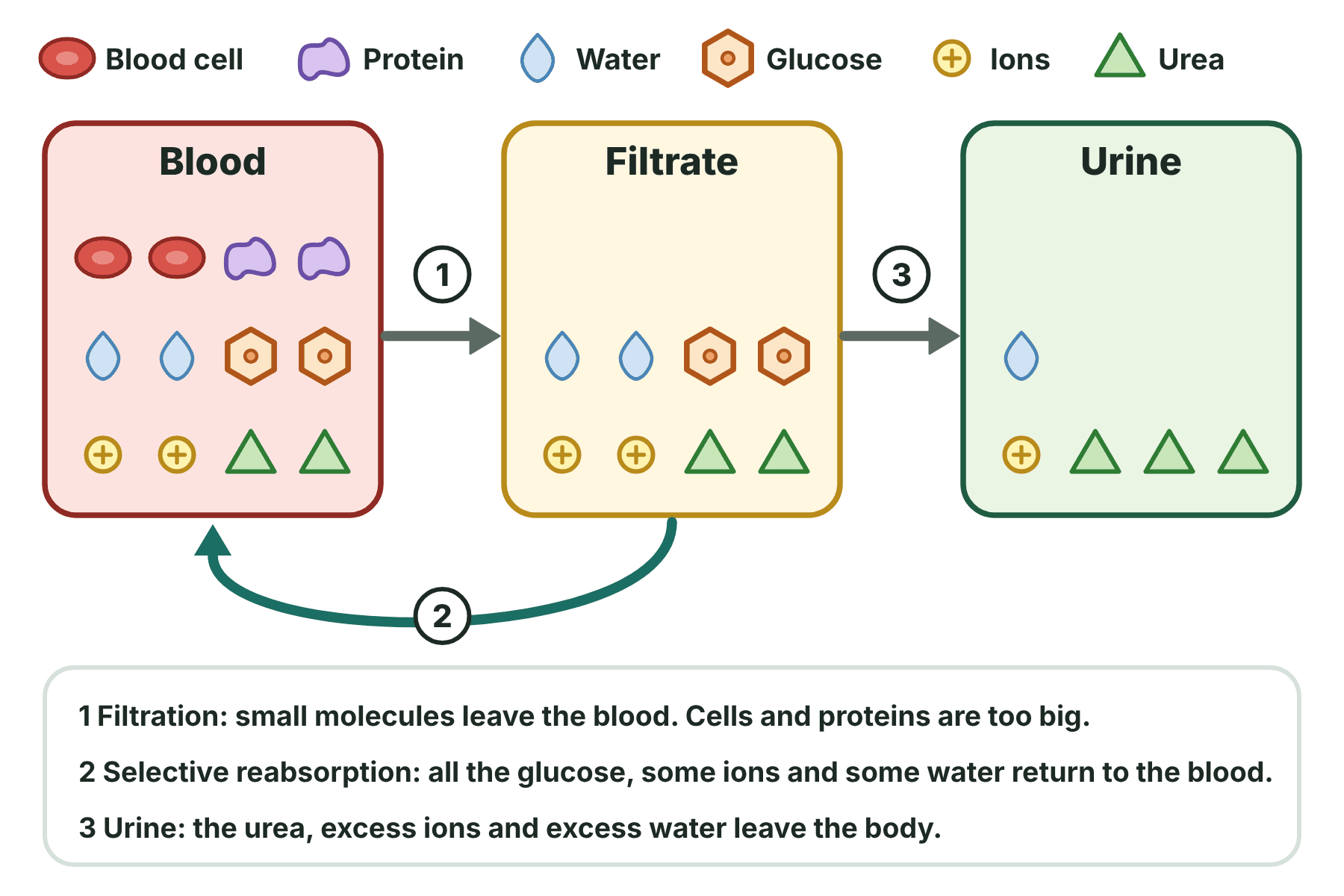
Filtration removes small molecules from the blood, and selective reabsorption takes back the useful ones.
Reading the data
Tables and bar charts compare the amounts of substances in the blood plasma, in the filtrate and in the urine.
-
Glucose
It is in the blood and the filtrate, but not in the urine, because all of it is reabsorbed.
-
Urea
It is in the blood and the filtrate, and it is not reabsorbed. It is more concentrated in the urine because water is reabsorbed.
-
Ions
Some are reabsorbed. The amount in the urine depends on what the body needs.
-
Proteins and blood cells
They are in the blood only, because they are too big to be filtered.
-
A tip
A substance in the filtrate but not in the urine has been reabsorbed. A substance that is more concentrated in the urine than in the blood has stayed behind while water was reabsorbed.
Concentrations before and after filtration
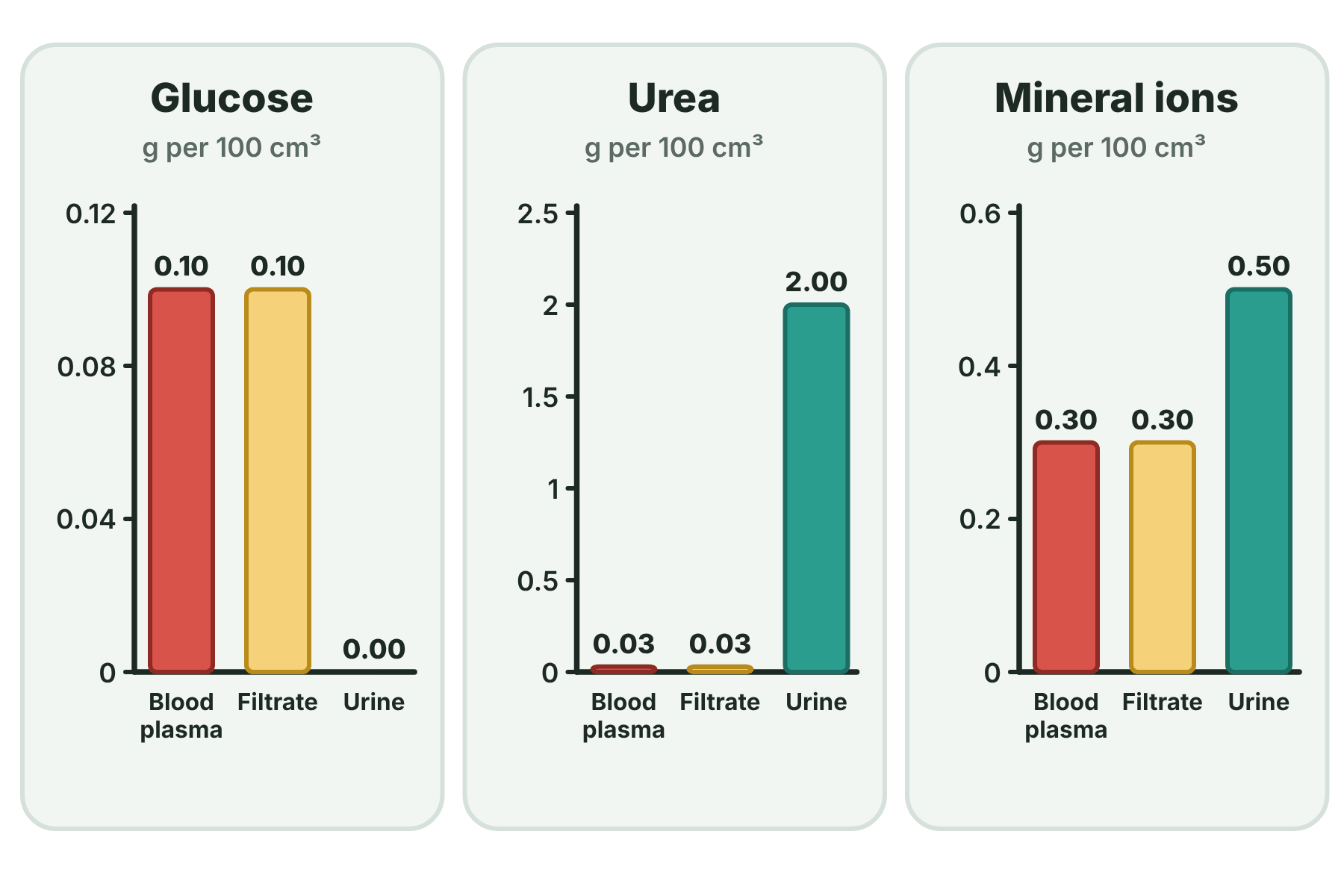
Glucose is all reabsorbed, so there is none in the urine, but the urea is concentrated.
Comparing the concentration of urea
The concentration of urea is 0.03 g per 100 cm³ in the blood plasma and 2.00 g per 100 cm³ in the urine. Calculate how many times more concentrated the urea is in the urine.
Show the solutionHide the solution
- 1 Divide the urine value by the plasma value \(2.00 \div 0.03\)
- 2 Calculate \(= 66.7\)
- 3 Round and give the meaning about 67 times more concentrated
AnswerThe urea is about 67 times more concentrated in the urine.
Deamination and urea (Higher tier)
Proteins from the diet are digested to amino acids. The body cannot store the extra amino acids, so they have to be removed safely.
-
Excess amino acids
The digestion of proteins from the diet results in excess amino acids, which need to be excreted safely.
-
Deamination
In the liver the excess amino acids are deaminated. The part that contains nitrogen is removed, and it forms ammonia.
-
Ammonia is toxic
Ammonia is poisonous, so the liver immediately converts it into urea.
-
Excretion
The urea is carried in the blood to the kidneys and is removed in the urine. Some is also lost in sweat.
ADH and water balance (Higher tier)
The water level in the body is controlled by the hormone ADH, which acts on the kidney tubules.
-
Too little water
When the blood is too concentrated, the pituitary gland releases more ADH.
-
The effect of ADH
ADH makes the kidney tubules more permeable to water, so more water is reabsorbed back into the blood. The urine is a small volume and concentrated.
-
Too much water
When the blood is too dilute, the pituitary releases less ADH. The tubules are less permeable, less water is reabsorbed, and the urine is a large volume and dilute.
-
Negative feedback
Each change in the water level causes a response that reverses it, so the water level stays close to normal.
Controlling water balance with ADH (Higher tier)
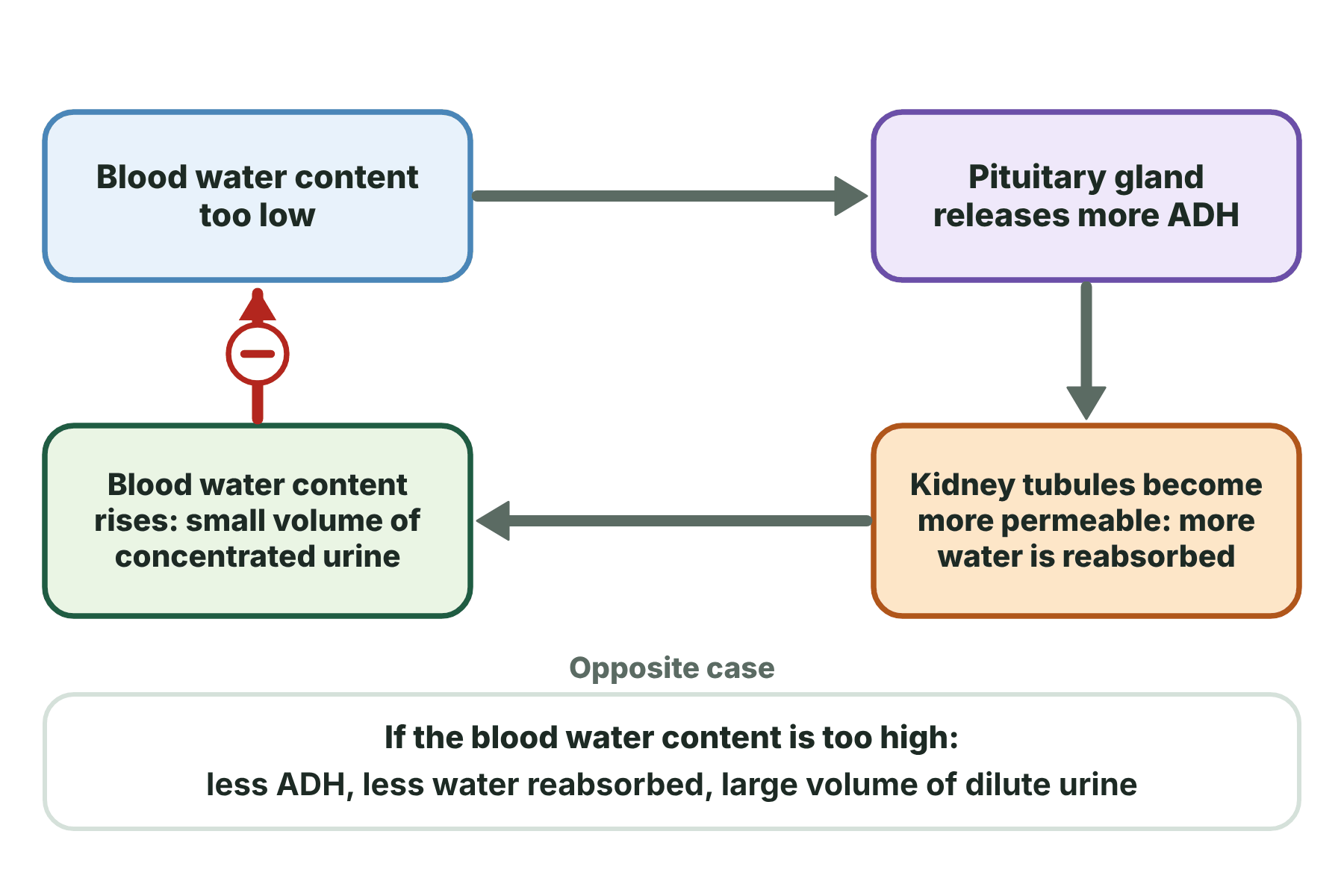
ADH makes the kidney tubules reabsorb more water when the blood is too concentrated.
Dilute urine and concentrated urine
Too much water in the body
- Less ADH is released
- Kidney tubules less permeable
- Less water is reabsorbed
- Large volume of pale, dilute urine
Too little water in the body
- More ADH is released
- Kidney tubules more permeable
- More water is reabsorbed
- Small volume of dark, concentrated urine
Case study
A long run on a hot day
A runner loses a lot of water and ions in sweat during a marathon on a hot day. Her blood becomes more concentrated. For Higher tier, the pituitary gland releases more ADH, which makes the kidney tubules more permeable, so more water is reabsorbed into her blood and she produces only a little dark urine. If she drinks plenty of water, the blood returns to normal and the ADH level falls.
The big idea
The kidneys keep the water and ion balance by filtering the blood and reabsorbing what is needed, and for Higher tier the liver makes urea from excess amino acids and ADH controls how much water is reabsorbed.
Water and nitrogen balance
Water and nitrogen balance
-
Losses
- lungs (water)
- skin (water
- ions
- urea)
- kidneys (urine)
-
Kidneys
- filtration
- then selective reabsorption
-
Reabsorbed
- all the glucose
- some ions
- some water
-
Deamination (Higher tier)
- amino acids to ammonia to urea in the liver
-
ADH (Higher tier)
- more water reabsorbed when the blood is too concentrated
Summary and exam focus
- Cells that gain or lose too much water by osmosis do not function efficiently.
- Water leaves in the breath, and water, ions and urea leave in sweat. These losses are not controlled.
- The kidneys remove excess water, ions and urea in the urine.
- The kidneys make urine by filtration and selective reabsorption of glucose, some ions and some water.
- (Higher tier) Excess amino acids are deaminated in the liver to form ammonia, which is converted to urea.
- (Higher tier) ADH makes the kidney tubules more permeable, so more water is reabsorbed, by negative feedback.
Exam focus
Describe how the kidneys produce urine. (4 marks) (4 marks)
Name the two stages in order. Filtration: small molecules such as water, glucose, ions and urea leave the blood. Selective reabsorption: all the glucose, some ions and some water go back into the blood. Then say what leaves in the urine.
Key terms
The words this lesson expects you to use. Each one is linked from the first place it appears above.
- Osmosis
- The movement of water across a partially permeable membrane from a dilute to a concentrated solution.
- Urea
- A waste substance made in the liver from excess amino acids, removed in the urine.
- Urine
- The liquid made by the kidneys that contains urea, excess water and excess ions.
- Filtration
- The removal of small molecules from the blood into the filtrate in the kidney.
- Selective reabsorption
- The taking back into the blood of useful substances such as glucose, some ions and some water.
- Filtrate
- The liquid that has been filtered out of the blood in the kidney.
- Deamination
- The removal of the nitrogen-containing part of an amino acid in the liver, forming ammonia (Higher tier).
- ADH
- The hormone from the pituitary gland that makes the kidney tubules more permeable to water (Higher tier).
You've finished the notes
Check your understanding
Test yourself while it is fresh. Start with the flashcards, then try the exam questions.
Something here looks wrong?
Tell us what and we will go and look. It goes to whoever writes these pages, nobody else, and we do not ask who you are — so there is nothing to sign and nothing comes back to you.