Exam questions · Biology · Variation and Evolution
Cloning Animals
- 6 exam questions
- 23 marks
- 8 quick checks
-
1 Describe [2 marks]
Describe how an embryo transplant can be used to produce several identical animals.
Show answerHide answer
Model answer
Cells are split apart from a developing animal embryo before they become specialised. The identical embryos are then transplanted into host mothers.
Mark scheme
- Cells of an early embryo are split apart — 1 mark
- Identical embryos transplanted into host mothers — 1 mark
-
2 Describe [5 marks]
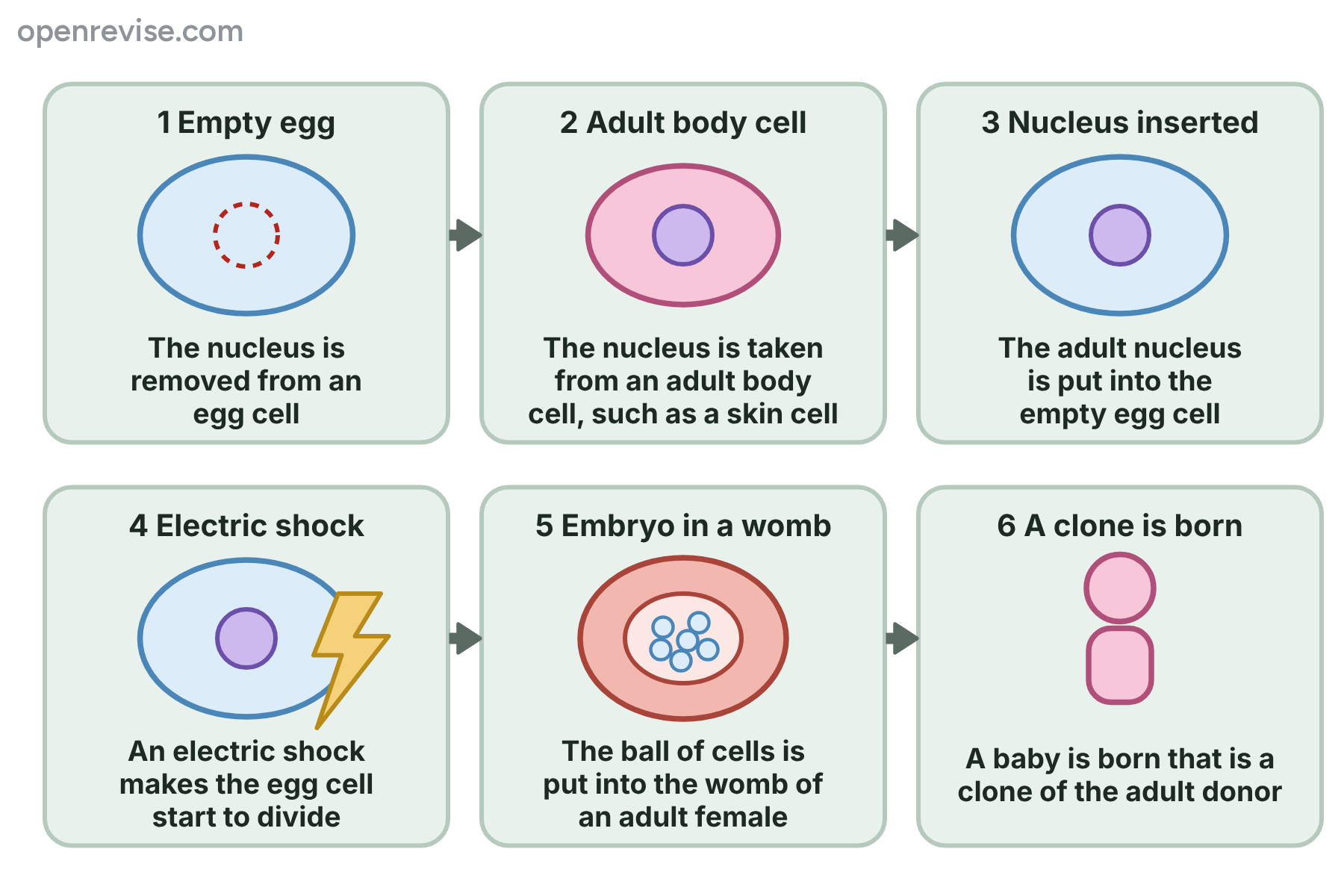
The diagram shows adult cell cloning. Describe the process.
Show answerHide answer
Model answer
The nucleus is removed from an unfertilised egg cell. The nucleus from an adult body cell, such as a skin cell, is inserted into the egg cell. An electric shock stimulates the egg cell to divide to form an embryo. When the embryo is a ball of cells, it is inserted into the womb of an adult female. The embryo develops into an animal that has the same genetic information as the adult donor.
Mark scheme
- Nucleus removed from an unfertilised egg — 1 mark
- Nucleus from adult body cell inserted — 1 mark
- Electric shock stimulates division — 1 mark
- Embryo inserted into the womb of an adult female — 1 mark
- Offspring has the same genetic information as the donor — 1 mark
-
3 Explain [3 marks]
Explain why Dolly the sheep looked like the Finn Dorset ewe that gave the nucleus, and not like the Scottish Blackface ewe that gave the egg cell.
Show answerHide answer
Model answer
The nucleus contains the genetic information, which was taken from the Finn Dorset ewe. The nucleus was removed from the Blackface egg cell, so it did not contribute any genes. Dolly's characteristics were controlled by the genes from the Finn Dorset nucleus.
Mark scheme
- The nucleus contains the genetic information — 1 mark
- The nucleus of the Blackface egg was removed — 1 mark
- Dolly's genes came from the Finn Dorset nucleus — 1 mark
-
4 Explain [4 marks]
Explain why the cells of an embryo have to be split apart before they have become specialised in an embryo transplant.
Show answerHide answer
Model answer
Before they are specialised, the cells are all alike and any one can develop into a complete animal. If they are left until after they have become specialised, they can only develop into particular types of cell and cannot form a whole animal. So the cells must be separated early to give several identical embryos.
Mark scheme
- Early cells are not specialised — 1 mark
- Any one can develop into a whole animal — 1 mark
- Specialised cells can only form certain cell types — 1 mark
- So it has to be early to give several identical embryos — 1 mark
-
5 Explain [3 marks]
A farmer clones the cow with the highest milk yield. Explain one benefit and one risk.
Show answerHide answer
Model answer
Benefit: the clones are genetically identical to the high-yielding cow, so they should all give a high milk yield. Risk: the clones have no genetic variation, so a new disease could affect the whole herd.
Mark scheme
- Benefit: all clones should have a high yield — 1 mark
- Risk: no genetic variation — 1 mark
- Developed: a disease could affect them all — 1 mark
-
6 Evaluate [6 marks]
Some scientists want to use adult cell cloning to produce large numbers of cattle that all give a very high milk yield. Evaluate this proposal.
Show answerHide answer
Model answer
Adult cell cloning produces cattle that are genetically identical to the best cow, so the herd would all give high milk yields, and the farmer would earn more. However, the success rate is low, many attempts fail, and so it is expensive. The cloned animals can have health problems, which raises welfare issues. Because the clones have no genetic variation, a single new disease could affect the whole herd. Some people also object to cloning animals on ethical grounds. Overall, the risks and cost may outweigh the benefit, unless the success rate improves and the health of the animals can be guaranteed.
Mark scheme
- Clones would all give a high yield — 1 mark
- Low success rate and expensive — 1 mark
- Health or welfare problems — 1 mark
- No genetic variation so one disease affects the whole herd — 1 mark
- Ethical objections — 1 mark
- A reasoned conclusion — 1 mark
Quick check
-
1
What is removed from the egg cell in adult cell cloning?
Show answerHide answer
A: The nucleus
The nucleus is removed so the egg has no genetic material of its own.
-
2
Which cell supplies the nucleus in adult cell cloning?
Show answerHide answer
C: An adult body cell
The nucleus comes from an adult body cell, such as a skin cell.
-
3
What makes the egg cell start to divide?
Show answerHide answer
B: An electric shock
An electric shock stimulates the egg cell to divide to form an embryo.
-
4
Where is the ball of cells placed to continue its development?
Show answerHide answer
D: The womb of an adult female
It is inserted into the womb of an adult female.
-
5
When are the cells split apart in an embryo transplant?
Show answerHide answer
A: Before they have become specialised
They are split apart before they become specialised.
-
6
Which was the first mammal cloned from an adult body cell?
Show answerHide answer
C: Dolly the sheep
Dolly the sheep was born in 1996.
-
7
Which is a risk of cloning animals?
Show answerHide answer
B: The success rate is low
The success rate is low and clones may have health problems.
-
8
How does the genetic information of a clone from adult cell cloning compare with the donor?
Show answerHide answer
D: It is the same
The embryo cells contain the same genetic information as the adult body cell.