Flashcards · Biology · Variation and Evolution
Cloning Animals
-
What is an embryo transplant?
Splitting cells apart from an early embryo and putting the identical embryos into host mothers.
-
When are the cells of an embryo split apart in embryo transplants?
Before they become specialised.
-
Are animals from an embryo transplant clones of their parents?
No. They are identical to each other, but made by sexual reproduction.
-
What is removed from the egg cell in adult cell cloning?
The nucleus.
-
Where does the new nucleus come from in adult cell cloning?
An adult body cell, such as a skin cell.
-
What starts the egg cell dividing in adult cell cloning?
An electric shock.
-
What happens to the embryo in adult cell cloning?
It is put into the womb of an adult female.
-
How does the clone compare with the adult donor?
It has the same genetic information.
-
Which animal was the first mammal cloned from an adult cell?
Dolly the sheep.
-
Why was Dolly a clone of the Finn Dorset ewe?
Her nucleus came from that ewe's cell.
-
Give one benefit of cloning animals.
Large numbers of animals with high yield or disease resistance.
-
Give one risk of cloning animals.
Low success rate and possible health problems.
-
Give one ethical objection to cloning animals.
Some people believe it is wrong or causes suffering, or fear it could lead to human cloning.
-
Why do clones have no variation?
They have the same alleles.
-
Why use an unfertilised egg?
It can be given a new nucleus and start to divide.
-
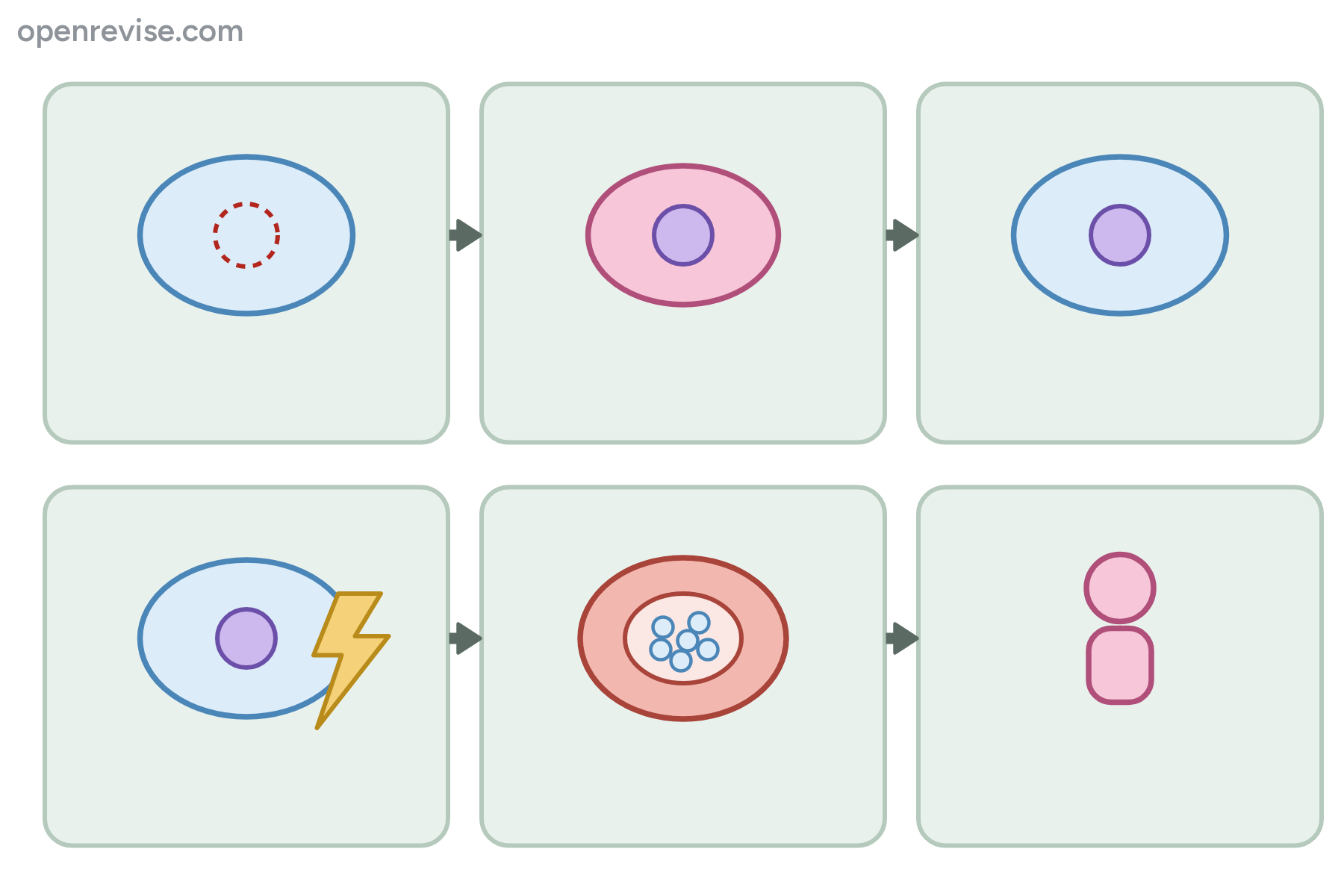 Put the stages of adult cell cloning in order, from the egg cell to the birth of the clone. (Biology only)
 1 The nucleus is removed from an unfertilised egg. 2 A nucleus is taken from an adult body cell. 3 It is inserted into the egg. 4 An electric shock makes the egg divide. 5 The embryo is put in the womb of an adult female. 6 A clone of the adult donor is born.