Biology · Variation and Evolution
Cloning Animals
This lesson is for separate Biology only: Combined Science students do not need it. It covers embryo transplants and adult cell cloning, Dolly the sheep, and the benefits, risks and ethical objections to cloning animals.
Learning Objectives
- 1Describe embryo transplants and adult cell cloning as methods of producing identical animals.
- 2Describe the steps of adult cell cloning in the correct order.
- 3Explain the potential benefits and risks of cloning in agriculture and in medicine.
- 4Explain why some people have ethical objections to cloning.
Retrieval practice
-
1
What is a clone?
Show answerHide answer
An organism that is genetically identical to its parent.
-
2
Where is the genetic material in an animal cell?
Show answerHide answer
In the nucleus.
-
3
What happens in fertilisation?
Show answerHide answer
A male gamete fuses with a female gamete.
-
4
What are specialised cells?
Show answerHide answer
Cells that are adapted to do a particular job.
Cloning in animals
Animals do not reproduce asexually, so cloning them is much harder than cloning plants. Scientists have developed two main methods. In one the cells of a very young embryo are split apart. In the other, a nucleus from an adult body cell is put into an egg cell. Both produce animals that are genetically identical to each other or to the donor.
Embryo transplants
Embryo transplants split a developing embryo so that one fertilised egg gives several identical animals.
-
Fertilisation
A female with the desired characteristics is mated with a male with the desired characteristics, or her eggs are fertilised outside her body.
-
Splitting the embryo
Cells are split apart from the developing animal embryo before they become specialised, when any cell could still develop into a complete animal.
-
Transplant
The identical embryos are transplanted into host mothers, where they develop.
-
The result
Several animals are born that are genetically identical to each other, but they are not clones of either parent, because they come from sexual reproduction.
Adult cell cloning
Adult cell cloning produces an animal that is genetically identical to the adult from which the cell was taken.
-
Remove the nucleus
The nucleus is removed from an unfertilised egg cell, so the egg has no genetic material of its own.
-
Insert an adult nucleus
The nucleus from an adult body cell, such as a skin cell, is inserted into the egg cell.
-
Electric shock
An electric shock stimulates the egg cell to divide to form an embryo. These embryo cells contain the same genetic information as the adult skin cell.
-
Implant the embryo
When the embryo has developed into a ball of cells, it is inserted into the womb of an adult female to continue its development.
Adult cell cloning
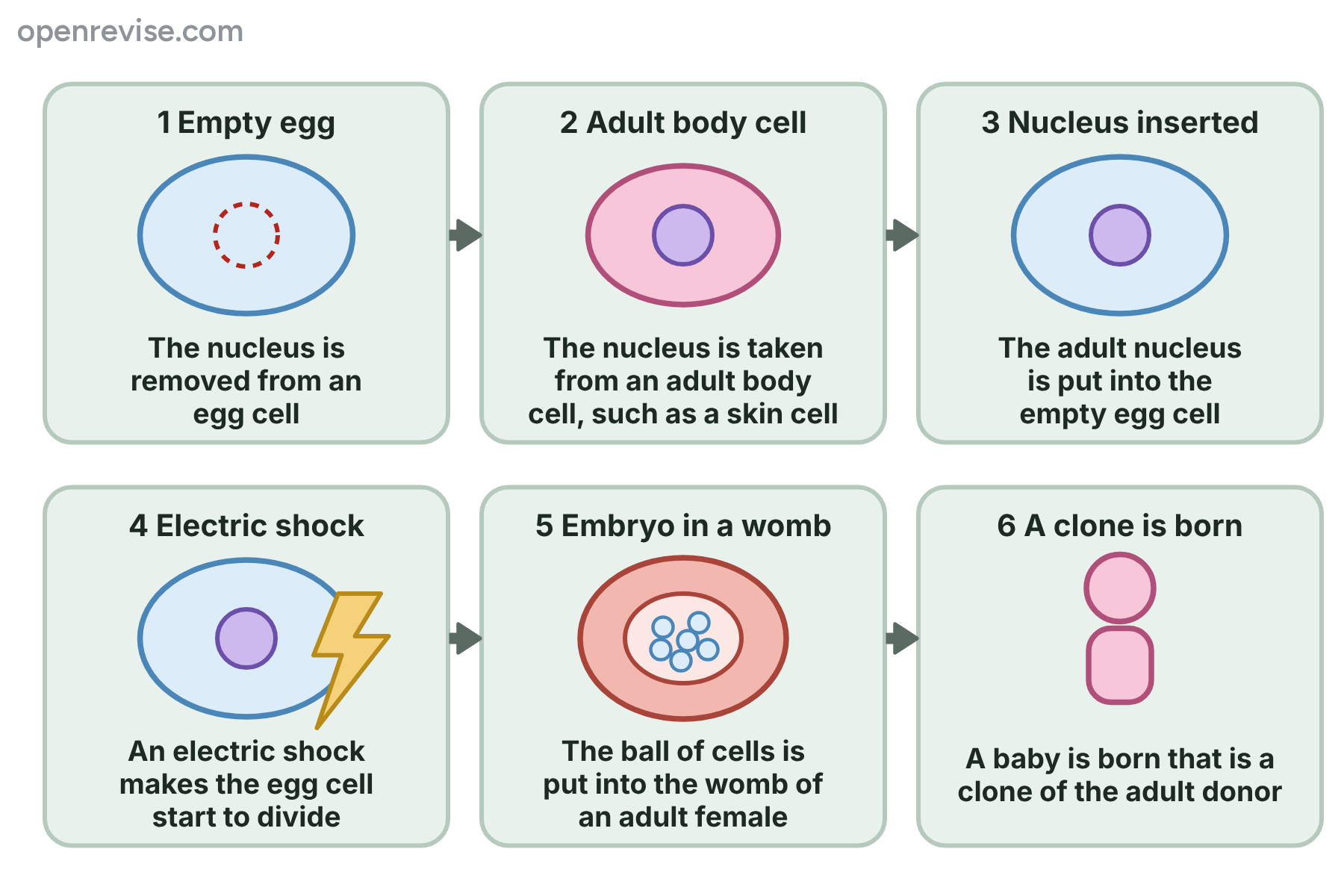
The clone has the same genes as the adult whose cell nucleus was used.
Case study
Dolly the sheep
In 1996 scientists in Scotland produced Dolly, the first mammal cloned from an adult body cell. The nucleus came from a cell from the udder of a six-year-old Finn Dorset ewe, and was put into the egg cell of a Scottish Blackface ewe from which the nucleus had been removed. Dolly was born after 277 attempts, and she looked like the Finn Dorset ewe. Dolly was put down in 2003 aged 6, after developing lung disease and arthritis, which is why many people ask whether clones age faster.
Embryo transplants and adult cell cloning
Embryo transplants
- Cells of an early embryo are split apart
- The embryos come from sexual reproduction
- Several animals identical to each other
- Not a clone of either parent
Adult cell cloning
- A nucleus from an adult body cell is used
- An egg with its nucleus removed
- An animal identical to the adult donor
- Needs an electric shock to start division
Benefits and risks of cloning animals
Scientists, farmers and the public weigh up the benefits and risks of cloning.
-
Agriculture
Cloning could be used to produce large numbers of farm animals with high milk yield or disease resistance, which gives uniform, high-quality products.
-
Medicine
Animals that make useful human proteins can be cloned in numbers, and the idea of cloning stem cells to grow replacement tissues is being explored.
-
Risks
The success rate is low, many embryos fail, and cloned animals may have health problems or age more quickly. Clones have no genetic variation, so a disease could affect them all.
-
Ethical objections
Some people feel that cloning animals is wrong, causes suffering, or is a step towards cloning humans, which many people strongly oppose.
The big idea
Cloning an animal gives offspring that are genetically identical to each other, or to the adult whose cell nucleus was used, but the methods are inefficient and raise ethical objections.
Cloning animals
Cloning animals
-
Embryo transplants
- split early embryo
- identical embryos
- host mothers
-
Adult cell cloning
- remove egg nucleus
- insert adult nucleus
- electric shock
- womb
-
Dolly
- first mammal cloned from an adult cell
- 277 attempts
-
Benefits
- high-yield animals
- useful proteins
-
Risks
- low success
- health problems
- no variation
-
Ethics
- some people object
Summary and exam focus
- Embryo transplants split apart cells from a developing embryo before they become specialised, and the identical embryos are transplanted into host mothers.
- In adult cell cloning, the nucleus is removed from an unfertilised egg and replaced with the nucleus from an adult body cell.
- An electric shock makes the egg cell divide to form an embryo, which is inserted into the womb of an adult female.
- The embryo cells contain the same genetic information as the adult skin cell, so the offspring is a clone.
- Cloning has potential benefits and risks, and some people have ethical objections.
Exam focus
Describe how adult cell cloning can be used to produce a sheep that is genetically identical to an adult sheep with high-quality wool. (5 marks) (5 marks)
Number the stages and keep them in order. Say the nucleus is removed from an unfertilised egg, a nucleus from a body cell of the adult sheep is inserted, an electric shock makes the egg divide, and the embryo is put in the womb of an adult female. Name the donor, and say the lamb has the same genes.
Key terms
The words this lesson expects you to use. Each one is linked from the first place it appears above.
- Cloning
- Producing genetically identical copies of an organism.
- Embryo transplant
- Splitting an early embryo into identical embryos and transplanting them into host mothers.
- Adult cell cloning
- Producing a clone by putting the nucleus of an adult body cell into an egg cell with its nucleus removed.
- Host mother
- A female animal into whose womb an embryo is placed to develop.
- Unfertilised egg
- An egg cell that has not been joined by a sperm cell.
- Specialised
- Adapted to do a particular job.
- Donor
- The adult animal that provides the nucleus for cloning.
- Embryo
- A ball of cells in the early stage of development.
You've finished the notes
Check your understanding
Test yourself while it is fresh. Start with the flashcards, then try the exam questions.
Something here looks wrong?
Tell us what and we will go and look. It goes to whoever writes these pages, nobody else, and we do not ask who you are — so there is nothing to sign and nothing comes back to you.