Exam questions · Biology · Variation and Evolution
Cloning Plants
- 7 exam questions
- 23 marks
- 8 quick checks
-
1 State [1 mark]
What is a clone?
Show answerHide answer
Model answer
An organism that is genetically identical to its parent.
Mark scheme
- Genetically identical organism — 1 mark
-
2 Describe [3 marks]
Describe how a gardener could use cuttings to produce new plants identical to a parent plant.
Show answerHide answer
Model answer
The gardener cuts a piece of stem from the parent plant and removes the lower leaves. The cutting is dipped in rooting powder and planted in compost. It grows roots and develops into a new plant that is identical to the parent.
Mark scheme
- Cut a piece of stem from the parent — 1 mark
- Plant it (in compost), perhaps after dipping in rooting powder — 1 mark
- It grows into a new identical plant — 1 mark
-
3 Describe [4 marks]
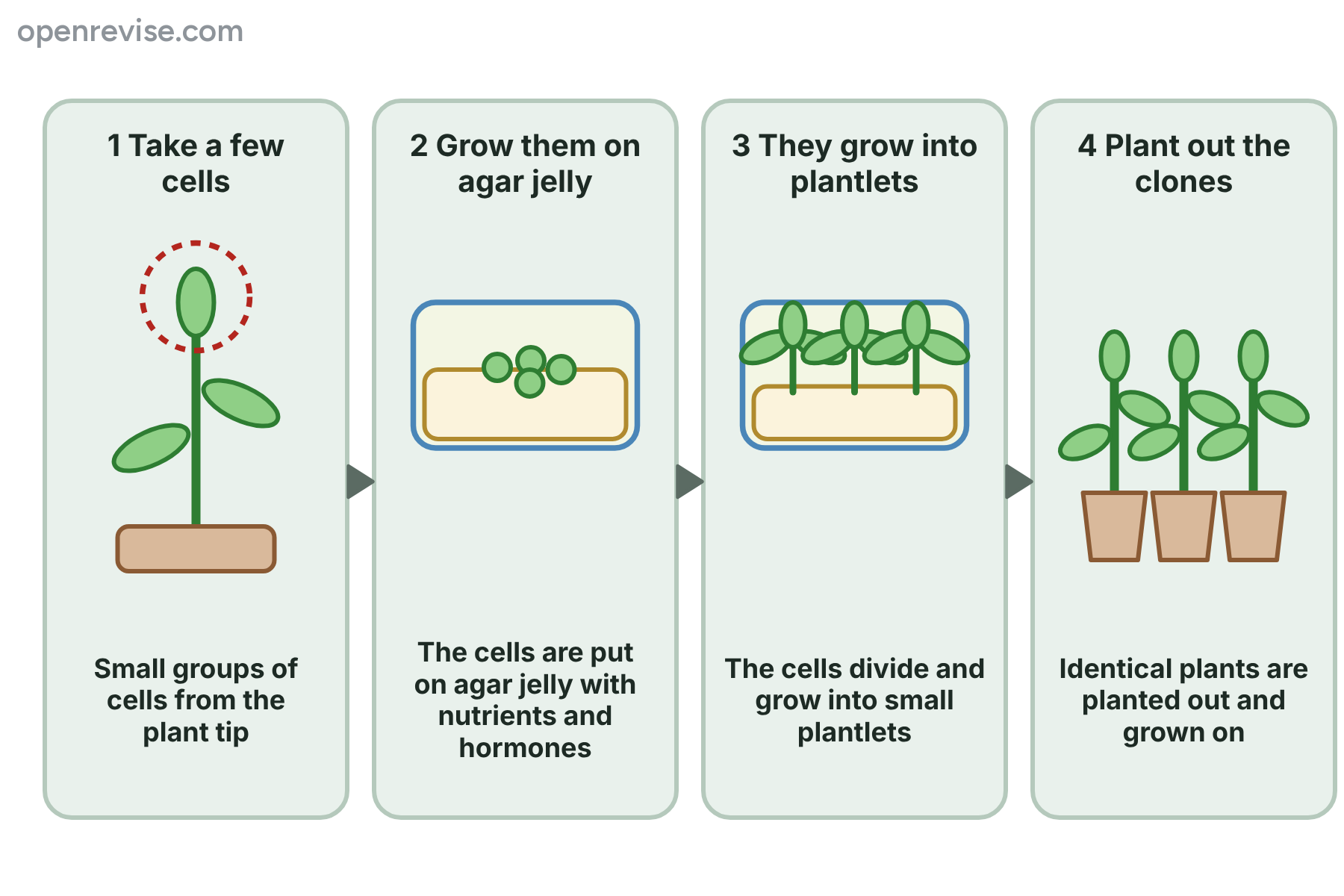
The diagram shows tissue culture. Describe the steps that are used to produce new plants.
Show answerHide answer
Model answer
Small groups of cells are taken from the tip of the plant. They are put on agar jelly which contains nutrients and hormones. The cells divide and grow into small plantlets. The plantlets are planted out and grown on into identical plants.
Mark scheme
- Small groups of cells taken from the plant — 1 mark
- Placed on agar jelly with nutrients and hormones — 1 mark
- They grow into small plantlets — 1 mark
- Planted out to grow into identical plants — 1 mark
-
4 Explain [3 marks]
Explain why tissue culture is useful for preserving a rare species of plant.
Show answerHide answer
Model answer
Many new plants can be grown from a tiny piece of tissue, so very few plants need to be taken from the wild. This does not damage the wild population. The new plants can be grown on and replanted to increase the numbers.
Mark scheme
- Many plants from a tiny piece of tissue — 1 mark
- Wild population is not damaged — 1 mark
- Numbers can be increased by planting out — 1 mark
-
5 Calculate [3 marks]
A nursery produces 600 plantlets by tissue culture. 8% of them die before being planted out. Calculate the number of plants that are planted out.
Show answerHide answer
Model answer
552 plants. \(\frac{8}{100} \times 600 = 48\) die, and \(600 - 48 = 552\).
Mark scheme
- \(\frac{8}{100} \times 600\) — 1 mark
- 48 die — 1 mark
- 552 — 1 mark
-
6 Explain [3 marks]
A grower uses cuttings from one tomato plant to produce a whole crop. Explain the risk of growing a crop in which all of the plants are clones.
Show answerHide answer
Model answer
The plants are genetically identical, so they have no variation. If a new disease arrives, or the climate changes, all the plants may be affected in the same way because none have a different allele that helps them survive. The whole crop could be lost.
Mark scheme
- Clones are genetically identical (no variation) — 1 mark
- A disease or change in conditions could affect them all — 1 mark
- The whole crop could be lost — 1 mark
-
7 Evaluate [6 marks]
A nursery wants to produce 10 000 identical plants of a variety that has large red flowers. Evaluate the use of tissue culture rather than cuttings.
Show answerHide answer
Model answer
Tissue culture can produce thousands of plants from a small amount of tissue, and so a nursery can make 10 000 identical plants quickly, in a small space and at any time of year. Cuttings give far fewer plants from each parent, so many parent plants would be needed. Tissue culture needs a laboratory, sterile conditions and trained staff, so it costs more. The plants from both methods are clones, so they will all have large red flowers, but the lack of variation means a disease could affect all of them. Overall, tissue culture is the better choice for such a large number of plants.
Mark scheme
- Many plants from a small piece of tissue — 1 mark
- Quick, small space, all year round — 1 mark
- Cuttings give fewer plants, so more parent plants are needed — 1 mark
- Tissue culture is more costly or needs a sterile laboratory — 1 mark
- Both methods give clones, so no variation and risk from disease — 1 mark
- A reasoned conclusion — 1 mark
Quick check
-
1
How are plants produced in tissue culture genetically?
Show answerHide answer
D: Identical to the parent
They are produced by mitosis from the parent's cells, so they are genetically identical clones.
-
2
What do the cells grow on in tissue culture?
Show answerHide answer
B: Agar jelly with nutrients
The cells grow on sterile agar jelly containing nutrients and hormones.
-
3
Why is tissue culture important for rare plants?
Show answerHide answer
A: Many plants can be grown without damaging the wild population
It allows many plants to be grown from a small piece of tissue, without damaging the wild population.
-
4
What is a cutting?
Show answerHide answer
C: A piece of a plant that grows into a new plant
A cutting is a piece cut from a plant that grows into a new plant identical to the parent.
-
5
Which statement about cloned plants is correct?
Show answerHide answer
B: They have no genetic variation
Cloned plants have the same genes, so there is no genetic variation between them.
-
6
Why is tissue culture done in sterile conditions?
Show answerHide answer
D: To stop microorganisms damaging the cells
To stop microorganisms growing on the jelly and killing the plant cells.
-
7
What is a risk of growing a crop of clones?
Show answerHide answer
C: One disease could affect all the plants
With no variation, a new disease could affect all of the plants.
-
8
Which method needs more equipment and sterile conditions?
Show answerHide answer
A: Tissue culture
Tissue culture needs a laboratory, whereas cuttings can be done by gardeners at home.