Biology · Variation and Evolution
Cloning Plants
This lesson is for separate Biology only: Combined Science students do not need it. It covers tissue culture and cuttings as ways of cloning plants, and the benefits and risks of cloning in agriculture.
Learning Objectives
- 1Describe tissue culture and cuttings as methods of producing identical new plants.
- 2Explain why tissue culture is important for preserving rare plant species and commercially in nurseries.
- 3Compare tissue culture with cuttings.
- 4Explain the potential benefits and risks of cloning in agriculture, and that some people have objections.
Retrieval practice
-
1
What is asexual reproduction?
Show answerHide answer
Reproduction with one parent, no fusion of gametes, which produces genetically identical offspring.
-
2
Which cell division makes identical cells?
Show answerHide answer
Mitosis.
-
3
What is a clone?
Show answerHide answer
An organism that is genetically identical to its parent.
-
4
What is meant by genetic variation?
Show answerHide answer
Differences in the genes of individuals in a population.
Making copies of a plant
A farmer who has a variety of fruit tree with exactly the right flavour and resistance cannot rely on seeds, because sexual reproduction mixes genes and the seedlings will all be different. To keep the variety, growers make copies of it. This is cloning. The new plants are genetically identical to the parent plant because they are produced by mitosis, with no fusion of gametes.
Cuttings
Cuttings are an older, but simple, method used by gardeners to produce many identical new plants from a parent plant.
-
The method
A piece of the stem is cut from the parent plant, the lower leaves are removed, and it is planted in compost, often after being dipped in rooting powder.
-
Rooting powder
The powder contains plant hormones that help roots to grow from the cut stem.
-
The result
The cutting grows into a new plant. It is a clone, because it contains the same genes as the parent.
-
Advantages
It is cheap, simple and needs no special equipment, so gardeners can do it at home.
Tissue culture
Tissue culture uses small groups of cells from part of a plant to grow identical new plants.
-
The method
Small groups of cells are taken from the tip of the plant and placed on a sterile agar jelly that contains nutrients and plant hormones.
-
Growth
The cells divide by mitosis and grow into small plantlets, which are then planted out and grown on.
-
Sterile conditions
The equipment and the agar are sterilised so that microorganisms do not grow on the jelly and kill the cells.
-
Advantages
Thousands of plants can be made from a tiny piece of tissue, in a small space, all year round, and they can be grown free of disease.
Tissue culture
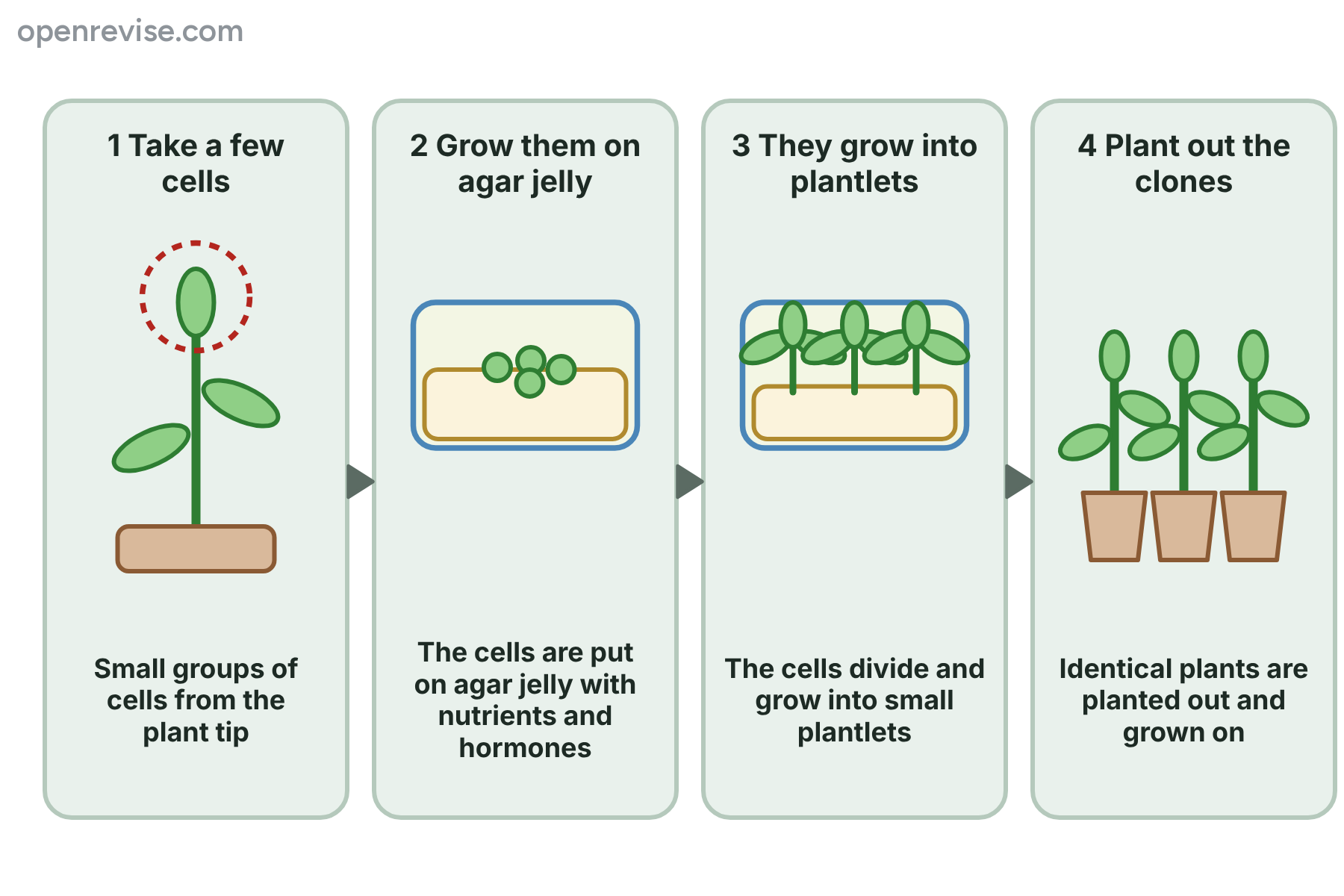
Every plantlet is genetically identical to the parent plant.
Cuttings and tissue culture
Cuttings
- A piece of stem planted in compost
- Cheap and simple, done by gardeners
- A few new plants from each parent
- No sterile conditions needed
Tissue culture
- A few cells grown on agar jelly
- Needs sterile conditions and equipment
- Thousands of plants from a tiny piece
- Used to preserve rare species and commercially
Why cloning plants is useful
Cloning has two main uses, in conservation and in agriculture and gardening.
-
Preserving rare species
Tissue culture is important for preserving rare plant species, because plants can be grown from a tiny piece of tissue without damaging the wild population.
-
Commercial use in nurseries
Nurseries use tissue culture to produce thousands of identical plants with desirable features, such as a particular flower colour or disease resistance.
-
Keeping a good characteristic
Cloning keeps a variety with the desired characteristic, whereas seeds produced by sexual reproduction would give variation.
-
Fast
Large numbers of plants can be produced quickly, as new plants do not need to wait for seeds.
Benefits and risks of cloning in agriculture
Because the clones are identical, there are risks as well as benefits.
-
Benefits
Plants with high yield, good taste or disease resistance can be produced in large numbers, so crops are uniform and predictable.
-
Reduced variation
The clones have no variation, as they have the same alleles. If a new disease or a change in the climate affects one plant it could affect all of them.
-
Cost
Tissue culture needs a laboratory, trained staff and sterile conditions, so it is more expensive than seeds.
-
Objections
Some people object to cloning in agriculture, for example because it reduces biodiversity or because they believe in more natural methods.
Scaling up a tissue culture business
A nursery takes 5 small groups of cells from one parent plant. Each group grows into 40 plantlets in the first stage, and 15% of the plantlets then die before they can be planted out. Calculate how many plants can be planted out.
Show the solutionHide the solution
- 1 Total plantlets \(5 \times 40 = 200\)
- 2 Number that die \(\frac{15}{100} \times 200 = 30\)
- 3 Plants that survive \(200 - 30 = 170\)
Answer170 plants
The big idea
Plant clones are made by mitosis, so every new plant is genetically identical to its parent, which keeps a good characteristic but removes variation.
Cloning plants
Cloning plants
-
Cuttings
- piece of stem
- compost
- rooting powder
- cheap and simple
-
Tissue culture
- small group of cells
- sterile agar jelly
- thousands of plants
-
Uses
- rare species
- nurseries
- keep a good variety
-
Benefits
- identical
- predictable plants
-
Risks
- no variation
- whole crop at risk from disease
-
Objections
- some people object
Summary and exam focus
- Tissue culture uses small groups of cells from part of a plant to grow identical new plants.
- It is important for preserving rare plant species and commercially in nurseries.
- Cuttings are an older but simple method used by gardeners to produce many identical new plants from a parent plant.
- Cloned plants are genetically identical, so they have no variation.
- The benefits of cloning in agriculture must be weighed against the risks, and some people have objections.
Exam focus
Explain why a nursery uses tissue culture rather than seeds to produce a large number of plants with the same flower colour, and give one risk of producing plants in this way. (4 marks) (4 marks)
Link each claim to cloning: tissue culture gives plants that are genetically identical to the parent, so they all have the same flower colour, whereas seeds from sexual reproduction would vary. For the risk, say that clones have no variation so they could all be affected by the same disease.
Key terms
The words this lesson expects you to use. Each one is linked from the first place it appears above.
- Cloning
- Producing genetically identical copies of an organism.
- Clone
- An organism that is genetically identical to its parent.
- Tissue culture
- Growing identical new plants from small groups of cells on agar jelly.
- Cutting
- A piece of stem cut from a plant and planted to grow into a new plant identical to the parent.
- Agar jelly
- A sterile jelly containing nutrients, used to grow cells and microorganisms.
- Plantlet
- A very small young plant grown in tissue culture.
- Rooting powder
- A powder containing plant hormones that helps cuttings to grow roots.
- Aseptic
- Free from microorganisms.
You've finished the notes
Check your understanding
Test yourself while it is fresh. Start with the flashcards, then try the exam questions.
Something here looks wrong?
Tell us what and we will go and look. It goes to whoever writes these pages, nobody else, and we do not ask who you are — so there is nothing to sign and nothing comes back to you.