Flashcards · Biology · Variation and Evolution
Cloning Plants
-
What is cloning?
Producing genetically identical copies of an organism.
-
Why are cloned plants genetically identical?
They are made by mitosis, with no fusion of gametes.
-
What is tissue culture?
Using small groups of cells from part of a plant to grow identical new plants.
-
Where are the cells for tissue culture taken from?
The tip of a plant.
-
What do the cells grow on in tissue culture?
Sterile agar jelly containing nutrients and hormones.
-
Why must conditions be sterile in tissue culture?
To stop microorganisms growing on the agar and killing the cells.
-
What are cuttings?
Pieces of stem used by gardeners to grow many identical new plants.
-
Why is rooting powder used on cuttings?
It contains hormones that help roots to grow.
-
Why is tissue culture important for rare plants?
It preserves species by growing many plants from a tiny piece of tissue.
-
Why do nurseries use tissue culture?
To produce thousands of identical plants commercially.
-
Give one advantage of cloning in agriculture.
The plants have the same desirable characteristics.
-
Give one risk of cloning in agriculture.
No variation, so a disease could affect all the plants.
-
Which is cheaper, cuttings or tissue culture?
Cuttings.
-
Do clones have genetic variation?
No. They have the same genes.
-
Can seeds be used to produce clones?
No, because seeds come from sexual reproduction, so they vary.
-
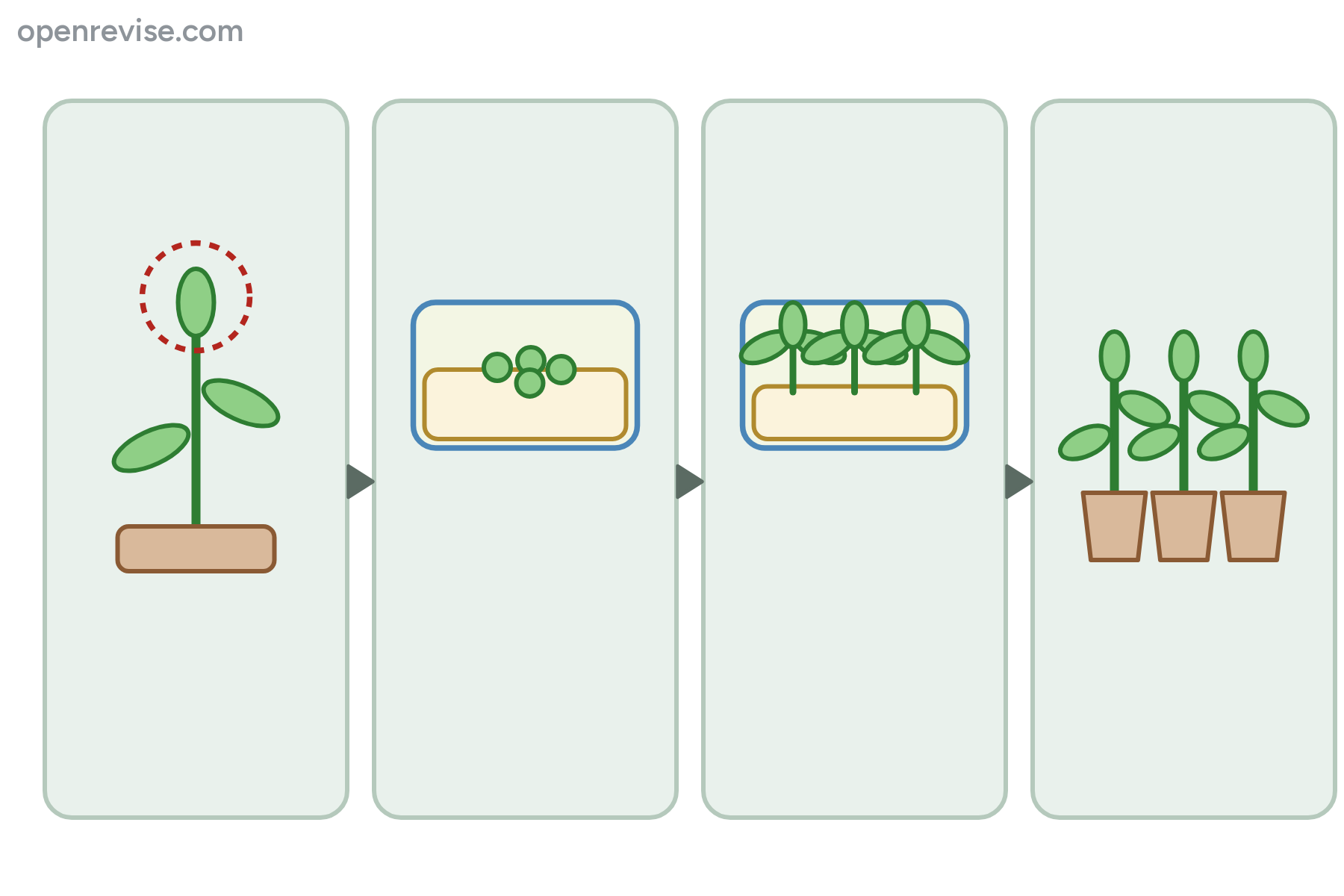 Describe how tissue culture can be used to produce hundreds of identical plants from one parent. (Biology only)
 Take small groups of cells from the plant tip. Put them on sterile agar jelly with nutrients and hormones. The cells divide into plantlets, which are then planted out and grown. All the plants are genetically identical to the parent.