Exam questions · Biology · Variation and Evolution
Evolution and Natural Selection
- 7 exam questions
- 22 marks
- 8 quick checks
-
1 State [1 mark]
What is meant by evolution?
Show answerHide answer
Model answer
A change in the inherited characteristics of a population over time, through natural selection.
Mark scheme
- A change in the inherited characteristics of a population over time — 1 mark
-
2 Explain [2 marks]
Explain why mutations are important in evolution.
Show answerHide answer
Model answer
Mutations produce new alleles, which give variation in the population. Natural selection can then act on this variation, so beneficial alleles may become more common.
Mark scheme
- Mutations produce new alleles (variation) — 1 mark
- Selection acts on the variation — 1 mark
-
3 Explain [4 marks]
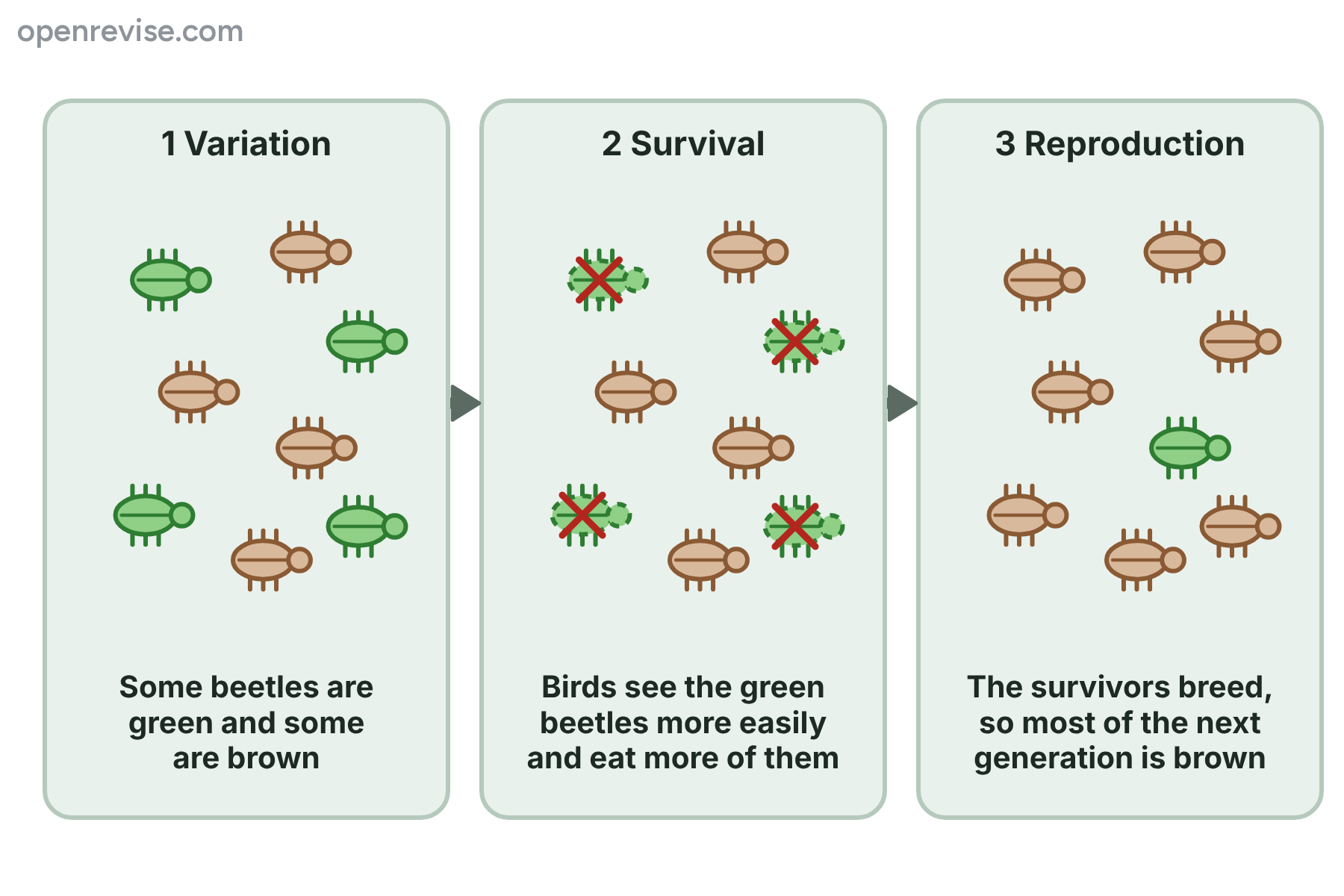
The diagram shows how the colour of a population of beetles changed. Use the theory of natural selection to explain the change.
Show answerHide answer
Model answer
There is variation in the colour of the beetles. The green beetles are easier for birds to see, so more of them are eaten and fewer survive to breed. The brown beetles are more likely to survive and breed, so they pass on the allele for brown to the next generation. Over time the allele for brown becomes more common.
Mark scheme
- There is variation in colour — 1 mark
- Green beetles are more likely to be eaten (predation) — 1 mark
- Brown beetles survive and breed — 1 mark
- The allele for brown is passed on, so it becomes more common — 1 mark
-
4 Calculate [3 marks]
A population of 600 beetles includes 240 green beetles. After many generations the population is the same size but only 12% of the beetles are green. Calculate the change in the number of green beetles.
Show answerHide answer
Model answer
At the end there are \(\frac{12}{100} \times 600 = 72\) green beetles. The change is \(240 - 72 = 168\), a fall of 168 green beetles.
Mark scheme
- \(\frac{12}{100} \times 600\) — 1 mark
- 72 green beetles — 1 mark
- A decrease of 168 — 1 mark
-
5 Explain [3 marks]
A student writes, "The peppered moths became dark because they needed to be camouflaged on the dark trees." Explain why this is not a correct use of the theory of natural selection.
Show answerHide answer
Model answer
Moths did not change colour because they needed to. Mutations produced dark moths by chance, so there was variation. When the trees became dark, dark moths were better camouflaged, so more survived and bred and passed on the allele for dark colour.
Mark scheme
- Mutations are random, so the moths did not change because they needed to — 1 mark
- Dark moths were already present, as variation — 1 mark
- Dark moths survived and bred, passing on their alleles — 1 mark
-
6 Explain [4 marks]
Explain how a new species of finch could form on an island that is separated from the mainland where the original species lives.
Show answerHide answer
Model answer
The island population is isolated from the mainland population, so the two do not interbreed. The island has a different environment, so different phenotypes are selected for. Over many generations mutations and natural selection make the two populations more and more different. If they become so different that they cannot interbreed to produce fertile offspring, they are two new species.
Mark scheme
- The two populations are separated and do not interbreed — 1 mark
- Different environments select different phenotypes — 1 mark
- The populations become more different over many generations — 1 mark
- They can no longer interbreed to produce fertile offspring — 1 mark
-
7 Explain [5 marks]
Rabbits in a snowy region show variation in fur colour. Explain, using the theory of evolution by natural selection, why after many generations most of the rabbits have white fur.
Show answerHide answer
Model answer
There is variation in the fur colour of the rabbits, due to different alleles that arose from mutations. White rabbits are better camouflaged on the snow, so predators find them less easily. White rabbits are more likely to survive and breed. They pass on the allele for white fur to their offspring. Over many generations the allele for white fur becomes more common.
Mark scheme
- Variation in fur colour, caused by mutations — 1 mark
- White rabbits are better camouflaged — 1 mark
- White rabbits are more likely to survive and breed — 1 mark
- They pass on the allele for white fur — 1 mark
- The allele becomes more common over many generations — 1 mark
Quick check
-
1
What is evolution?
Show answerHide answer
C: A change in the inherited characteristics of a population over time
Evolution is a change in the inherited characteristics of a population over time, through natural selection.
-
2
Which individuals are most likely to pass on their alleles?
Show answerHide answer
B: Those best suited to the environment
Individuals best suited to the environment are more likely to survive and breed successfully.
-
3
What is the original source of new alleles?
Show answerHide answer
D: Mutation
All new alleles arise from mutations.
-
4
What does a selection pressure do?
Show answerHide answer
A: It affects which individuals survive and breed
A selection pressure, such as a predator or disease, affects which individuals survive and breed.
-
5
Two populations of one species form two new species when they...
Show answerHide answer
C: Can no longer interbreed to produce fertile offspring
Two species cannot interbreed to produce fertile offspring.
-
6
Why did dark peppered moths become common in industrial cities?
Show answerHide answer
B: Dark moths were better camouflaged on dark trees, so survived and bred
Soot darkened the trees, so dark moths were better camouflaged, survived and bred more, and passed on the allele for dark colour.
-
7
Which statement is correct?
Show answerHide answer
D: Populations evolve over many generations
Natural selection acts on populations over many generations, and the individuals do not change.
-
8
How long ago did the first simple life forms develop, according to the theory of evolution?
Show answerHide answer
A: More than three billion years ago
All species have evolved from simple life forms that developed more than three billion years ago.