Biology · Variation and Evolution
Evolution and Natural Selection
How did the huge variety of life on Earth come about? This lesson is for both Combined Science and separate Biology. It explains evolution as a change in the inherited characteristics of a population through natural selection, the steps of natural selection, and how two populations can become different species.
Learning Objectives
- 1Describe evolution as a change in the inherited characteristics of a population over time through natural selection.
- 2Explain how evolution occurs through natural selection of variants that give rise to phenotypes best suited to their environment.
- 3Use the theory of evolution by natural selection to explain a given example.
- 4Explain how two populations can become two new species.
Retrieval practice
-
1
What causes new alleles to appear?
Show answerHide answer
Mutations.
-
2
What is variation?
Show answerHide answer
Differences in the characteristics of individuals in a population.
-
3
What is an allele?
Show answerHide answer
A different form of the same gene.
-
4
What is a species?
Show answerHide answer
A group of organisms that can breed together to produce fertile offspring.
Change in a population over time
The theory of evolution by natural selection states that all of the species of living things alive today have evolved from simple life forms that first developed more than three billion years ago. Evolution does not happen to a single organism during its lifetime. It is a change in the inherited characteristics of a population over many generations. This lesson takes the theory apart, one step at a time.
The steps of natural selection
Use these steps in the exam, with the example you are given.
-
1
Variation
Individuals in a population show a wide range of variation in a characteristic, because of differences in their alleles, caused by mutations.
-
2
A change or a struggle
There is a selection pressure, such as a predator, a disease, competition for food or a change in the environment.
-
3
Survival of the best suited
Individuals with the characteristics best suited to the environment are more likely to survive and breed successfully.
-
4
Passing on alleles
The alleles that gave them an advantage are passed on to their offspring in the next generation.
-
5
A change over time
Over many generations the alleles that help survival become more common, and the population changes.
Natural selection in beetles
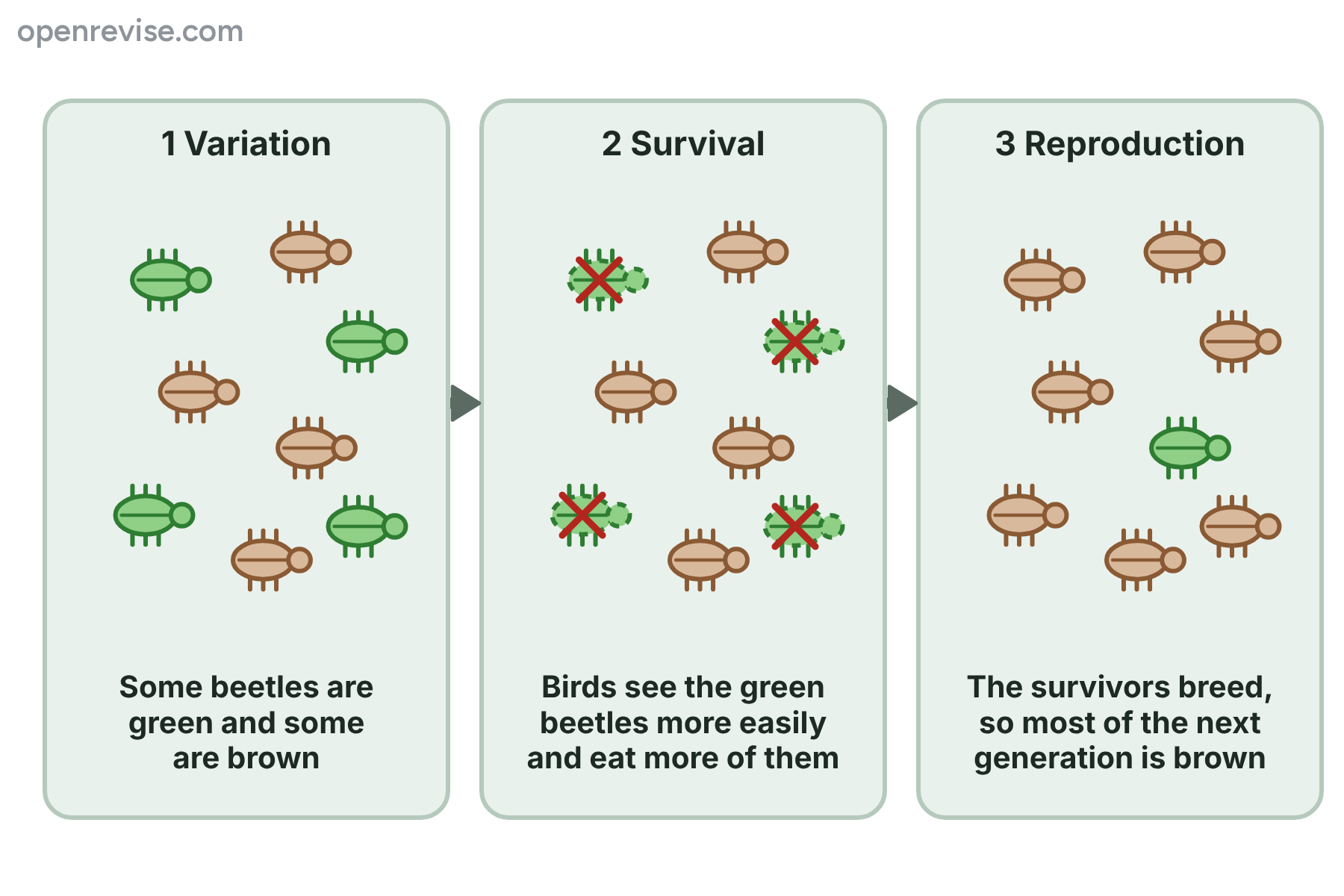
The alleles for the better-camouflaged colour become more common in each generation.
Getting the wording right
Examiners mark the use of the key ideas, so use them exactly.
-
Phenotypes best suited
Natural selection is of variants that give rise to phenotypes best suited to their environment. It is not strength or size that matters but the match to the environment.
-
Survive and breed
An individual must survive to adulthood and reproduce for its alleles to reach the next generation. Surviving without breeding changes nothing.
-
Alleles are passed on
What is inherited is the allele, not the characteristic. Say that the alleles are passed on to the offspring.
-
Populations evolve
Individuals do not change by natural selection in order to become better adapted. Mutations are random, and the environment selects the individuals that happen to have the best-suited variant.
A change in the proportion of green beetles
A population of 200 beetles starts with 50% green beetles. After several generations of predation by birds the population is still 200 beetles, but only 15% are green. Calculate how many green beetles there are at the start and at the end, and explain the change.
Show the solutionHide the solution
- 1 Green beetles at the start \(\frac{50}{100} \times 200 = 100\)
- 2 Green beetles at the end \(\frac{15}{100} \times 200 = 30\)
- 3 Explain the change Green beetles were easier for birds to see, so more were eaten and fewer bred, so the allele for green was passed on less often
AnswerThere are 100 green beetles at the start and 30 at the end. Birds ate more of the green beetles, so fewer of them bred, and the allele for green became less common.
Case study
The peppered moth
Before the industrial revolution, most peppered moths in England were pale and well camouflaged against lichen-covered tree trunks. Soot from factories killed the lichen and blackened the trees, and dark moths, which had been rare, were now better camouflaged and survived better. In Manchester the proportion of dark moths rose from about 2% in 1848 to about 98% in 1895. When the air was cleaned up in the twentieth century, the pale moths became common again.
How new species form
Evolution may result in the formation of a new species.
-
Two populations
If two populations of one species are separated, for example by a mountain range or water, different environments select for different phenotypes.
-
Growing differences
Over many generations the two populations become more and more different, because new mutations occur and different alleles are selected.
-
Can no longer interbreed
If the populations become so different in phenotype that they can no longer interbreed to produce fertile offspring, they have formed two new species.
-
A long process
It takes many generations, so it is usually thousands of years for animals and plants.
Natural selection and selective breeding
Natural selection
- The environment selects
- Individuals best suited survive and breed
- Happens without human choice
- A slow process over many generations
Selective breeding
- Humans choose the parents
- Individuals with the desired characteristic breed
- Aims at a characteristic that humans want
- Can be speeded up by humans
The big idea
Individuals with phenotypes best suited to their environment survive and breed, so their alleles become more common in the next generation.
Evolution by natural selection
Evolution by natural selection
-
Variation
- caused by mutations
- wide range in a population
-
Selection pressure
- predators
- disease
- competition
- environmental change
-
Survival
- best-suited individuals survive and breed
-
Inheritance
- alleles passed to offspring
-
Result
- population changes
- may form a new species
-
New species
- cannot interbreed to give fertile offspring
Summary and exam focus
- Evolution is a change in the inherited characteristics of a population over time through natural selection.
- Individuals with the phenotypes best suited to the environment are more likely to survive and breed successfully.
- The alleles that gave them the advantage are passed on, so they become more common in the population.
- Mutations produce the variation, and the environment selects.
- If two populations become so different that they cannot interbreed to produce fertile offspring, they are two new species.
Exam focus
Rabbits that live in a snowy region show variation in fur colour. Use the theory of evolution by natural selection to explain why, after many generations, most of the rabbits have white fur. (5 marks) (5 marks)
Write the five steps in order and apply each to rabbits: variation in fur colour, predators, survival of white rabbits, passing on the allele, and an increase in the proportion of white rabbits. Use the words survive, breed and allele.
Key terms
The words this lesson expects you to use. Each one is linked from the first place it appears above.
- Evolution
- A change in the inherited characteristics of a population over time, through natural selection.
- Natural selection
- The process in which individuals best suited to their environment survive and breed, passing on their alleles.
- Selection pressure
- A factor in the environment, such as predators or disease, that affects which individuals survive.
- Adaptation
- A feature that helps an organism survive in its environment.
- Species
- A group of organisms that can interbreed to produce fertile offspring.
- Population
- All the organisms of one species living in the same area.
- Camouflage
- Colouring that makes an organism hard for predators to see.
- Allele
- A different form of a gene that can be passed on to offspring.
You've finished the notes
Check your understanding
Test yourself while it is fresh. Start with the flashcards, then try the exam questions.
Something here looks wrong?
Tell us what and we will go and look. It goes to whoever writes these pages, nobody else, and we do not ask who you are — so there is nothing to sign and nothing comes back to you.