Flashcards · Biology · Variation and Evolution
Evolution and Natural Selection
-
What is evolution?
A change in the inherited characteristics of a population over time, through natural selection.
-
How long ago did the first simple life forms develop?
More than three billion years ago.
-
What does natural selection act on?
The variants in a population that give phenotypes best suited to the environment.
-
What happens to the best-suited individuals?
They are more likely to survive and breed successfully.
-
What is passed on to the next generation in natural selection?
The alleles that gave the advantage.
-
What is the source of new alleles?
Mutations.
-
Does natural selection happen to one individual in its lifetime?
No. It changes a population over many generations.
-
What is a selection pressure?
A factor, such as a predator, that affects survival.
-
When have two populations formed two new species?
When they can no longer interbreed to produce fertile offspring.
-
How can isolation lead to a new species?
Different environments select different phenotypes, so the populations grow apart.
-
Why did dark peppered moths become common in industrial areas?
The trees were blackened by soot, so dark moths were better camouflaged and survived to breed.
-
Why did pale peppered moths become common again?
The air was cleaned, the trees became lighter, and pale moths were better camouflaged.
-
Why is saying "the moth changed colour to hide" wrong?
Individuals do not change. Mutations are random and the environment selects.
-
Name two selection pressures.
Predation and disease (or competition for food).
-
What must an individual do for its alleles to be passed on?
Survive and breed.
-
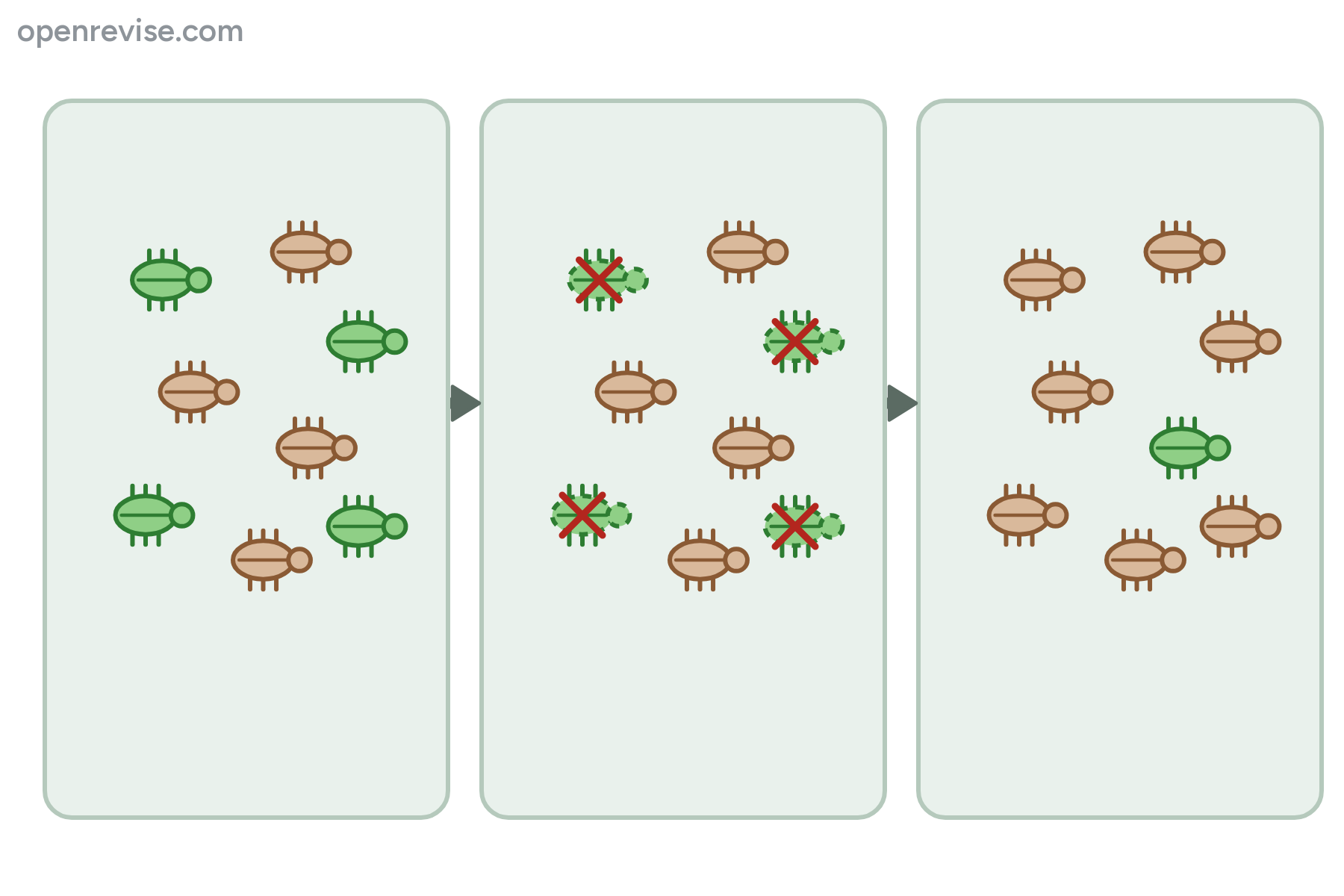 Describe what is happening in each panel, using the words variation, survive, breed and allele. (Beetles on soil, eaten by birds.)
 Panel 1: there is variation in colour. Panel 2: the green beetles are easier to see, so more are eaten and fewer survive. Panel 3: the brown beetles survive and breed and pass on their alleles, so most of the next generation is brown.