Exam questions · Biology · Variation and Evolution
Genetic Engineering
- 8 exam questions
- 25 marks
- 8 quick checks
-
1 State [1 mark]
What is meant by genetic engineering?
Show answerHide answer
Model answer
Modifying the genome of an organism by introducing a gene from another organism to give a desired characteristic.
Mark scheme
- Introducing a gene from one organism into another to give a desired characteristic — 1 mark
-
2 Give [2 marks]
Give two ways in which crop plants have been genetically engineered.
Show answerHide answer
Model answer
Any two of: to be resistant to diseases, to be resistant to insect attack, to be resistant to herbicides, to produce bigger or better fruits.
Mark scheme
- First correct way — 1 mark
- Second correct way — 1 mark
-
3 Describe [2 marks]
Describe how genetic engineering is used in the treatment of diabetes.
Show answerHide answer
Model answer
Bacterial cells are genetically engineered with the human insulin gene, so they make human insulin. The insulin is harvested and used to treat people with diabetes.
Mark scheme
- Bacteria are genetically engineered to make human insulin — 1 mark
- The insulin is used to treat diabetes — 1 mark
-
4 Explain [4 marks]
Some people are in favour of growing GM crops and some are against. Explain one reason in favour and one reason against.
Show answerHide answer
Model answer
In favour: GM crops generally show increased yields, which means more food can be produced from the same land, so more people can be fed. Against: there are concerns about the effects on populations of wild flowers and insects, and some people feel that the effects of eating GM crops on human health have not been fully explored.
Mark scheme
- In favour: increased yield or insect/herbicide resistance — 1 mark
- Developed: more food or lower costs — 1 mark
- Against: effect on wild flowers and insects or on health — 1 mark
- Developed: for example populations may decline, or long-term effects are uncertain — 1 mark
-
5 Describe [4 marks]
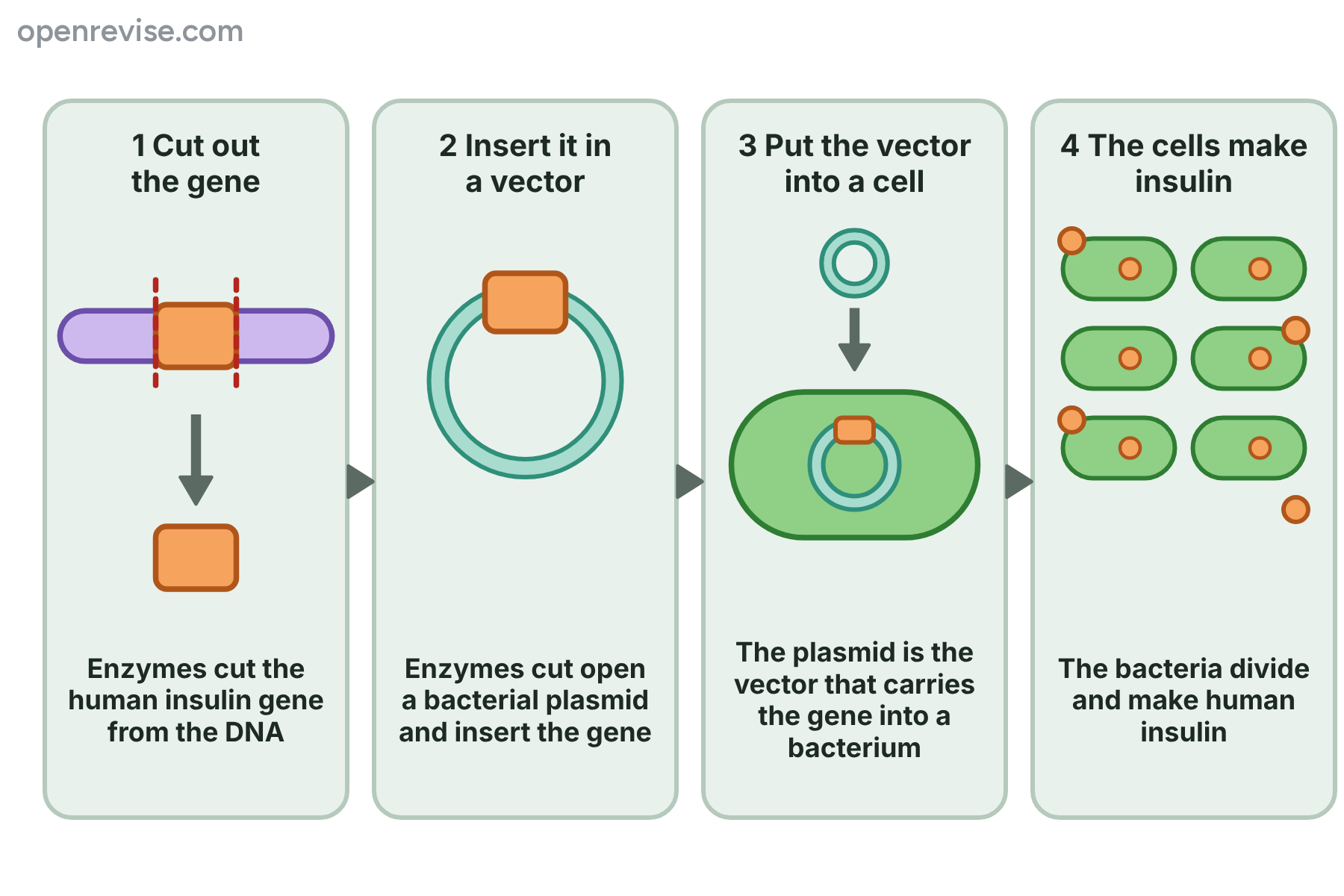
Describe the main steps in the process of genetic engineering of a bacterium to make human insulin.
Show answerHide answer
Model answer
Enzymes are used to isolate the human insulin gene from the DNA. The gene is inserted into a vector, which is usually a bacterial plasmid. The vector is used to insert the gene into the bacterial cells. The bacteria then divide and make human insulin.
Mark scheme
- Enzymes isolate the required gene — 1 mark
- The gene is inserted into a vector such as a plasmid — 1 mark
- The vector inserts the gene into the bacterial cells — 1 mark
- The bacteria make the human insulin — 1 mark
-
6 Name [3 marks]
The diagram shows the genetic engineering of bacteria. Name the substances that cut the gene out of the DNA, name the vector, and state what the bacteria make.
Show answerHide answer
Model answer
Enzymes cut the gene out. The vector is the plasmid. The bacteria make human insulin.
Mark scheme
- Enzymes — 1 mark
- Plasmid — 1 mark
- Human insulin — 1 mark
-
7 Explain [3 marks]
Explain why genes are transferred to animals and plants at an early stage of their development when they are genetically engineered.
Show answerHide answer
Model answer
At an early stage the organism is only a few cells. If the gene is transferred then, every cell that develops from it will contain the gene. So the organism develops with the desired characteristic.
Mark scheme
- Early stage means few cells — 1 mark
- All the cells that develop contain the gene — 1 mark
- So the organism develops with the desired characteristic — 1 mark
-
8 Evaluate [6 marks]
A company wants to grow a genetically modified crop that is resistant to insect attack. Evaluate the benefits and risks of growing the crop.
Show answerHide answer
Model answer
The crop is resistant to insects, so less is lost to pests and yields are higher. The farmer may need to use fewer insecticides, which saves money and may reduce pollution. However, there are concerns about the effects on populations of wild flowers and insects, because insects are part of food chains and pollinate flowers. Some people feel that the effects on human health of eating the crop have not been fully explored. Some people object to genetic engineering for ethical reasons. Overall, the benefits of food production may outweigh the risks if the crop is tested carefully, but some people will still object.
Mark scheme
- Higher yields because less is lost to insects — 1 mark
- Fewer insecticides, so lower cost or less pollution — 1 mark
- Effects on wild flowers and insects — 1 mark
- Effects on human health not fully explored — 1 mark
- Some people object on ethical grounds — 1 mark
- A reasoned conclusion that weighs both sides — 1 mark
Quick check
-
1
What does genetic engineering involve?
Show answerHide answer
C: Moving a gene from one organism to another
A gene is introduced from one organism into another to give a desired characteristic.
-
2
Which substance is made by genetically engineered bacteria to treat diabetes?
Show answerHide answer
A: Human insulin
Bacteria with the human insulin gene make human insulin.
-
3
What are crops with modified genes called?
Show answerHide answer
D: GM crops
They are genetically modified (GM) crops.
-
4
Which is a characteristic that GM crops may be given?
Show answerHide answer
B: Resistance to insect attack
Resistance to insect attack or herbicides is a common modification.
-
5
Which is a concern about GM crops?
Show answerHide answer
A: Effects on wild flowers and insects
There are concerns about effects on populations of wild flowers and insects.
-
6
What are enzymes used for in genetic engineering?
Show answerHide answer
C: To isolate the required gene
Enzymes are used to isolate the required gene.
-
7
Which of these is usually used as a vector?
Show answerHide answer
D: A bacterial plasmid
Vectors are usually bacterial plasmids or viruses.
-
8
Why are genes transferred at an early stage of development?
Show answerHide answer
B: All the cells that develop will contain the gene
Then all the cells that develop contain the gene, so the organism develops with the desired characteristic.