Flashcards · Biology · Variation and Evolution
Genetic Engineering
-
What is genetic engineering?
Modifying the genome of an organism by introducing a gene from another organism to give a desired characteristic.
-
What are GM crops?
Crops that have had their genes modified.
-
Name two characteristics given to GM crops.
Resistance to insect attack and resistance to herbicides.
-
What effect do GM crops generally have on yield?
They generally show increased yields.
-
Which useful substance do genetically engineered bacteria make?
Human insulin.
-
Why is human insulin made by bacteria useful?
It treats people with diabetes.
-
Give one concern about GM crops and wildlife.
They could affect the populations of wild flowers and insects.
-
Give one concern about GM crops and health.
The effects of eating them on human health have not been fully explored.
-
Name one area of medical research using genetic modification.
Overcoming some inherited disorders.
-
Why do some people object to genetic engineering?
They believe it is wrong to change the genes of living organisms.
-
How is genetic engineering different from selective breeding?
It can use genes from a different species, and works in a single generation.
-
What are enzymes used for in genetic engineering? (Higher tier)
To isolate the required gene.
-
What is a vector? (Higher tier)
A carrier, usually a bacterial plasmid or a virus, that inserts the gene into the cells.
-
When are genes transferred to animals and plants? (Higher tier)
At an early stage of development, so they develop with the desired characteristics.
-
What is a plasmid? (Higher tier)
A small ring of DNA in a bacterial cell, used as a vector.
-
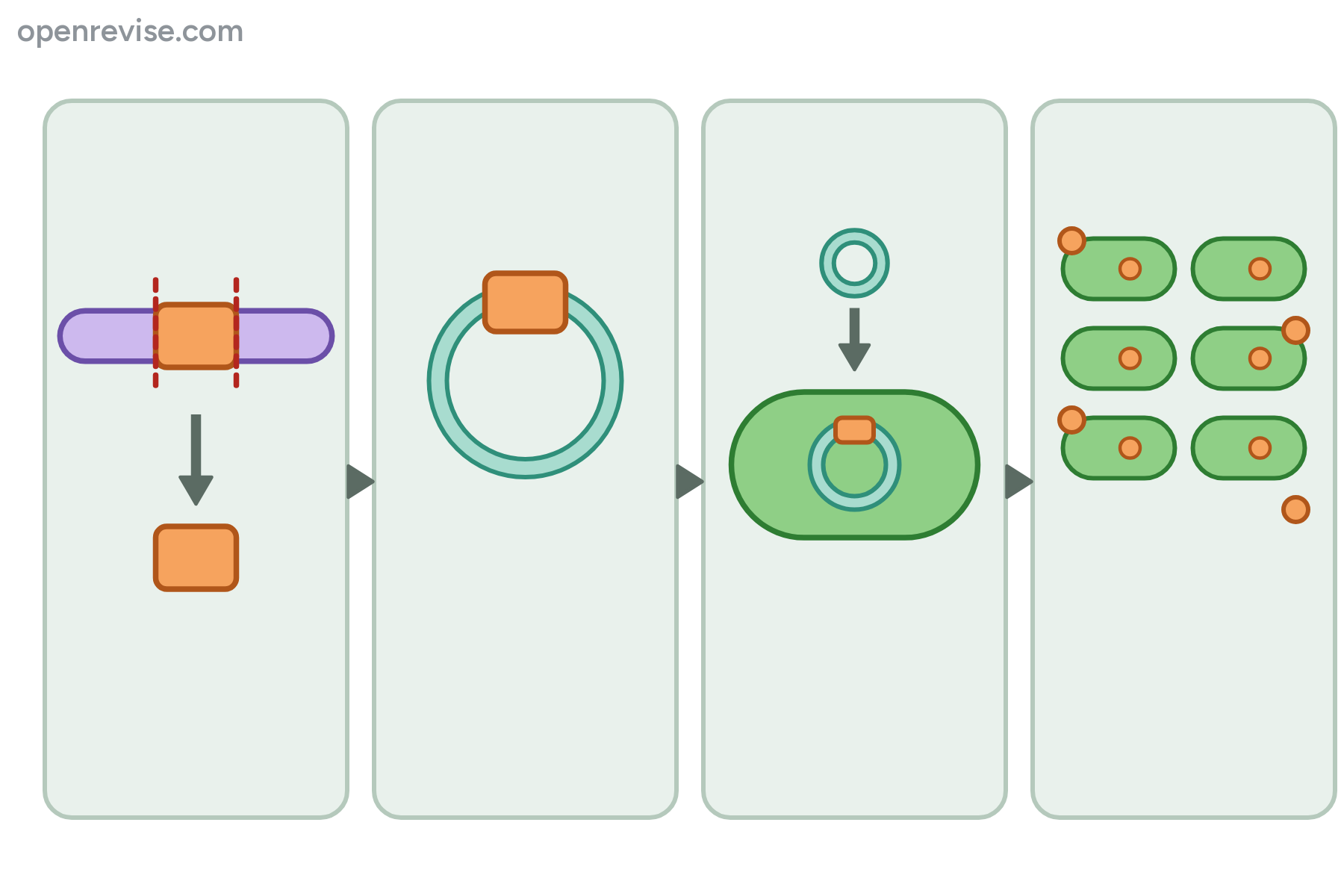 Describe what is happening at each of the four stages. (Higher tier)
 1 Enzymes cut the human insulin gene from the DNA. 2 The gene is inserted into a plasmid, the vector. 3 The vector carries the gene into a bacterium. 4 The bacteria divide and make human insulin.