Biology · Variation and Evolution
Genetic Engineering
Genetic engineering moves a gene from one organism into another to give it a new characteristic. This lesson is for both Combined Science and separate Biology. It covers what genetic engineering is, GM crops, bacteria that make human insulin, and the benefits, risks and objections. Higher tier students also need the main steps of the process, which are marked.
Learning Objectives
- 1Describe genetic engineering as modifying the genome of an organism by introducing a gene from another organism to give a desired characteristic.
- 2Describe examples of genetic engineering in crops and in bacteria.
- 3Explain the potential benefits and risks of genetic engineering in agriculture and in medicine, and why some people object.
- 4(Higher tier) Describe the main steps in the process of genetic engineering.
Retrieval practice
-
1
What does a gene code for?
Show answerHide answer
A particular sequence of amino acids, to make a specific protein.
-
2
What is the genome of an organism?
Show answerHide answer
All of its genetic material.
-
3
What is selective breeding?
Show answerHide answer
The process by which humans breed plants and animals for particular genetic characteristics.
-
4
What is a bacterial cell's genetic material?
Show answerHide answer
A loop of DNA, and often small rings of DNA called plasmids.
Moving genes between species
In selective breeding, a breeder can only use the alleles already present in a species. Genetic engineering goes further. It lets scientists take a gene from the chromosomes of one organism, such as a human, and transfer it into the cells of a completely different organism, such as a bacterium. The organism then has the characteristic that the gene codes for. This lesson looks at what it is used for and the debate about whether it should be.
What genetic engineering is
The key idea is the transfer of a gene to give the organism a new, desired characteristic.
-
The process
Genetic engineering is a process which involves modifying the genome of an organism by introducing a gene from another organism to give a desired characteristic.
-
Cutting out a gene
Genes from the chromosomes of humans and other organisms can be cut out and transferred to the cells of other organisms.
-
Different from selective breeding
Selective breeding only uses alleles already in the species. Genetic engineering can use a gene from a different species, and gives the new characteristic in a single generation.
-
Genetically modified
Organisms that have had their genes changed like this are called genetically modified (GM) organisms.
Examples of genetic engineering
Both plants and bacteria have been genetically engineered.
-
Crops
Plant crops have been genetically engineered to be resistant to diseases or to produce bigger, better fruits.
-
GM crops
Crops that have had their genes modified are called genetically modified (GM) crops. They include crops that are resistant to insect attack or to herbicides.
-
Yields
GM crops generally show increased yields, because less of the crop is lost to pests and weeds.
-
Bacteria
Bacterial cells have been genetically engineered to produce useful substances such as human insulin to treat diabetes.
Benefits and risks in agriculture
A farmer, a consumer and an environmentalist will each weigh these differently.
-
Benefits
GM crops generally show increased yields. Insect-resistant crops need fewer insecticides, and herbicide-resistant crops make weed control easier, so food can be grown at lower cost.
-
Concern for wildlife
There are concerns about the effect of GM crops on populations of wild flowers and insects, for example if the insects that feed on weeds die out.
-
Concern for health
Some people feel that the effects of eating GM crops on human health have not been fully explored.
-
Objections
Some people object on ethical grounds to changing the genes of living organisms, and some are worried about large companies controlling the seed supply.
Benefits and risks in medicine
In medicine the products are the same chemicals the body makes itself.
-
Human insulin
Bacteria containing the human insulin gene make human insulin, which is harvested and used to treat people with diabetes. It replaced insulin from pigs and cattle.
-
Inherited disorders
Modern medical research is exploring the possibility of genetic modification to overcome some inherited disorders.
-
Risks
There may be unexpected effects on the patient, the techniques are costly, and some people object to changing human genes, especially in embryos.
-
A judgement
You must be able to weigh up the benefits and the risks and say that some people have objections.
Benefits and risks of GM crops
Benefits
- Increased yields
- Resistance to insects and herbicides
- Crops can be grown with fewer chemicals
- Bigger, better fruit or crops that resist disease
Risks and concerns
- Possible effects on wild flowers and insects
- Effects on human health not fully explored
- Ethical objections from some people
- Cost of seeds and technology
The main steps of genetic engineering (Higher tier)
Higher tier students must be able to describe the main steps of the process.
-
Isolate the gene
Enzymes are used to isolate the required gene, for example the human insulin gene.
-
Insert it into a vector
The gene is inserted into a vector, usually a bacterial plasmid or a virus.
-
The vector enters the cells
The vector is used to insert the gene into the required cells, such as bacteria.
-
At an early stage
For animals, plants or microorganisms, the genes are transferred at an early stage in their development, so that they develop with the desired characteristics.
Making human insulin with bacteria (Higher tier)
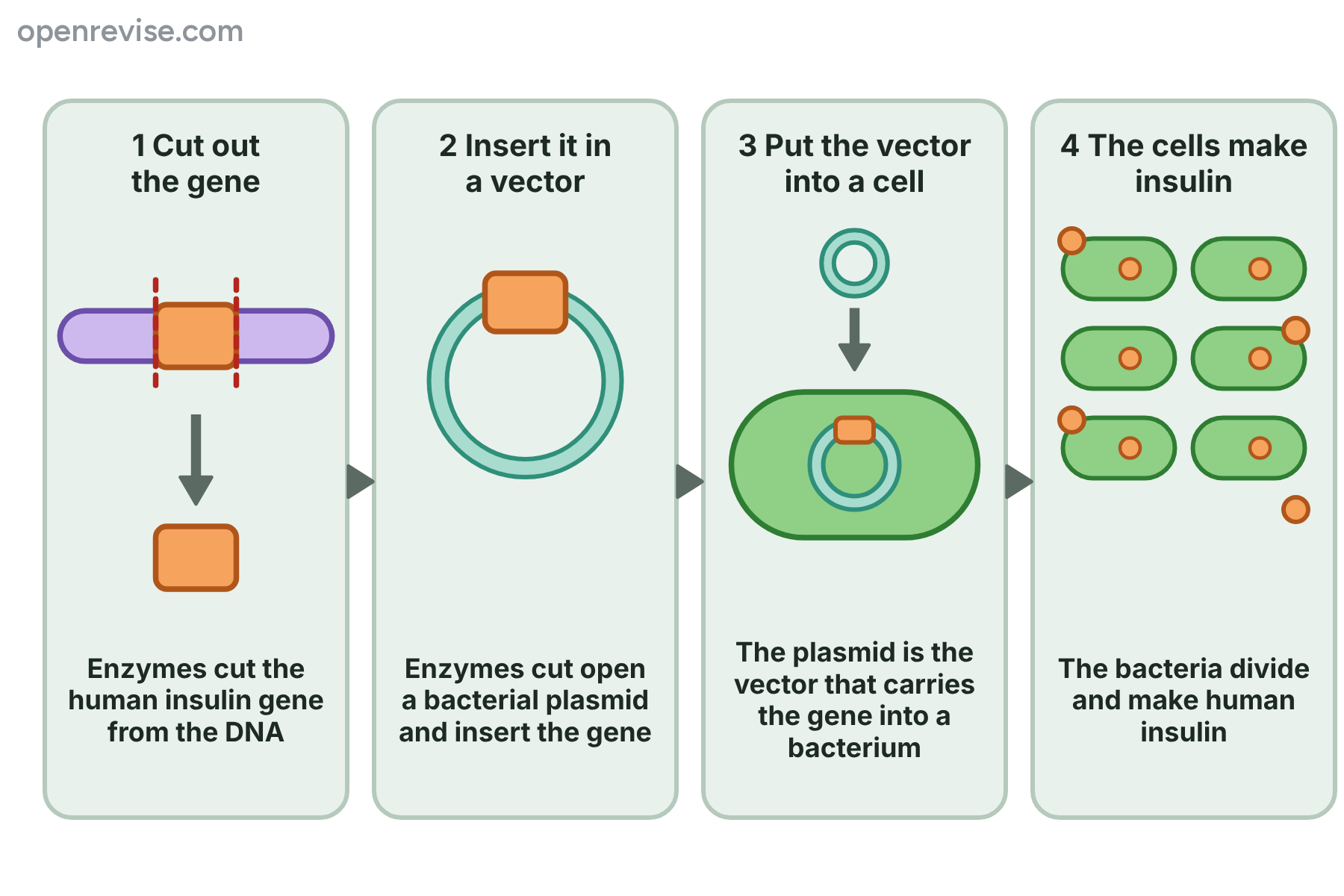
The plasmid acts as the vector that carries the human gene into the bacterium.
From a human gene to human insulin (Higher tier)
This is the example you will be asked about.
-
1
Find the gene
The gene for human insulin is located on a human chromosome.
-
2
Cut it out
Enzymes cut the gene from the DNA, and cut open a bacterial plasmid.
-
3
Insert it
The gene is inserted into the plasmid, which acts as the vector.
-
4
Transfer
The vector carries the gene into bacterial cells.
-
5
Grow and harvest
The bacteria divide quickly, and each new cell has the gene and makes insulin. The insulin is harvested and purified for patients with diabetes.
Case study
Insulin from bacteria
Before the 1980s, people with diabetes were treated with insulin taken from the pancreases of pigs and cattle, which was slightly different from human insulin and could cause reactions. In 1982 human insulin made by genetically engineered bacteria became the first genetically engineered medicine to be approved for patients. Large tanks of bacteria now make insulin in huge quantities, at a cost far below that of animal insulin.
The big idea
Genetic engineering transfers a gene from one organism into another, so that the organism has a new characteristic, but people disagree about whether the benefits outweigh the risks.
Genetic engineering
Genetic engineering
-
What
- gene transferred from one organism to another
-
Crops
- disease or insect resistance
- herbicide resistance
- bigger fruits
-
Bacteria
- make human insulin
-
Benefits
- higher yields
- useful medicines
-
Concerns
- wild flowers and insects
- human health
- ethics
-
Steps (Higher tier)
- enzymes isolate the gene
- vector
- into the cells
Summary and exam focus
- Genetic engineering modifies the genome of an organism by introducing a gene from another organism to give a desired characteristic.
- Crops have been genetically engineered to be resistant to disease, to insects or to herbicides, or to give bigger, better fruits.
- Bacteria have been genetically engineered to make human insulin to treat diabetes.
- There are potential benefits, such as increased yields, and risks, such as effects on wild flowers, insects and human health, and some people object.
- (Higher tier) Enzymes isolate the gene, which is inserted into a vector such as a plasmid or a virus, and the vector inserts the gene into the required cells.
Exam focus
Give one benefit and one risk of growing genetically modified crops, and explain why some people object to genetic engineering. (4 marks) (4 marks)
Name a specific benefit, such as higher yields, and a specific risk, such as effects on wild flowers and insects or on health. For the objection, give a reason that a person might hold, such as the belief that it is wrong to interfere with the genes of living organisms.
Key terms
The words this lesson expects you to use. Each one is linked from the first place it appears above.
- Genetic engineering
- Modifying the genome of an organism by introducing a gene from another organism to give a desired characteristic.
- Genetically modified (GM)
- Having had its genes changed by genetic engineering.
- GM crop
- A crop plant that has had a gene added, for example for insect or herbicide resistance.
- Herbicide
- A chemical that kills weeds.
- Vector
- A carrier, such as a plasmid or virus, that transfers a gene into a cell (Higher tier).
- Plasmid
- A small ring of DNA in bacteria that can be used as a vector (Higher tier).
- Insulin
- A hormone made in the pancreas that controls blood glucose.
- Yield
- The amount of a crop produced from an area of land.
You've finished the notes
Check your understanding
Test yourself while it is fresh. Start with the flashcards, then try the exam questions.
Something here looks wrong?
Tell us what and we will go and look. It goes to whoever writes these pages, nobody else, and we do not ask who you are — so there is nothing to sign and nothing comes back to you.