Exam questions · Biology · Variation and Evolution
Selective Breeding
- 7 exam questions
- 22 marks
- 8 quick checks
-
1 State [1 mark]
What is meant by selective breeding?
Show answerHide answer
Model answer
The process by which humans breed plants and animals for particular genetic characteristics.
Mark scheme
- Humans breed plants or animals for particular genetic characteristics — 1 mark
-
2 Give [2 marks]
Give two characteristics that farmers might select in domesticated animals or food plants.
Show answerHide answer
Model answer
Any two of: disease resistance in food crops, more meat or milk from animals, larger fruit, a gentle nature in dogs, large or unusual flowers.
Mark scheme
- First suitable characteristic — 1 mark
- Second suitable characteristic — 1 mark
-
3 Describe [4 marks]
Describe how a farmer could use selective breeding to produce a herd of cattle that gives more milk.
Show answerHide answer
Model answer
The farmer chooses the cows that give the most milk and the bulls from mothers that gave a lot of milk, and breeds them together. From the offspring the farmer selects the ones that give the most milk, and breeds these together. This is repeated for many generations until the herd gives high yields.
Mark scheme
- Choose parents with high milk yield — 1 mark
- Breed them together — 1 mark
- Select offspring with the highest yield and breed them — 1 mark
- Repeat over many generations — 1 mark
-
4 Calculate [3 marks]
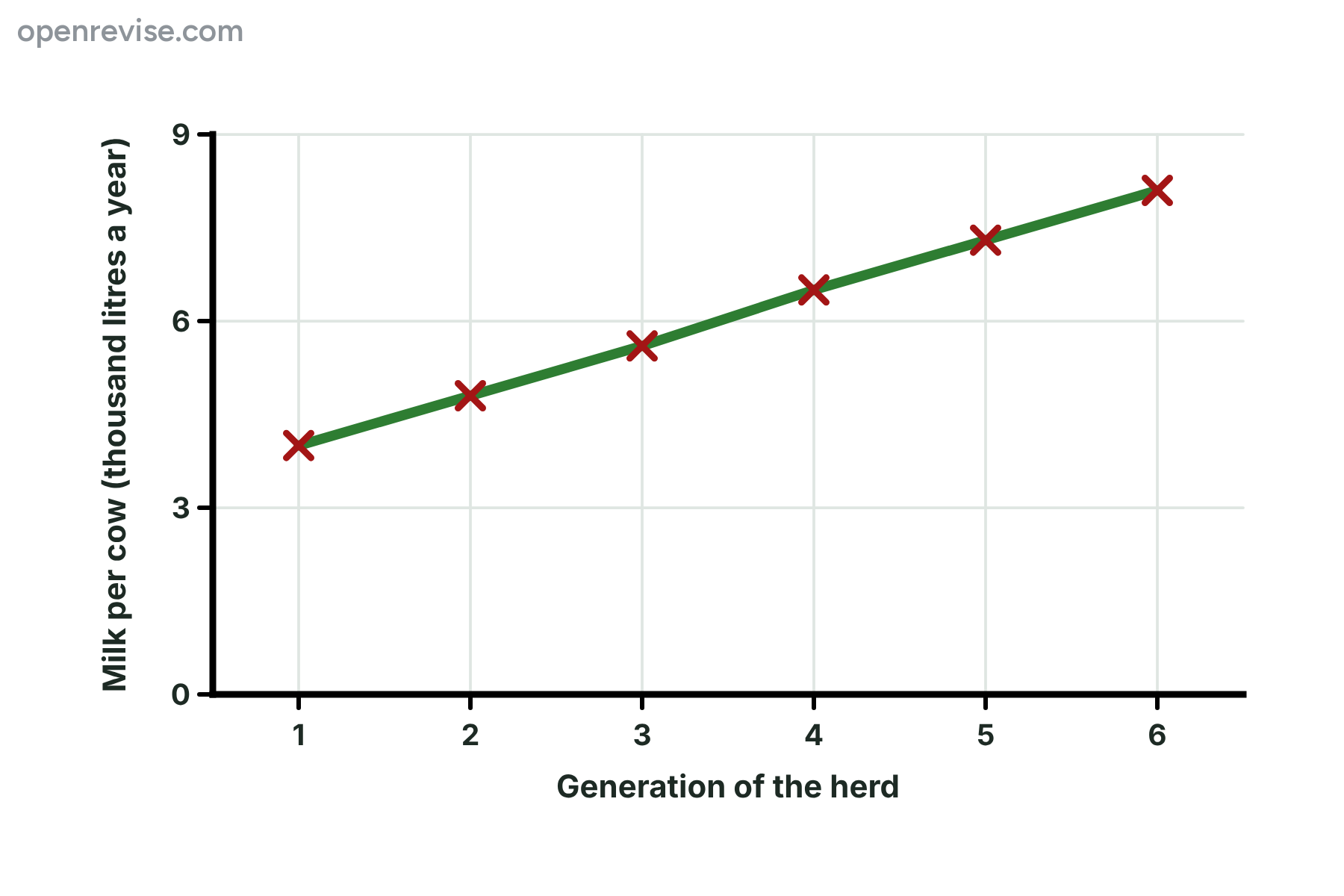
The graph shows the average milk yield over six generations of selective breeding. Calculate the mean increase in yield per generation between generation 1 and generation 6, in thousand litres per cow per year.
Show answerHide answer
Model answer
0.82 thousand litres per generation. The total increase is \(8.1 - 4.0 = 4.1\), over 5 generations, so \(4.1 \div 5 = 0.82\).
Mark scheme
- \(8.1 - 4.0 = 4.1\) — 1 mark
- Divided by 5 generations (not 6) — 1 mark
- 0.82 — 1 mark
-
5 Explain [3 marks]
Explain why selective breeding can lead to inbreeding.
Show answerHide answer
Model answer
Breeding only from the few individuals with the desired characteristic means that the parents are often closely related. After many generations all the animals are closely related. This is inbreeding.
Mark scheme
- Only a few individuals with the desired characteristic are bred — 1 mark
- They are often closely related — 1 mark
- Over many generations all the individuals are closely related, giving inbreeding — 1 mark
-
6 Explain [3 marks]
Some breeds of dog are particularly prone to disease and inherited defects. Explain why.
Show answerHide answer
Model answer
These breeds have been selectively bred from a small number of closely related dogs, which is inbreeding. Inbreeding reduces the variety of alleles, so harmful recessive alleles are more likely to be inherited from both parents. This causes inherited defects and disease.
Mark scheme
- Small number of related parents (inbreeding) — 1 mark
- Less variety of alleles — 1 mark
- Harmful alleles more likely to be inherited, so more defects or disease — 1 mark
-
7 Evaluate [6 marks]
A farmer is deciding whether to grow a variety of wheat that has been selectively bred for high yield and disease resistance. Evaluate the benefits and risks of using selectively bred crops.
Show answerHide answer
Model answer
The wheat gives a higher yield, so the farmer produces more food and income from the same land. Disease resistance means that less of the crop is lost and the farmer may spend less on pesticides. However, if all the plants in the crop are closely related they have very little variation. A new disease or a change in the climate could damage the whole crop, because no plants have the suited allele. The seed may be costly. Overall, the benefits of higher yield and resistance are likely to outweigh the risks, as long as the farmer keeps some variety and watches for new diseases.
Mark scheme
- Higher yield means more food or income — 1 mark
- Disease resistance means less crop loss or fewer pesticides — 1 mark
- A further benefit such as consistent quality — 1 mark
- Crops closely related so little variation — 1 mark
- A new disease or environmental change could affect all plants — 1 mark
- A reasoned conclusion that weighs benefits and risks — 1 mark
Quick check
-
1
Selective breeding is also called...
Show answerHide answer
B: Artificial selection
Artificial selection, because humans choose which individuals breed.
-
2
Which of these is the first step in selective breeding?
Show answerHide answer
A: Choose parents with the desired characteristic
The breeder starts by choosing parents with the desired characteristic.
-
3
How many generations does selective breeding usually take?
Show answerHide answer
D: Many
The process continues over many generations until all offspring show the characteristic.
-
4
Which characteristic might be selected in a food crop?
Show answerHide answer
C: Disease resistance
Disease resistance is a useful characteristic in food crops.
-
5
What is inbreeding?
Show answerHide answer
B: Breeding closely related individuals
Inbreeding is breeding closely related individuals, which reduces genetic variation.
-
6
Why are some dog breeds prone to inherited defects?
Show answerHide answer
D: They have been inbred
Inbreeding reduces variation, so harmful alleles are more likely to be inherited from both parents.
-
7
How is selective breeding different from natural selection?
Show answerHide answer
A: Humans choose which individuals breed
In selective breeding humans choose the individuals which breed, whereas in natural selection the environment selects.
-
8
Why is low variation in a crop a risk?
Show answerHide answer
C: A new disease could affect the whole crop
If the plants are very similar, a new disease or change in the environment could affect all of them.