Flashcards · Biology · Variation and Evolution
Selective Breeding
-
What is selective breeding?
The process by which humans breed plants and animals for particular genetic characteristics.
-
Another name for selective breeding?
Artificial selection.
-
How long have humans been doing selective breeding?
For thousands of years.
-
What is the first step in selective breeding?
Choose parents with the desired characteristic.
-
How many generations does selective breeding take?
Many, until all the offspring show the desired characteristic.
-
Give an example of selective breeding in food plants.
Disease resistance in crops, or large fruit.
-
Give an example of selective breeding in animals.
More meat or milk, or a gentle nature in dogs.
-
Why are large or unusual flowers selected?
Gardeners find them attractive, so they sell better.
-
What is inbreeding?
Breeding closely related individuals again and again.
-
What problem does inbreeding cause?
Some breeds are prone to disease or inherited defects.
-
Why is a lack of variation a risk?
A new disease or environmental change could affect all individuals.
-
How is selective breeding different from natural selection?
Humans choose the parents, not the environment.
-
Name a vegetable group from one wild species.
Cabbage, broccoli, cauliflower and kale all come from wild cabbage.
-
Give one welfare concern about selective breeding.
Some breeds have health problems, such as breathing difficulties.
-
Why can selective breeding take a long time?
It has to be repeated for many generations.
-
Describe the stages of selective breeding for the cow with the highest milk yield.
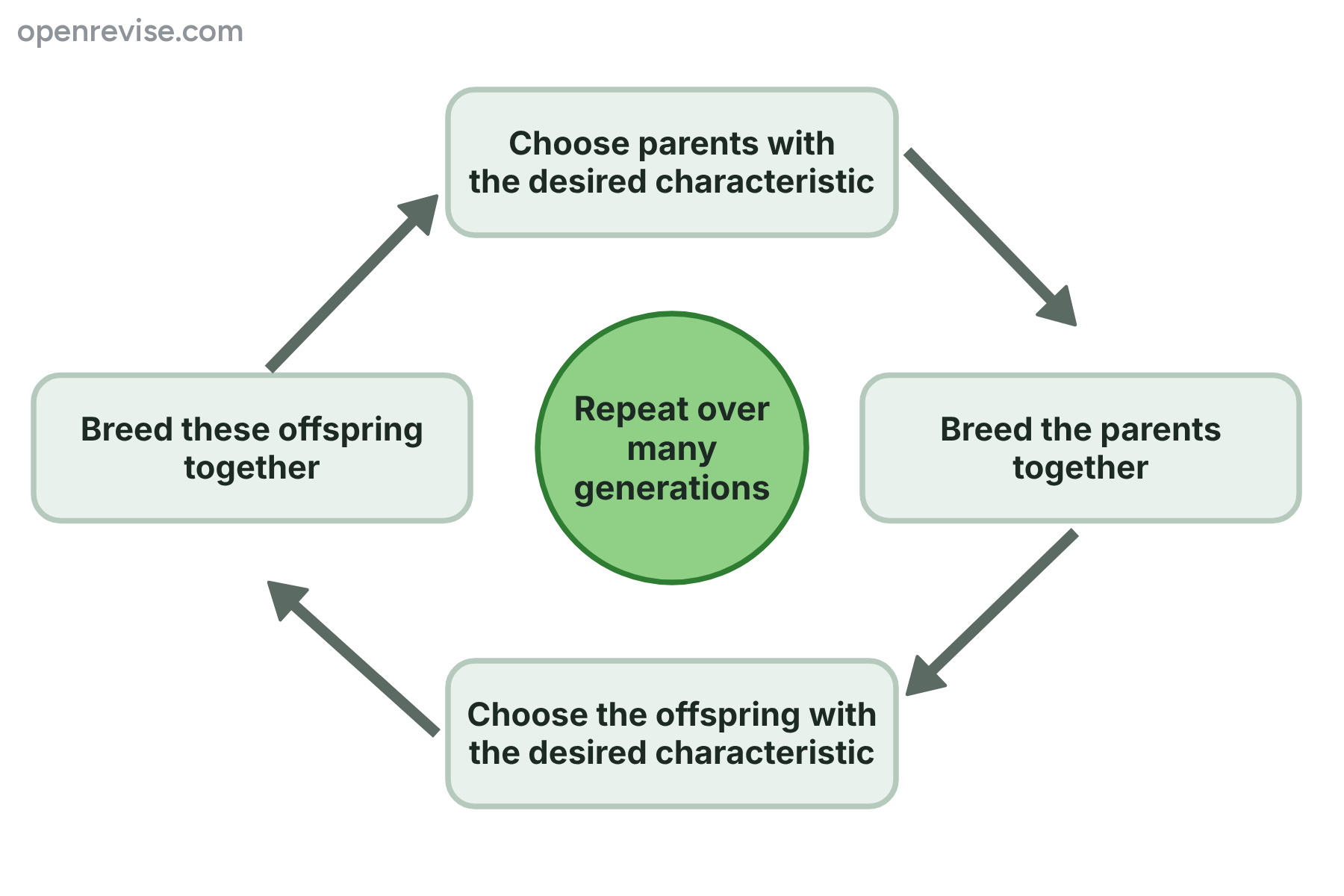
Choose the cows that give the most milk and breed them. Choose the offspring that give the most milk and breed them together. Repeat for many generations until the herd gives high yields.