Biology · Variation and Evolution
Selective Breeding
Humans have been shaping the plants and animals around them for thousands of years. This lesson is for both Combined Science and separate Biology. It explains how selective breeding works, what it has been used for, and its benefits and risks, including inbreeding.
Learning Objectives
- 1Describe selective breeding (artificial selection) and the steps of the process.
- 2Explain the impact of selective breeding of food plants and domesticated animals, using examples.
- 3Explain the benefits and risks of selective breeding, including inbreeding.
- 4Interpret data on the effect of selective breeding over several generations.
Retrieval practice
-
1
What is natural selection?
Show answerHide answer
The process in which individuals best suited to their environment survive and breed, passing on their alleles.
-
2
What is variation?
Show answerHide answer
Differences in the characteristics of individuals in a population.
-
3
What is an allele?
Show answerHide answer
A different form of the same gene.
-
4
What is a mutation?
Show answerHide answer
A change in the base sequence of DNA.
Evolution with a human choosing
Selective breeding, also called artificial selection, is the process by which humans breed plants and animals for particular genetic characteristics. Humans have been doing this for thousands of years, ever since they first bred food crops from wild plants and domesticated animals. It works in the same way as natural selection, except that people, and not the environment, decide which individuals breed.
How selective breeding works
The steps are the same for a farmer breeding cows, a gardener breeding roses and a vet breeding dogs.
-
1
Choose the parents
Select parents with the desired characteristic from a mixed population.
-
2
Breed them together
The chosen parents are bred together.
-
3
Select from the offspring
From the offspring, choose those with the desired characteristic and breed them together.
-
4
Repeat over generations
This continues over many generations, until all the offspring show the desired characteristic.
The cycle of selective breeding
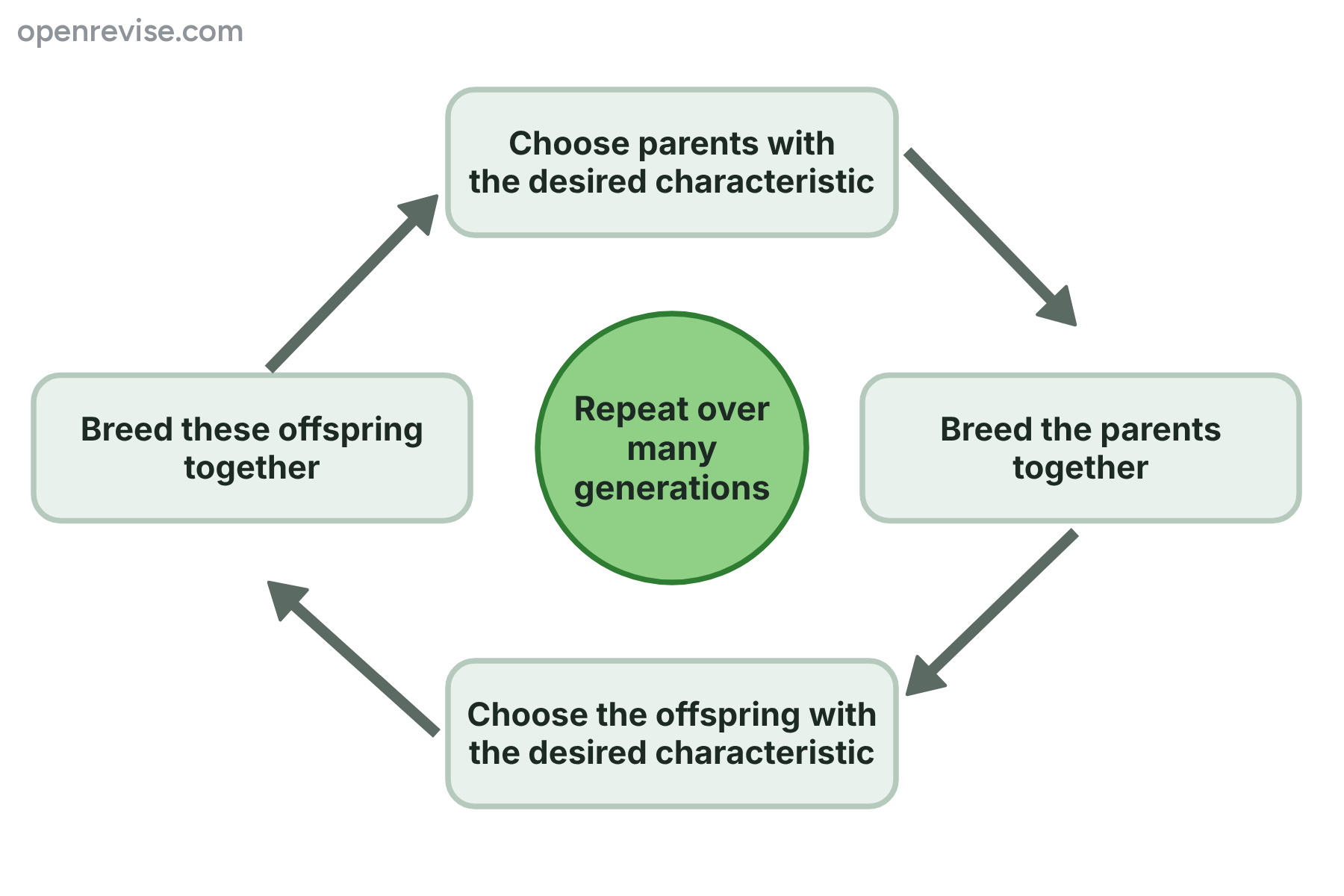
The process is repeated for many generations until all the offspring have the characteristic.
What selective breeding is used for
The characteristic can be chosen for usefulness or for appearance.
-
Disease resistance
Food crops can be bred to resist disease, so that more of the crop survives and fewer pesticides are needed.
-
More meat or milk
Animals which produce more meat or milk, such as dairy cows that give more milk, are chosen as parents.
-
Gentle nature
Domestic dogs are bred for a gentle nature, so they make better pets or guide dogs.
-
Appearance
Large or unusual flowers are bred because gardeners want them, and different dogs are bred for different appearance.
Reading a graph of selective breeding
The graph shows the average milk yield per cow in a herd over six generations of selective breeding (example data). Calculate the increase in milk yield from generation 1 to generation 6, and the percentage increase.
Show the solutionHide the solution
- 1 Read the values Generation 1 is 4.0 and generation 6 is 8.1 thousand litres per cow per year
- 2 Subtract \(8.1 - 4.0 = 4.1\)
- 3 Divide by the start value \(\frac{4.1}{4.0} = 1.025\)
- 4 Turn it into a percentage \(1.025 \times 100 = 102.5\%\)
AnswerThe yield increased by 4.1 thousand litres per cow per year, which is a 102.5% increase.
Milk yield over six generations
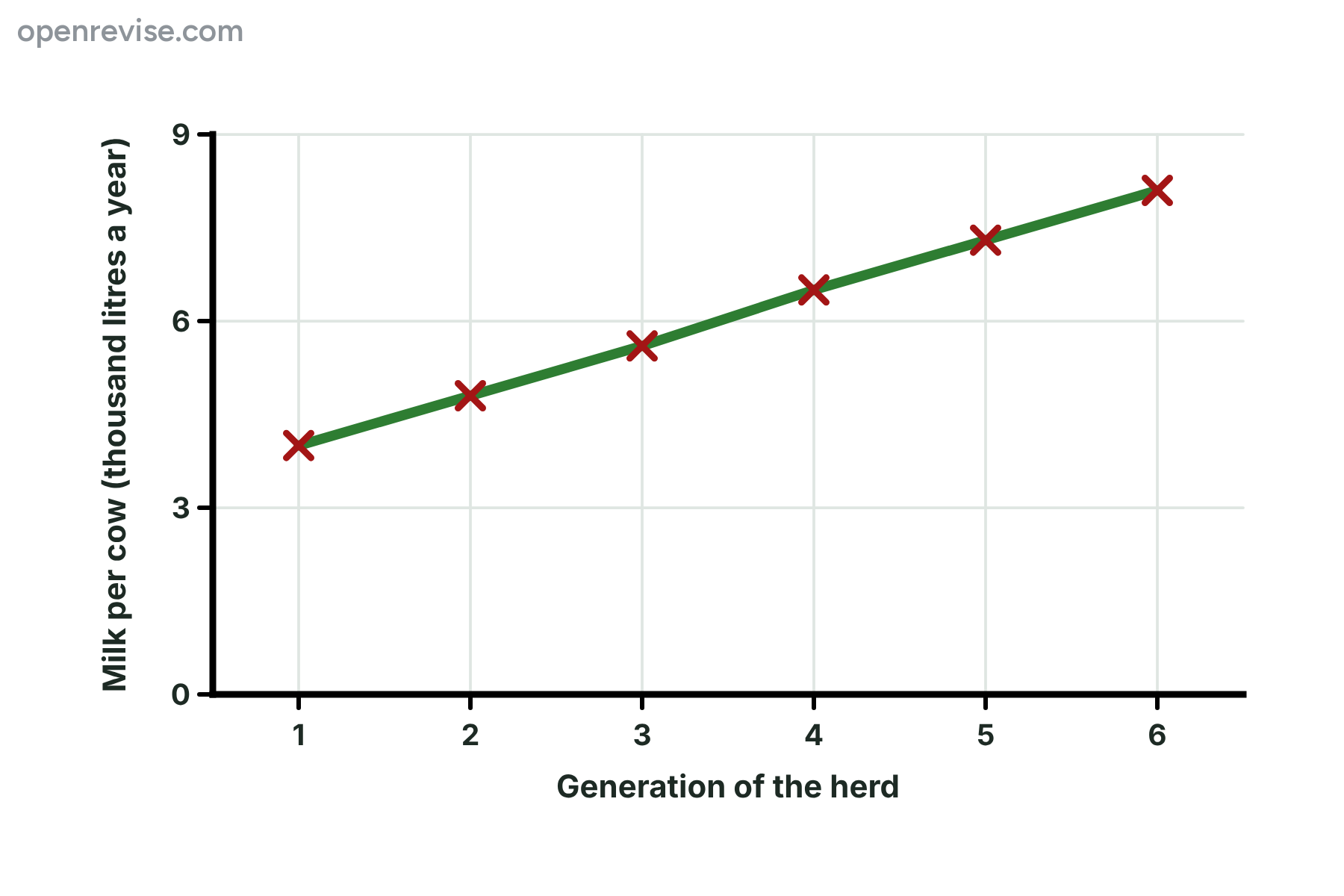
Each generation of selective breeding raised the average yield (example data).
Benefits and risks
Selective breeding has made food production far more efficient, but it has costs.
-
Benefits
Crops with higher yields and disease resistance, and animals with more meat or milk, increase food production, so farmers can feed more people from the same land.
-
Inbreeding
Breeding the same close relatives over and over is called inbreeding. It reduces the variety of alleles in a population, so some breeds are particularly prone to disease or inherited defects.
-
Reduced variation
Fewer alleles means that if a new disease or a change in the environment arrives, the whole population may be at risk because no individuals have a suited allele.
-
Welfare and ethics
Some breeds have health problems, such as breathing difficulties in flat-faced dogs, which some people find unacceptable.
Benefits and risks of selective breeding
Benefits
- Higher yields of crops, milk and meat
- Disease-resistant crops
- Useful characteristics, such as a gentle nature
- Quicker than waiting for natural selection
Risks
- Inbreeding reduces the number of alleles
- Breeds prone to disease or inherited defects
- A whole population may be at risk from one disease
- Animal welfare concerns
Case study
One wild plant, many vegetables
Cabbage, broccoli, cauliflower, kale, kohlrabi and Brussels sprouts are all varieties of one species, wild cabbage, which grows on sea cliffs in Europe. Farmers selected plants with larger leaves for cabbage, bigger flower buds for broccoli, swollen stems for kohlrabi and so on, and bred from them for many generations. The result is very different vegetables that have the same species ancestor.
The big idea
Selective breeding is artificial selection: humans choose which individuals breed, so the desired characteristic becomes more common in each generation.
Selective breeding
Selective breeding
-
Process
- choose parents
- breed
- choose offspring
- repeat for generations
-
Examples
- disease-resistant crops
- more meat or milk
- gentle dogs
- large flowers
-
Benefits
- higher yields
- useful features
- more food
-
Risks
- inbreeding
- disease
- inherited defects
- welfare
-
Compare
- natural selection is by the environment
- selective breeding is by humans
Summary and exam focus
- Selective breeding is the process by which humans breed plants and animals for particular genetic characteristics.
- It involves choosing parents with the desired characteristic and breeding them, then choosing the best offspring and repeating over many generations.
- It has been used for disease resistance, more meat or milk, gentle dogs and large or unusual flowers.
- Selective breeding can lead to inbreeding, so some breeds are prone to disease or inherited defects.
- Inbreeding reduces the number of different alleles in a population.
Exam focus
Describe how selective breeding could be used to produce a variety of apple tree that is resistant to disease. (4 marks) (4 marks)
Write the steps in order and apply each to the apple tree: choose parents with some resistance, breed them, select the most resistant offspring, and repeat for many generations. Always say what characteristic is selected, not just that the best are chosen.
Key terms
The words this lesson expects you to use. Each one is linked from the first place it appears above.
- Selective breeding
- The process by which humans breed plants and animals for particular genetic characteristics.
- Artificial selection
- Another name for selective breeding, in which humans choose which individuals reproduce.
- Domesticated
- Bred by humans to be kept as farm animals or pets.
- Inbreeding
- Breeding closely related individuals, which reduces variation and increases the chance of inherited defects.
- Desired characteristic
- The feature, such as high milk yield, that the breeder wants to produce.
- Yield
- The amount of a product, such as milk or grain, obtained from an animal or plant.
- Disease resistance
- The ability to avoid becoming ill when exposed to a pathogen.
- Allele
- A different form of a gene.
You've finished the notes
Check your understanding
Test yourself while it is fresh. Start with the flashcards, then try the exam questions.
Something here looks wrong?
Tell us what and we will go and look. It goes to whoever writes these pages, nobody else, and we do not ask who you are — so there is nothing to sign and nothing comes back to you.