Exam questions · Biology · Variation and Evolution
Variation
- 7 exam questions
- 21 marks
- 8 quick checks
-
1 Give [3 marks]
Give three possible causes of the differences between individuals of the same species.
Show answerHide answer
Model answer
Differences in the genes they inherited. Differences in the environment in which they developed. A combination of genes and the environment. (Mutations also produce new variants.)
Mark scheme
- Genetic causes — 1 mark
- Environmental causes — 1 mark
- A combination of both — 1 mark
-
2 State [2 marks]
Name one characteristic that is controlled only by genes in humans and one that is controlled mainly by the environment.
Show answerHide answer
Model answer
Genes only: eye colour (or blood group). Environment: a scar (or the language a person speaks).
Mark scheme
- A characteristic controlled by genes, such as eye colour — 1 mark
- A characteristic caused by the environment, such as a scar — 1 mark
-
3 Explain [3 marks]
Two plants have identical genes and are grown from cuttings. One is grown in the light and one in the dark. The plant in the dark is pale and weak. Explain this difference.
Show answerHide answer
Model answer
The plants have the same genes, so the difference cannot be genetic. The environment is different, because one plant had no light. Without light the plant cannot make chlorophyll or photosynthesise properly, so it is pale and weak.
Mark scheme
- Same genes, so the difference is not genetic — 1 mark
- The environment (light) is different — 1 mark
- No light, so little chlorophyll or photosynthesis — 1 mark
-
4 Calculate [3 marks]
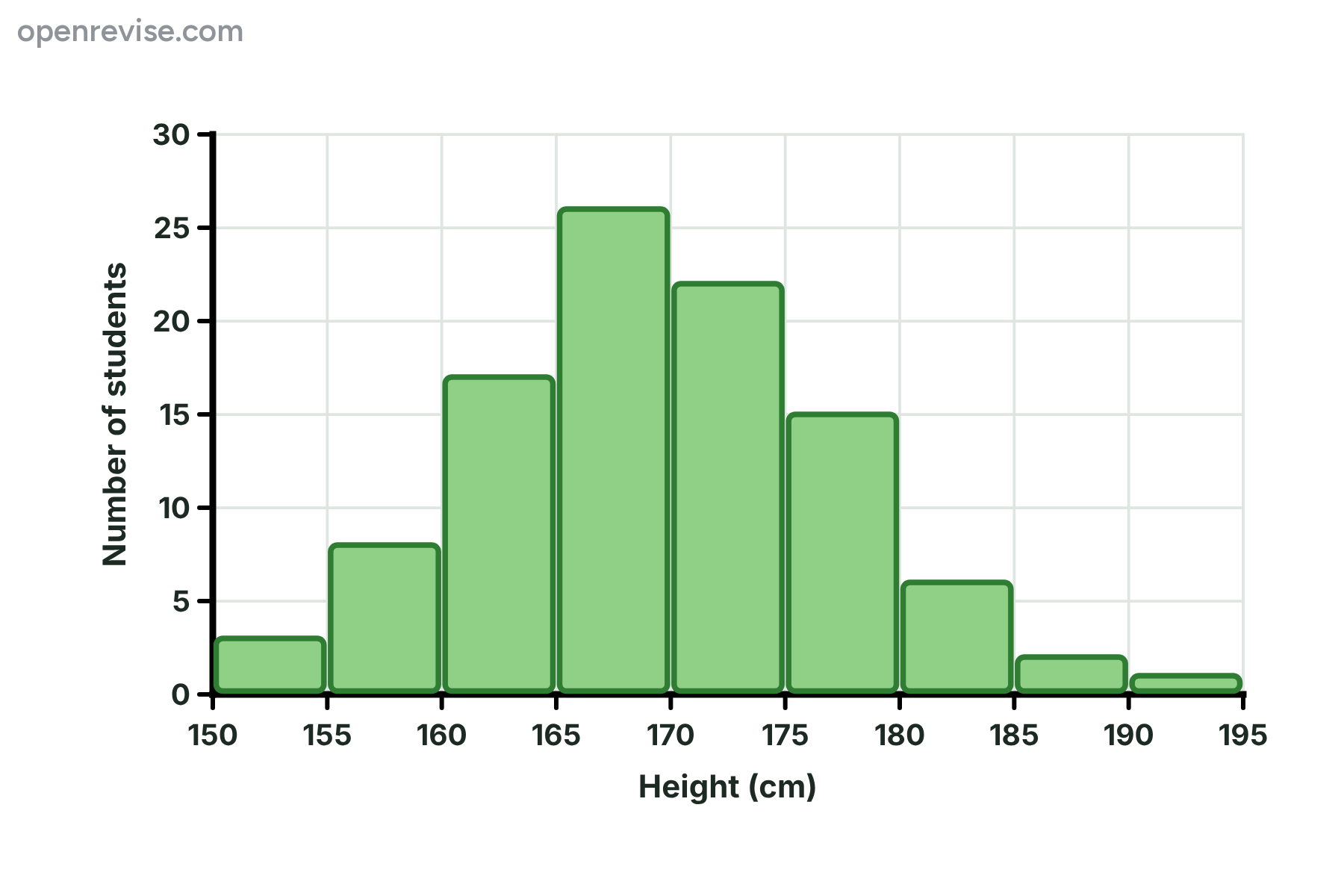
Use the chart to calculate the percentage of the students who are shorter than 160 cm.
Show answerHide answer
Model answer
11%. The students shorter than 160 cm are in the first two bars, 3 + 8 = 11, and \(\frac{11}{100} \times 100 = 11\%\).
Mark scheme
- \(3 + 8 = 11\) — 1 mark
- \(\frac{11}{100} \times 100\) — 1 mark
- 11% — 1 mark
-
5 Describe [3 marks]
Describe the pattern shown by the chart, and state the modal class.
Show answerHide answer
Model answer
Most students have a height near the middle of the range, and fewer students are very short or very tall, so the chart is bell-shaped. The modal class is 165 to 170 cm.
Mark scheme
- Most near the middle, fewer at the extremes — 1 mark
- Bell-shaped (or symmetrical) — 1 mark
- Modal class 165 to 170 cm — 1 mark
-
6 Explain [3 marks]
Mutations occur continuously, but most have no effect on the phenotype. Explain why a very small number of mutations can matter to a species.
Show answerHide answer
Model answer
A mutation can produce a new allele and so a new phenotype. If the new phenotype is suited to a change in the environment, the individuals with it are more likely to survive and breed. The allele can then become common and bring about a relatively rapid change in the species.
Mark scheme
- A mutation may give a new phenotype — 1 mark
- It may be suited to a changed environment, so those individuals survive and breed — 1 mark
- This can lead to a relatively rapid change in the species — 1 mark
-
7 Explain [4 marks]
Explain why most of the differences between people in height cannot be put down to genes alone.
Show answerHide answer
Model answer
Height is controlled by many genes, not a single gene. The conditions in which a person develops also matter, such as diet and health. A person can inherit the genes for being tall but not reach their full height if they are not well fed. So height depends on a combination of genes and the environment.
Mark scheme
- Height is controlled by many genes — 1 mark
- The environment affects it, such as diet — 1 mark
- Example of a person with tall genes who does not reach full height — 1 mark
- A combination of genes and environment — 1 mark
Quick check
-
1
What is variation?
Show answerHide answer
B: Differences between individuals in a population
Variation is the differences in the characteristics of individuals in a population.
-
2
Which characteristic is controlled only by genes?
Show answerHide answer
D: Eye colour
Eye colour is genetic, but a scar, a suntan and the ability to speak French are caused by the environment.
-
3
Which characteristic is caused by a combination of genes and the environment?
Show answerHide answer
A: Height
Height depends on the genes inherited and on conditions such as diet.
-
4
Where do all genetic variants originally come from?
Show answerHide answer
C: Mutations
All variants arise from mutations.
-
5
What effect do most mutations have on the phenotype?
Show answerHide answer
B: They have no effect
Most mutations have no effect on the phenotype.
-
6
How often do mutations occur?
Show answerHide answer
D: Continuously
Mutations occur continuously, by chance.
-
7
Two identical twins have different body masses. What is the most likely cause?
Show answerHide answer
A: Differences in diet and exercise
Identical twins have the same genes, so differences are caused by the environment, such as diet and exercise.
-
8
On a frequency chart, what does the tallest bar show?
Show answerHide answer
C: The modal class
The tallest bar is the group with the most individuals, the modal class.