Flashcards · Biology · Variation and Evolution
Variation
-
What is variation?
Differences in the characteristics of individuals in a population.
-
Name three possible causes of variation.
Genes, the environment, or a combination of both.
-
Give an example of a characteristic caused only by genes.
Eye colour or blood group.
-
Give an example of a characteristic caused by the environment.
Scars, or the language you speak.
-
Give an example of a characteristic caused by genes and the environment.
Height or body mass.
-
Where do all genetic variants come from?
Mutations.
-
How often do mutations occur?
Continuously.
-
What do most mutations do to the phenotype?
Nothing.
-
What do a very few mutations do to the phenotype?
Determine it.
-
What can happen if a rare mutation gives a phenotype suited to a changed environment?
A relatively rapid change in the species.
-
Why is variation important for a species?
It means some individuals may survive if the environment changes.
-
What is the modal class on a frequency chart?
The tallest bar, the group with the most individuals.
-
Do identical twins have exactly the same phenotype?
No. The environment gives small differences.
-
Is there usually a lot or a little genetic variation in a population?
Extensive variation.
-
What shape is a frequency chart for height?
Bell-shaped.
-
Sort these into genetic, environmental or both: eye colour, scars, height, language spoken.
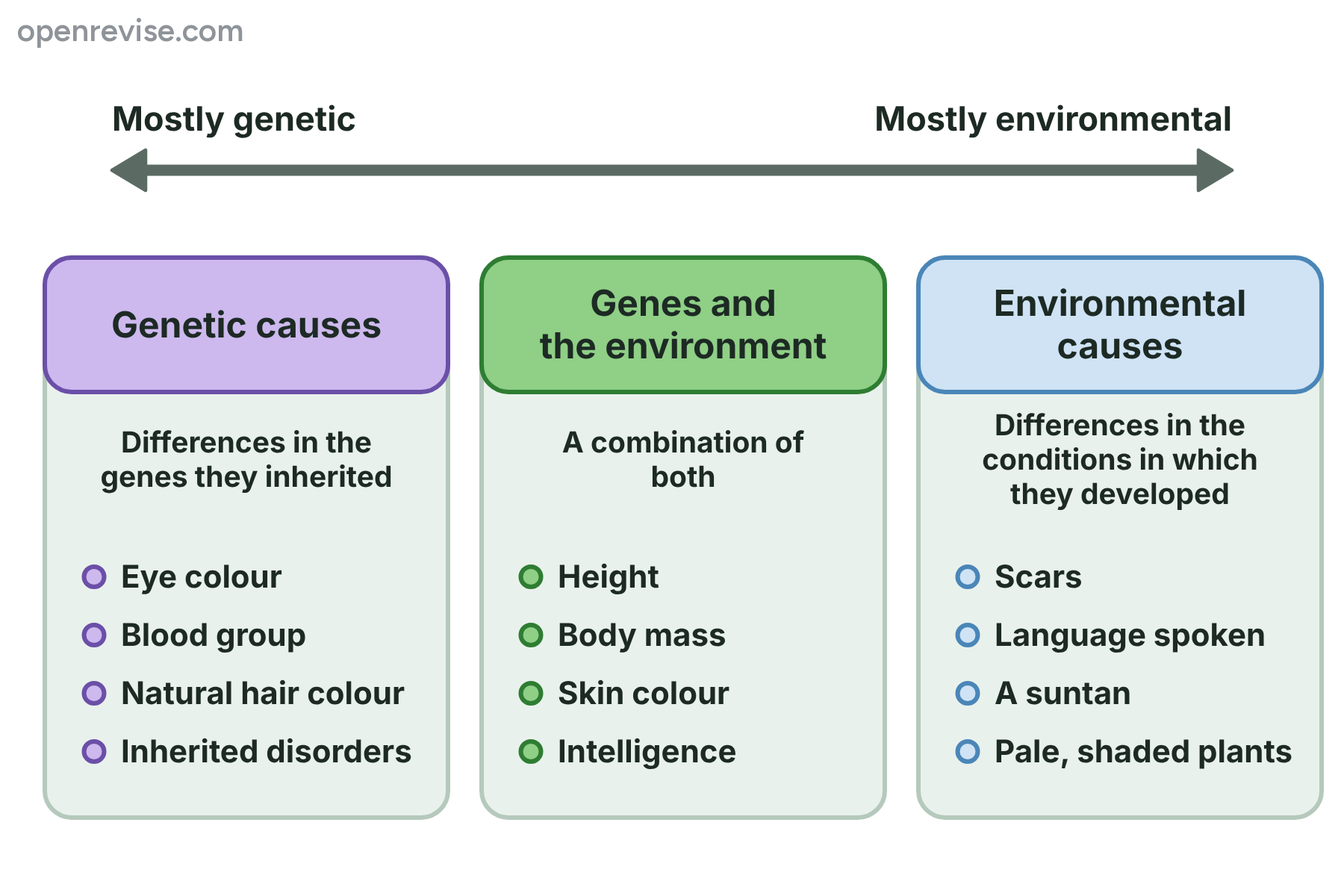
Eye colour is genetic. Scars and language spoken are environmental. Height is both.