Biology · Variation and Evolution
Variation
No two individuals are exactly the same, not even identical twins. This lesson is for both Combined Science and separate Biology. It covers the causes of variation, the part that mutations play in producing new alleles, and how to read data about variation.
Learning Objectives
- 1Describe variation as differences in the characteristics of individuals in a population.
- 2Explain how variation can be caused by genes, by the environment or by a combination of both.
- 3Recall that all genetic variants arise from mutations, and that most have no effect on the phenotype, some influence it and very few determine it.
- 4Interpret data about variation from tables and charts, including a frequency chart.
Retrieval practice
-
1
What is an allele?
Show answerHide answer
A different form of the same gene.
-
2
What is a mutation?
Show answerHide answer
A change in the base sequence of DNA.
-
3
What is a phenotype?
Show answerHide answer
The characteristic that is expressed, which results from the genotype and the environment.
-
4
What is a population?
Show answerHide answer
All the organisms of one species living in the same area.
Why individuals differ
Walk into any school and you will see variation: heights, hair colours, voices, even the way people write. Differences in the characteristics of individuals in a population are called variation. Variation matters because it is the raw material for evolution. If every member of a species were identical, a change in the environment could wipe out the whole population at once.
Causes of variation
The characteristics of an individual depend on its genes and on the conditions in which it develops.
-
Genetic causes
Differences in the genes that individuals inherit from their parents. Eye colour and blood group are controlled by genes, and are almost unaffected by the environment.
-
Environmental causes
Differences in the conditions in which individuals have developed. Scars, the language you speak and a plant's pale leaves when grown without light are examples.
-
A combination
Most characteristics depend on both. Height depends on the genes inherited, but also on diet and health. A plant can have genes for tallness but stay short if it has too little light and too few minerals.
-
The genome and the environment
The genome and its interaction with the environment influence the development of the phenotype of an organism.
Causes of variation
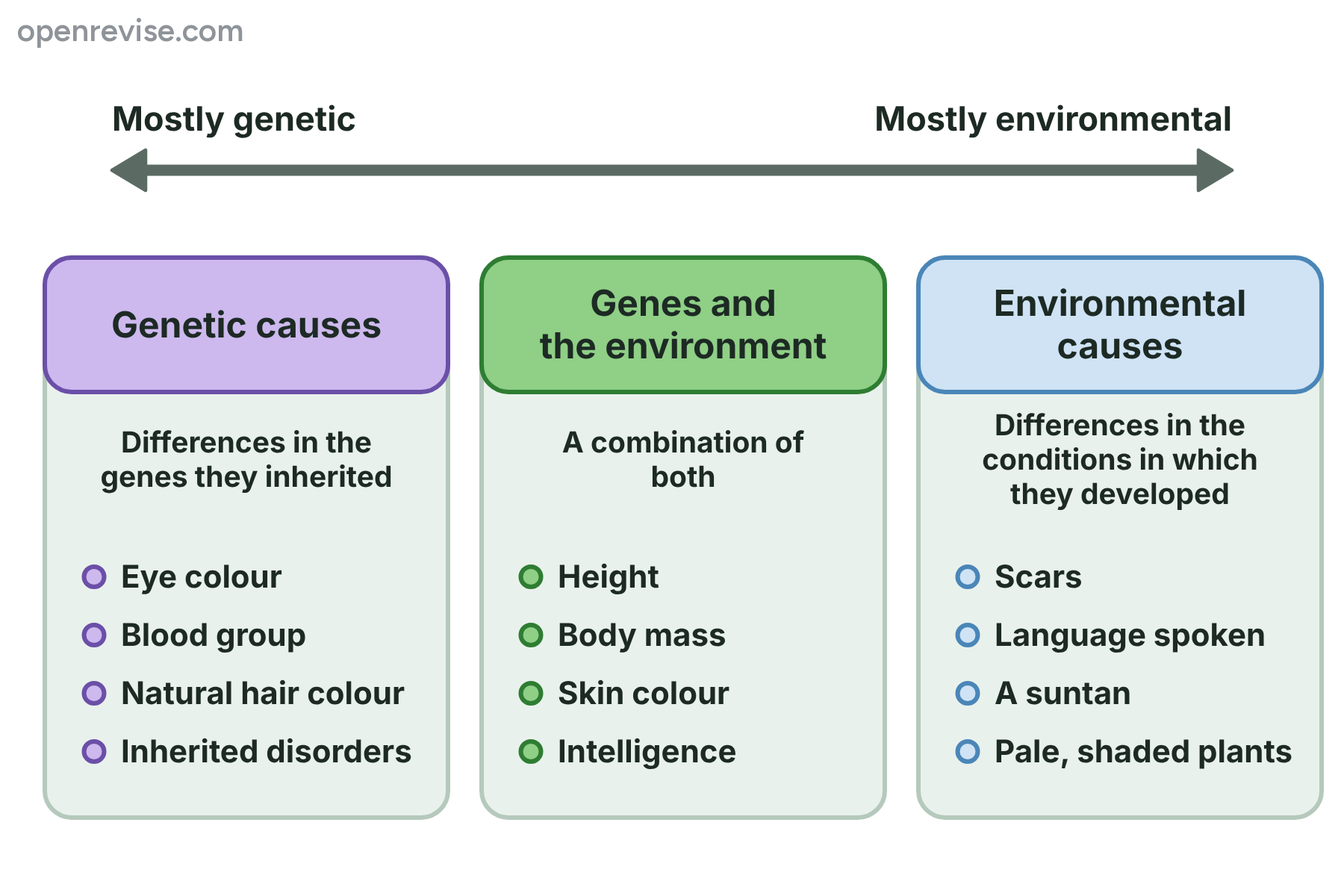
Most characteristics are the result of both genes and the environment.
Mutations: the source of new variants
All genetic variants arise from mutations, which are changes in the base sequence of DNA.
-
Extensive variation
There is usually extensive genetic variation within a population of a species, so individuals have different combinations of alleles.
-
Most mutations
Most mutations have no effect on the phenotype, because the protein is unchanged or only changed slightly.
-
Some mutations
Some mutations influence the phenotype. Fewer still, a very few, determine the phenotype.
-
Mutations occur continuously
They occur by chance all the time, in every species.
-
A rare benefit
Very rarely, a mutation leads to a new phenotype. If this phenotype is suited to a change in the environment, it can lead to a relatively rapid change in the species.
Case study
The mutation that let adults drink milk
Most mammals, and most people in the world, make less of the enzyme lactase after childhood, so they cannot digest the sugar in milk as adults. In some populations a mutation arose that keeps the lactase gene switched on throughout life. Where people kept cattle and drank milk, adults with the mutation had a better food supply, so they were more likely to survive and have children, and the allele became common in only a few thousand years.
Reading data about variation
A frequency chart shows how many individuals fall into each group. You may have to read it, or calculate from it.
-
Modal class
The tallest bar, the class with the most individuals. It is the mode.
-
Range
The spread from the smallest to the largest value, which shows how much variation there is.
-
The shape
When most individuals are near the middle and few are at the extremes, the chart is bell-shaped, which is typical of characteristics controlled by many genes.
-
Calculating
Add the frequencies to find the total. A percentage is the frequency divided by the total, times 100.
The heights of 100 students
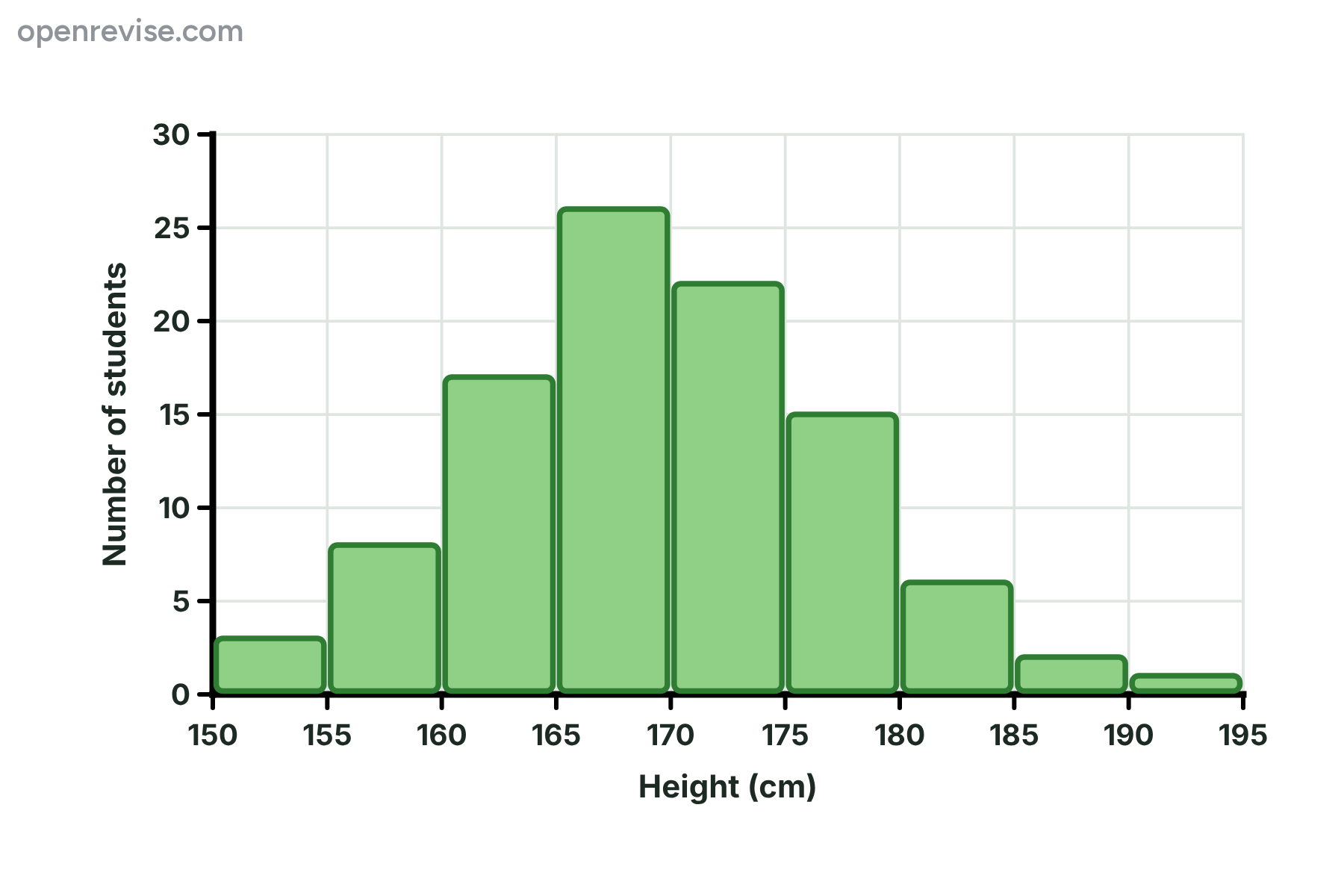
Most students are near the middle of the range, and few are very short or very tall.
Reading the chart
Use the chart of the heights of 100 students to find the modal class and the percentage of students who are 175 cm or taller.
Show the solutionHide the solution
- 1 Find the tallest bar The tallest bar is 165 to 170 cm, with 26 students, so that is the modal class
- 2 Add the bars at 175 cm or above \(15 + 6 + 2 + 1 = 24\)
- 3 Divide by the total and multiply by 100 \(\frac{24}{100} \times 100\)
- 4 Give the answer 24%
AnswerThe modal class is 165 to 170 cm. 24% of the students are 175 cm or taller.
The big idea
Variation comes from genes and the environment, and mutations are the original source of every new allele.
Variation
Variation
-
Definition
- differences between individuals in a population
-
Genetic causes
- inherited alleles
-
Environmental causes
- conditions in which they developed
-
Both
- most characteristics
- such as height
-
Mutations
- continuous
- most have no effect
- very rarely beneficial
-
Data
- modal class
- range
- percentages
Summary and exam focus
- Variation is the differences in the characteristics of individuals in a population.
- Variation may be due to genes, to the environment or to a combination of the two.
- All genetic variants arise from mutations, which occur continuously.
- Most mutations have no effect on the phenotype, some influence it and very few determine it.
- Very rarely a mutation gives a phenotype suited to a changed environment, which can lead to rapid change in a species.
Exam focus
Identical twins have exactly the same genes but are not exactly the same. Explain why. (3 marks) (3 marks)
The question is about the environment. Name what is the same (the genes) and what can differ (the conditions in which each twin has developed), and give a specific example such as diet, exercise or a scar. Say that the phenotype depends on both.
Key terms
The words this lesson expects you to use. Each one is linked from the first place it appears above.
- Variation
- The differences in the characteristics of individuals in a population.
- Population
- All the organisms of one species living in the same area.
- Genetic variation
- Variation caused by differences in the genes individuals inherit.
- Environmental variation
- Variation caused by the conditions in which an individual has developed.
- Mutation
- A change in the base sequence of DNA.
- Variant
- A different version of a gene, which arose from a mutation.
- Phenotype
- The characteristics of an organism that result from its genes and the environment.
- Modal class
- The group with the highest frequency.
You've finished the notes
Check your understanding
Test yourself while it is fresh. Start with the flashcards, then try the exam questions.
Something here looks wrong?
Tell us what and we will go and look. It goes to whoever writes these pages, nobody else, and we do not ask who you are — so there is nothing to sign and nothing comes back to you.