Exam questions · Biology · Blood, Blood Vessels and the Heart
Arteries, Veins and Capillaries
- 8 exam questions
- 25 marks
- 8 quick checks
-
1 State [1 mark]
Name the type of blood vessel that carries blood away from the heart at high pressure.
Show answerHide answer
Model answer
An artery.
Mark scheme
- Artery — 1 mark
-
2 Name [3 marks]
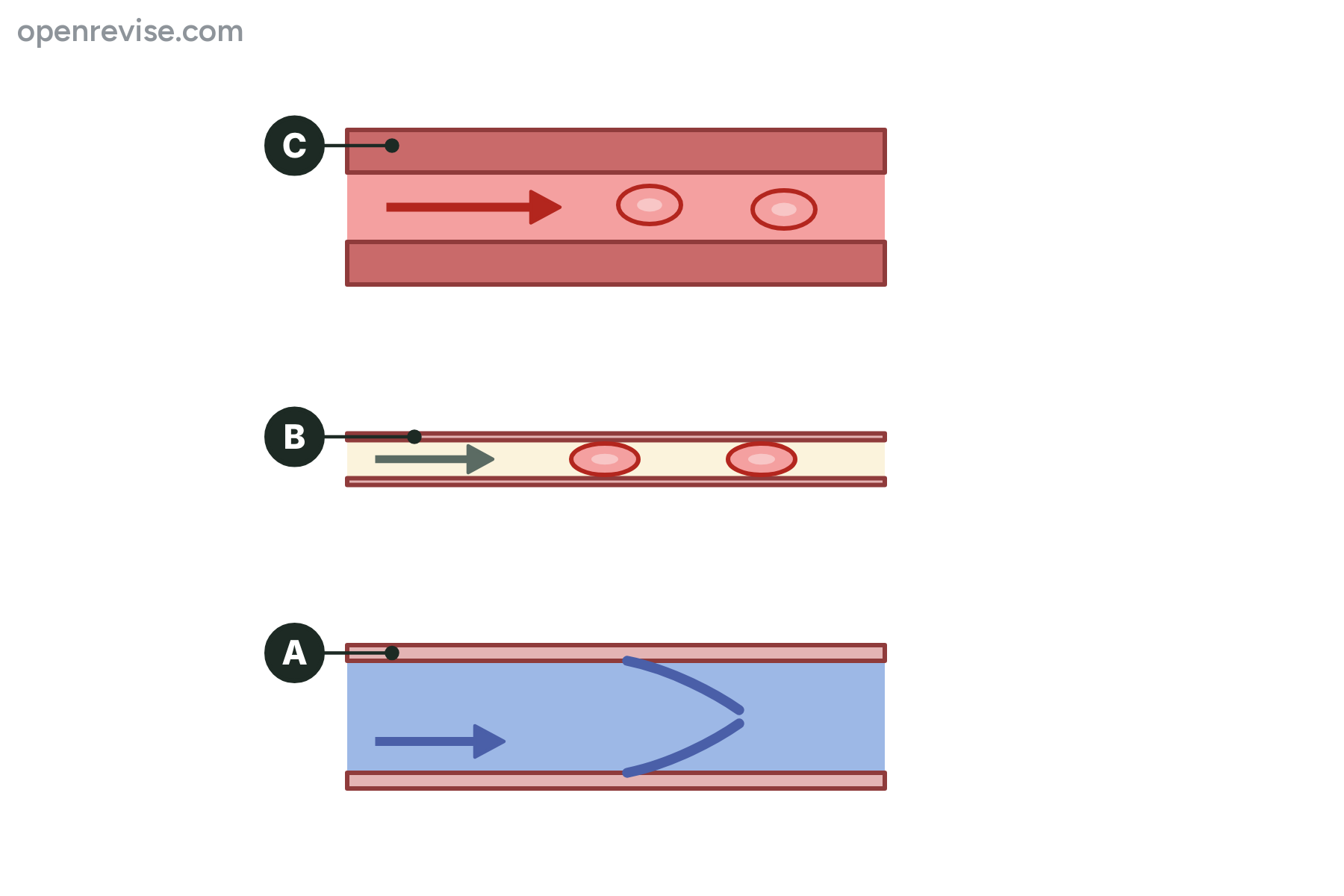
The diagram shows three types of blood vessel. Name the blood vessels labelled A, B and C.
Show answerHide answer
Model answer
A is a vein. B is a capillary. C is an artery.
Mark scheme
- A: vein — 1 mark
- B: capillary — 1 mark
- C: artery — 1 mark
-
3 Explain [2 marks]
Explain why veins have valves.
Show answerHide answer
Model answer
The blood in veins is at a low pressure, so it could flow backwards. The valves close if the blood tries to flow back, so the blood only flows towards the heart.
Mark scheme
- The pressure is low and the blood could flow backwards — 1 mark
- Valves prevent backflow, so blood flows towards the heart — 1 mark
-
4 Explain [3 marks]
Explain how the structure of a capillary is adapted for the exchange of substances between the blood and the cells.
Show answerHide answer
Model answer
The wall of a capillary is only one cell thick, so the diffusion distance is very short. Capillaries are very narrow, so red blood cells pass through in single file, close to the wall. They form a dense network, which gives a large surface area, and the blood flows slowly through them, which gives more time for exchange.
Mark scheme
- Wall one cell thick, so a short diffusion distance — 1 mark
- Very narrow, so red blood cells are close to the wall — 1 mark
- Large network gives a large surface area (and slow flow gives time for exchange) — 1 mark
-
5 Explain [4 marks]
Explain how the structure of an artery is related to its function.
Show answerHide answer
Model answer
An artery carries blood away from the heart at high pressure. It has a thick wall containing muscle, which can withstand the pressure without bursting. The wall also has elastic fibres, which stretch and recoil to smooth the flow of the blood and keep the pressure up. The lumen is narrow, which also helps to keep the pressure high.
Mark scheme
- Carries blood at high pressure — 1 mark
- Thick muscular wall withstands the pressure — 1 mark
- Elastic fibres stretch and recoil, which keeps the pressure up and smooths the flow — 1 mark
- Narrow lumen helps to maintain the pressure — 1 mark
-
6 Calculate [3 marks]
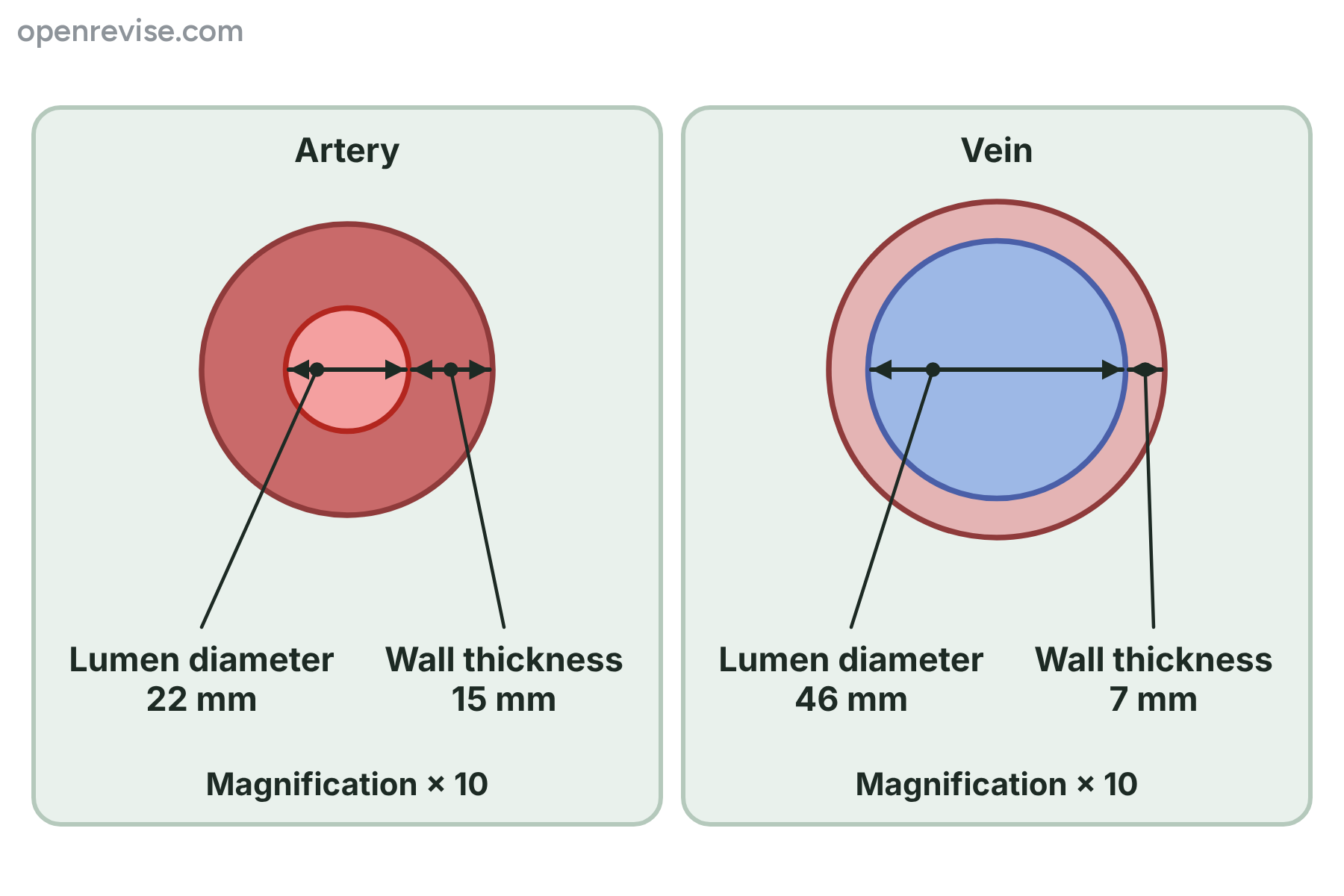
The diagram shows an artery and a vein, both magnified \(\times 10\). Calculate the actual diameter of the lumen of the vein, in mm, and the number of times wider the lumen of the vein is than the lumen of the artery. Give the second answer to 2 significant figures.
Show answerHide answer
Model answer
The actual diameter of the vein's lumen is \(46 \div 10 = 4.6\ \text{mm}\). The vein's lumen is \(46 \div 22 = 2.09\), which is 2.1 times wider than the artery's.
Mark scheme
- \(46 \div 10\) — 1 mark
- 4.6 mm — 1 mark
- 2.1 times (from \(46 \div 22\)) — 1 mark
-
7 Calculate [3 marks]
In a vein in the leg, 360 cm\(^3\) of blood flows past a point in 2 minutes. In an artery in the same leg, 480 cm\(^3\) flows past a point in 90 seconds. Calculate the rate of blood flow in cm\(^3\) per minute in each vessel.
Show answerHide answer
Model answer
Vein: \(360 \div 2 = 180\ \text{cm}^3\) per minute. Artery: \(480 \div 90 = 5.33\ \text{cm}^3\) per second, and \(5.33 \times 60 = 320\ \text{cm}^3\) per minute.
Mark scheme
- Vein: 180 cm\(^3\) per minute — 1 mark
- Artery: converts 90 seconds to 1.5 minutes, or the rate per second to per minute — 1 mark
- Artery: 320 cm\(^3\) per minute — 1 mark
-
8 Explain [6 marks]
Explain how the structure of arteries, veins and capillaries is related to the function of each type of blood vessel.
Show answerHide answer
Model answer
Arteries carry blood away from the heart at high pressure, so they have a thick wall of muscle and elastic fibres to withstand the pressure and keep it up, and a narrow lumen. Veins carry blood back to the heart at low pressure, so they have a thin wall and a wide lumen, which lets the blood flow easily, and valves that stop the blood flowing backwards. Capillaries exchange substances between the blood and the cells, so their walls are one cell thick to give a short diffusion distance, and they are very narrow and form dense networks, which gives a large surface area for exchange.
Mark scheme
- Arteries: high pressure, so a thick muscular wall — 1 mark
- Arteries: elastic fibres and narrow lumen to maintain the pressure — 1 mark
- Veins: low pressure, so a thin wall and a wide lumen — 1 mark
- Veins: valves stop backflow — 1 mark
- Capillaries: wall one cell thick, so a short diffusion distance — 1 mark
- Capillaries: narrow and in dense networks, so large surface area for exchange — 1 mark
Quick check
-
1
Which blood vessels carry blood away from the heart?
Show answerHide answer
B: Arteries
Arteries carry blood away from the heart at high pressure.
-
2
Why does the wall of an artery contain elastic fibres?
Show answerHide answer
D: To stretch and recoil with each heartbeat
The fibres stretch as each surge of blood arrives and recoil afterwards, which smooths the flow and keeps the pressure up.
-
3
What is the main function of the valves in veins?
Show answerHide answer
A: To stop the blood flowing backwards
Valves close if the blood tries to flow backwards, so it can only flow towards the heart.
-
4
How thick is the wall of a capillary?
Show answerHide answer
C: One cell thick
A capillary wall is one cell thick, which gives a short diffusion distance.
-
5
Which statement about the pulmonary vein is correct?
Show answerHide answer
B: It carries oxygenated blood to the heart
The pulmonary vein carries oxygenated blood from the lungs to the heart. It is a vein because it carries blood to the heart.
-
6
An image of a vessel is 60 mm across and the magnification is \(\times 20\). What is the actual diameter?
Show answerHide answer
A: 3 mm
Actual size equals image size divided by magnification, so \(60 \div 20 = 3\ \text{mm}\).
-
7
Which feature is found in a vein but not in an artery?
Show answerHide answer
D: Valves
Veins have valves to stop backflow. Arteries carry blood at high pressure, so they do not need them.
-
8
In 60 seconds, 240 cm\(^3\) of blood flows through a vessel. What is the rate of blood flow?
Show answerHide answer
C: 240 cm\(^3\) per minute
Rate equals volume divided by time, so \(240 \div 1 = 240\ \text{cm}^3\) per minute, which is 4 cm\(^3\) per second.