Flashcards · Biology · Blood, Blood Vessels and the Heart
Arteries, Veins and Capillaries
-
Which direction does blood flow in arteries?
Away from the heart.
-
Which direction does blood flow in veins?
Towards the heart.
-
What is the function of capillaries?
To allow substances to be exchanged between the blood and the cells.
-
Why do arteries have thick walls?
To withstand the high pressure of the blood from the heart.
-
What do the elastic fibres in an artery do?
They stretch and recoil to smooth the flow and keep the pressure up.
-
What is the lumen?
The space inside a blood vessel.
-
Why is the lumen of an artery narrow?
It helps to keep the pressure high.
-
Why do veins have a wide lumen?
The blood has little resistance, so it flows easily at low pressure.
-
Why do veins have valves?
To stop the blood flowing backwards.
-
What helps to push blood along the veins in the legs?
The squeezing of the leg muscles.
-
Why are capillary walls one cell thick?
So that the diffusion distance is very short.
-
Why are capillaries so narrow?
Red blood cells pass through in single file, close to the wall, so oxygen exchange is fast.
-
Why does the blood flow slowly through the capillaries?
The total space in the capillary network is large. It gives time for exchange.
-
Which artery carries deoxygenated blood?
The pulmonary artery, to the lungs.
-
Which vein carries oxygenated blood?
The pulmonary vein, from the lungs.
-
What is your pulse?
The stretching and recoil of an artery wall with each heartbeat.
-
How do you calculate the rate of blood flow?
Volume of blood divided by the time.
-
A vessel image is 40 mm across at \(\times 8\) magnification. What is the actual size?
\(40 \div 8 = 5\ \text{mm}\).
-
Why does a cut artery spurt but a cut vein ooze?
Arteries have high pressure and pulse with the heartbeat. Veins have low pressure.
-
What is the usual mistake with arteries and veins?
Saying arteries carry oxygenated blood and veins deoxygenated. It is the direction of flow that matters.
-
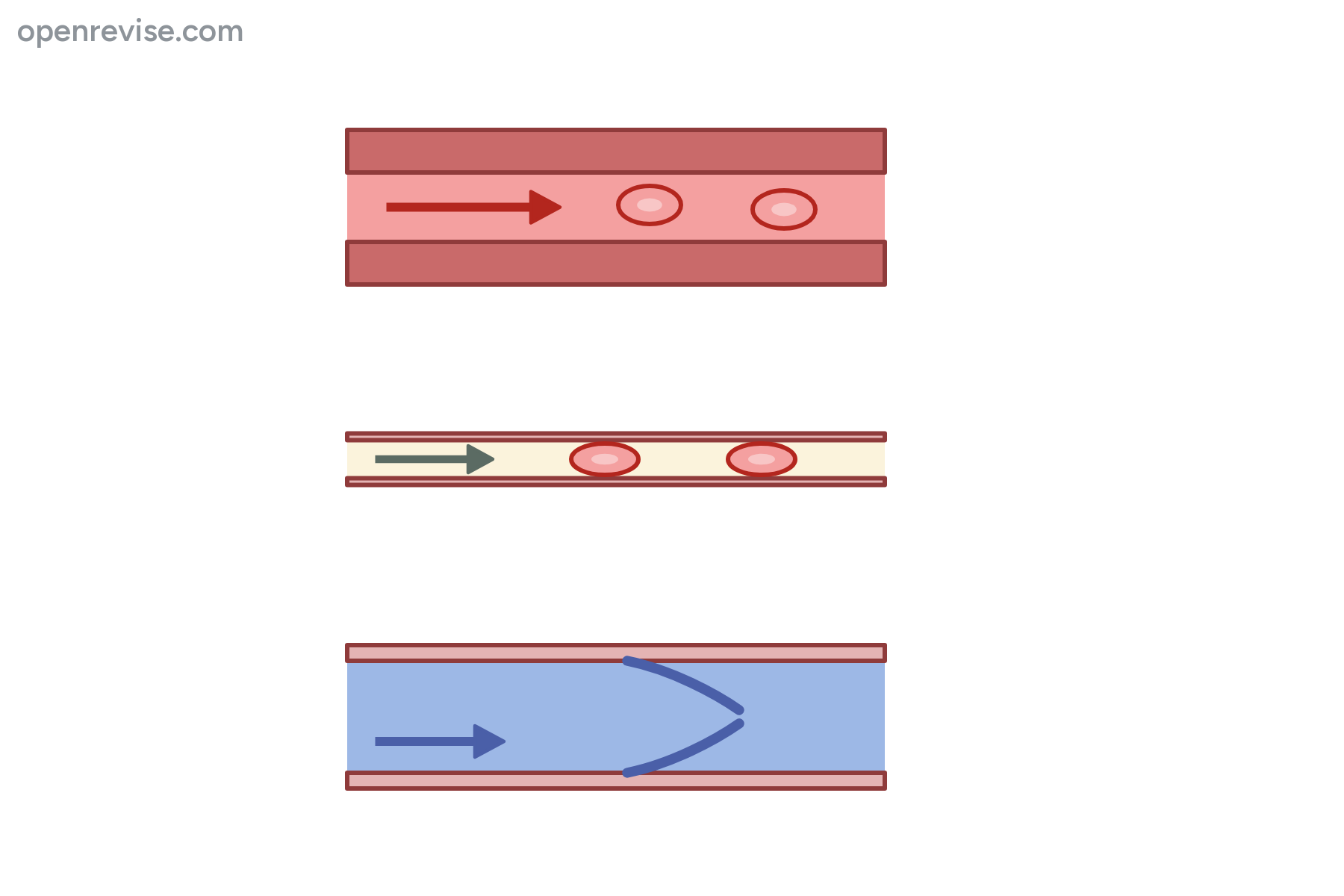 Name the three vessels in this diagram, and say how each is adapted.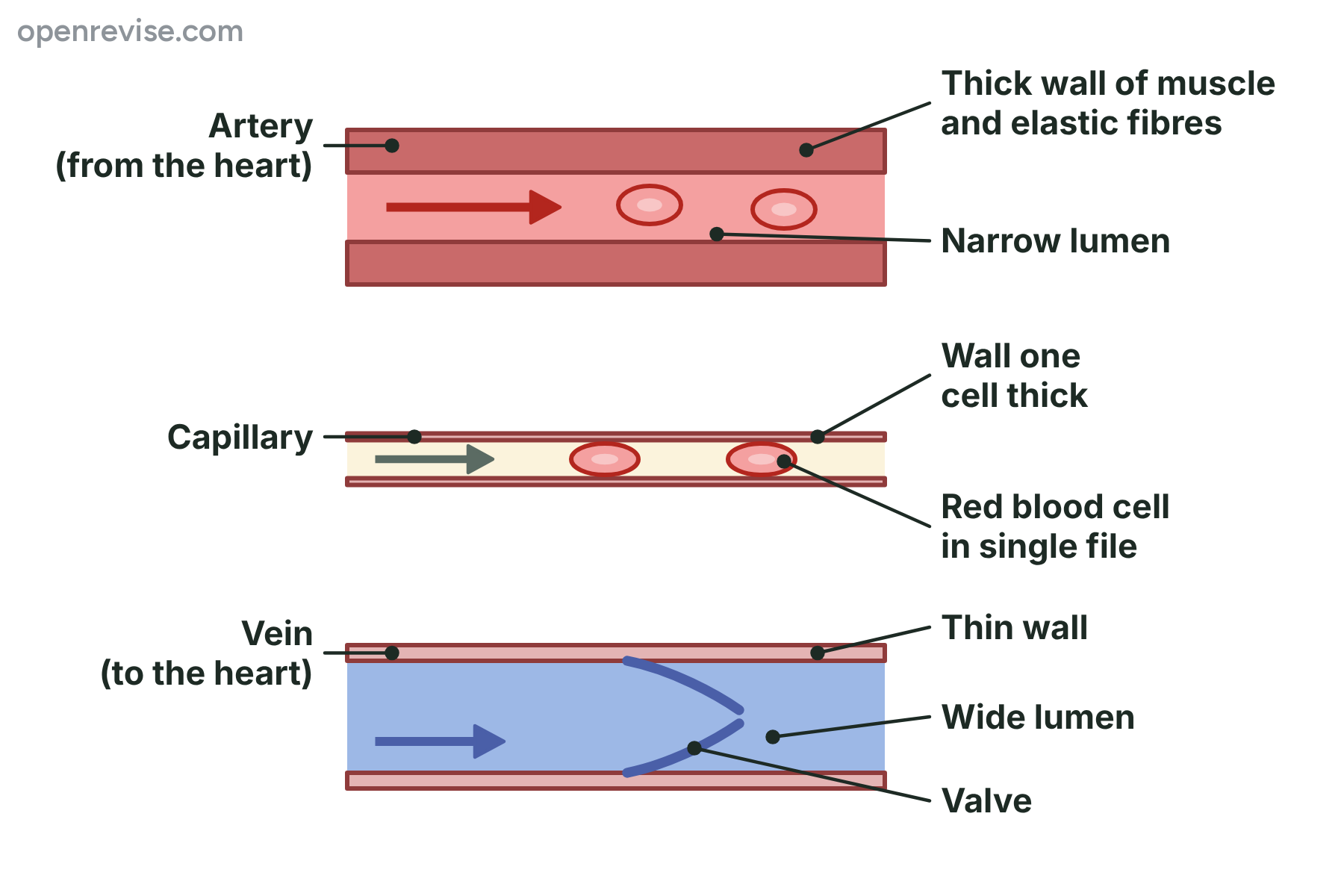
Top is an artery with a thick muscular, elastic wall and a narrow lumen for high pressure. Middle is a capillary, with a wall one cell thick for fast exchange. Bottom is a vein, with a thin wall, a wide lumen and a valve to stop backflow.
-
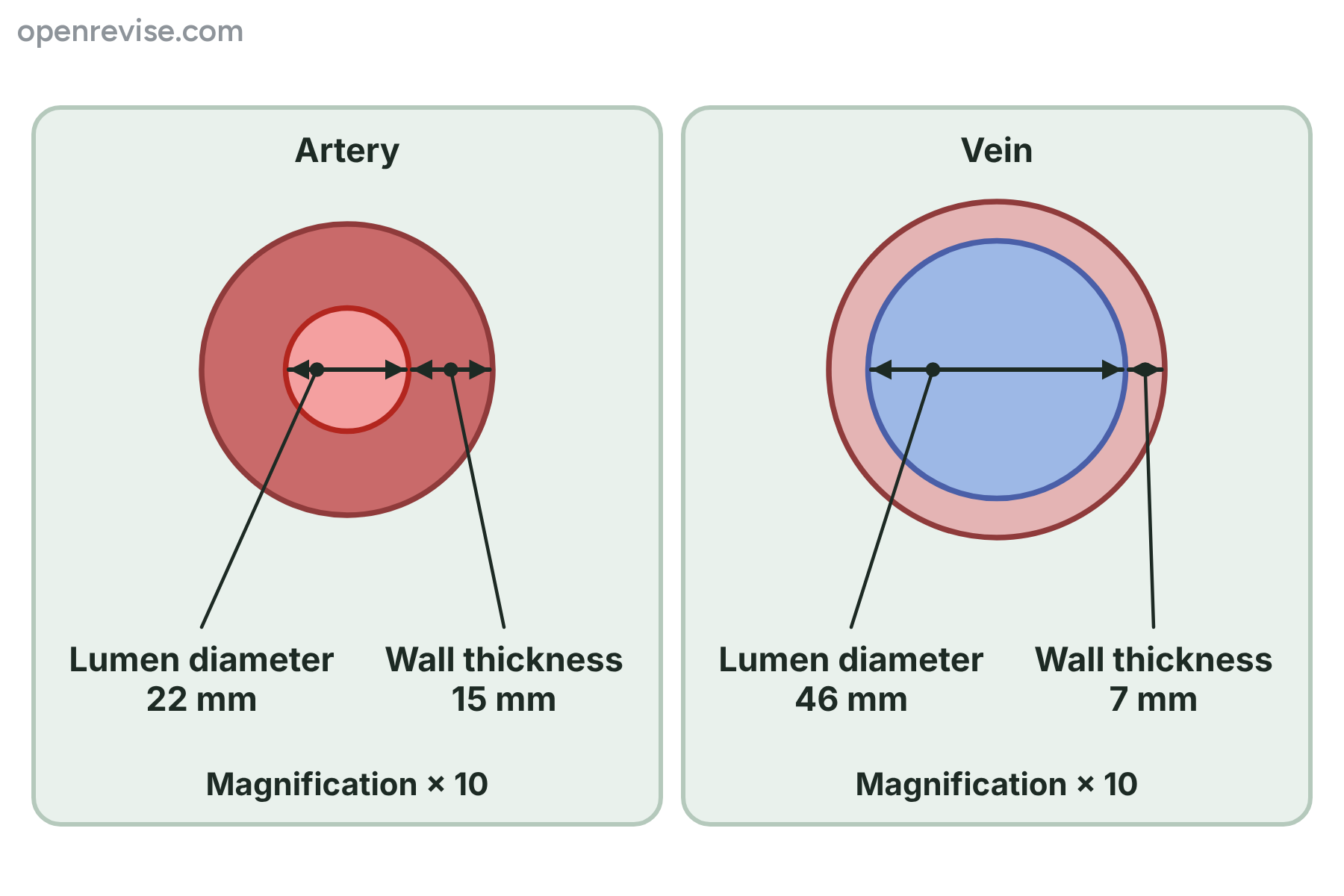 Calculate the actual lumen diameter of the artery.
 Actual size equals image size divided by magnification, so \(22 \div 10 = 2.2\ \text{mm}\).