Exam questions · Biology · Blood, Blood Vessels and the Heart
The Heart and Double Circulation
- 8 exam questions
- 28 marks
- 8 quick checks
-
1 State [1 mark]
Name the chamber of the heart that has the thickest wall.
Show answerHide answer
Model answer
The left ventricle.
Mark scheme
- Left ventricle — 1 mark
-
2 Name [3 marks]
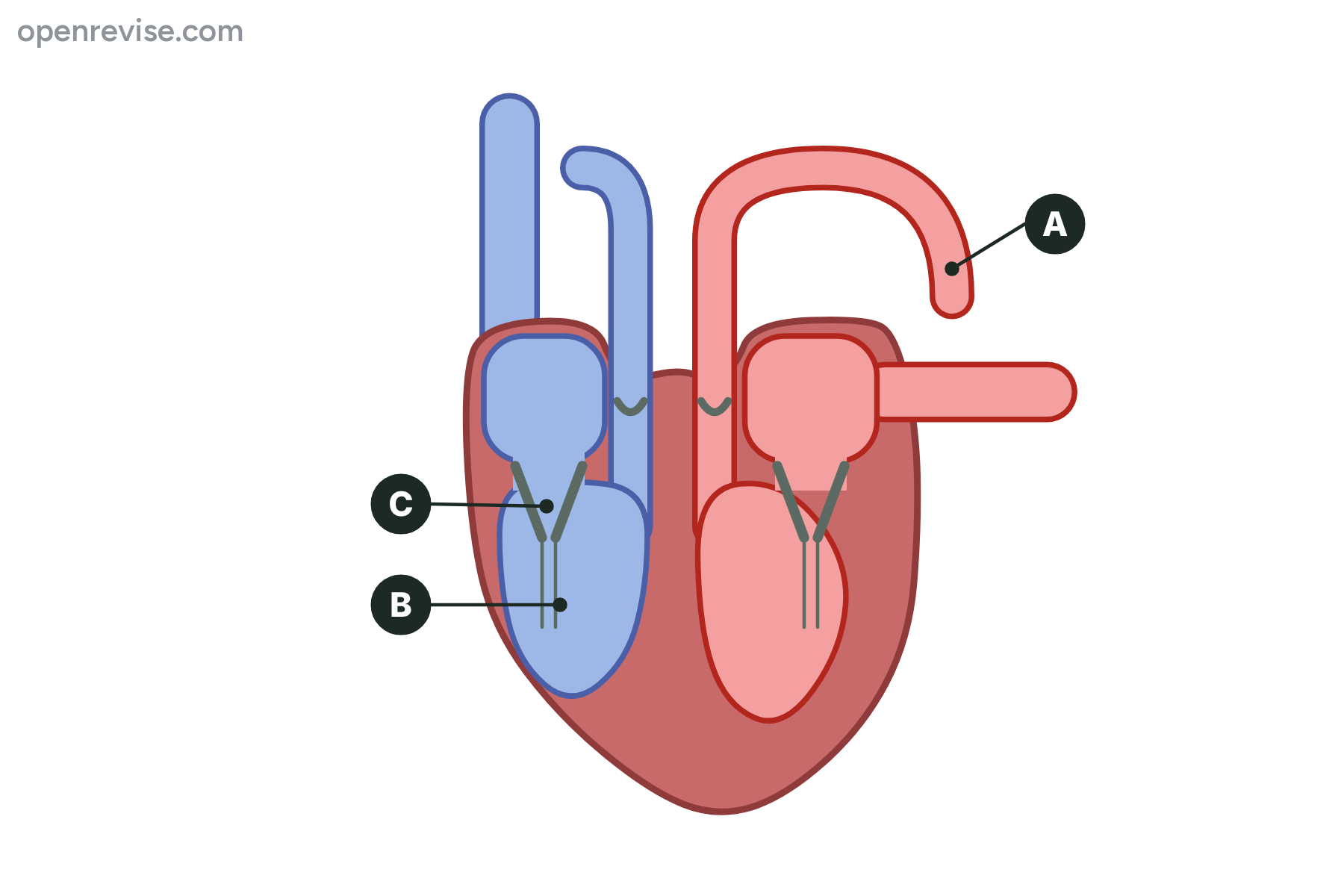
The diagram shows a section through the human heart. Name the parts labelled A, B and C.
Show answerHide answer
Model answer
A is the aorta. B is the right ventricle. C is an atrioventricular valve.
Mark scheme
- A: aorta — 1 mark
- B: right ventricle — 1 mark
- C: atrioventricular valve (valve) — 1 mark
-
3 Name [3 marks]
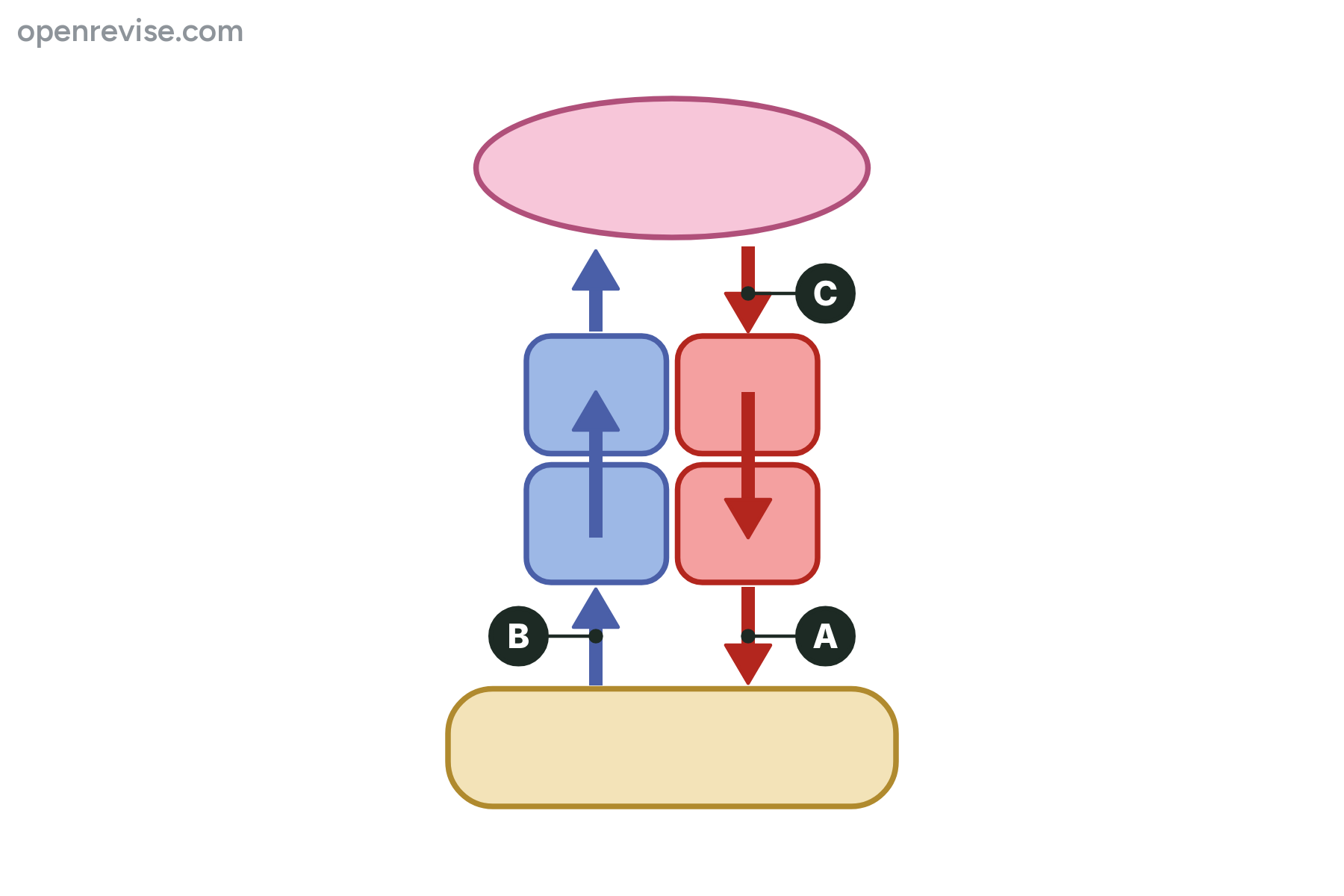
The diagram shows the circulation of the blood. Name the blood vessels labelled A, B and C.
Show answerHide answer
Model answer
A is the aorta. B is the vena cava. C is the pulmonary vein.
Mark scheme
- A: aorta — 1 mark
- B: vena cava — 1 mark
- C: pulmonary vein — 1 mark
-
4 Describe [5 marks]
Describe the route taken by blood from the vena cava to the aorta, through the heart and the lungs.
Show answerHide answer
Model answer
The blood enters the right atrium from the vena cava. It passes into the right ventricle and is pumped out through the pulmonary artery to the lungs. It returns from the lungs in the pulmonary vein to the left atrium. It passes into the left ventricle and is pumped out into the aorta.
Mark scheme
- Vena cava to the right atrium — 1 mark
- Right atrium to the right ventricle — 1 mark
- Right ventricle to the lungs through the pulmonary artery — 1 mark
- Lungs to the left atrium through the pulmonary vein — 1 mark
- Left atrium to the left ventricle, then out through the aorta — 1 mark
-
5 Explain [3 marks]
Explain why the wall of the left ventricle is thicker than the wall of the right ventricle.
Show answerHide answer
Model answer
The left ventricle pumps blood to the whole body, which is a long way, so it has to produce a high pressure. A thick muscular wall contracts with more force. The right ventricle only pumps blood to the lungs, which are close, so a lower pressure is enough and a thinner wall will do.
Mark scheme
- The left ventricle pumps blood all round the body — 1 mark
- A thick muscular wall produces a higher pressure — 1 mark
- The right ventricle only pumps blood to the lungs, so needs less pressure — 1 mark
-
6 Explain [3 marks]
Explain the function of the valves in the heart.
Show answerHide answer
Model answer
The valves make sure that the blood flows in one direction only. The atrioventricular valves close when the ventricles contract, so blood cannot flow back into the atria. The semilunar valves close when the ventricles relax, so blood cannot flow back from the arteries into the ventricles.
Mark scheme
- Valves keep the blood flowing in one direction — 1 mark
- Atrioventricular valves prevent backflow into the atria — 1 mark
- Semilunar valves prevent backflow into the ventricles — 1 mark
-
7 Explain [4 marks]
Humans have a double circulation. Explain why this is an advantage.
Show answerHide answer
Model answer
Blood passes through the heart twice on each trip round the body. After it has been through the narrow capillaries of the lungs its pressure is low, so it returns to the heart to be pumped again at a high pressure. This means that oxygenated blood reaches the body quickly. The septum keeps oxygenated and deoxygenated blood separate, so the blood leaving for the body carries as much oxygen as possible. The lungs receive blood at a lower pressure, which protects their delicate capillaries.
Mark scheme
- The blood goes through the heart twice (lungs and then body) — 1 mark
- The pressure is raised again after the lungs — 1 mark
- Oxygenated blood reaches the body faster — 1 mark
- Oxygenated and deoxygenated blood are kept separate — 1 mark
-
8 Explain [6 marks]
Explain how the structure of the heart and the circulatory system is related to their function.
Show answerHide answer
Model answer
The heart has four chambers. The atria have thin walls because they only push blood into the ventricles, and the ventricles have thicker walls because they pump blood out of the heart. The left ventricle has the thickest wall because it pumps blood at high pressure round the whole body, while the right ventricle pumps blood only to the lungs. The septum keeps oxygenated and deoxygenated blood apart. Valves between the atria and ventricles, and in the arteries, stop blood flowing backwards. Blood goes to the lungs through the pulmonary artery and returns in the pulmonary vein, and leaves for the body through the aorta and returns in the vena cava. This double circulation lets the pressure be raised again after the lungs.
Mark scheme
- Thin atria and thicker ventricles, linked to function — 1 mark
- Left ventricle thicker than right, linked to the pressure needed — 1 mark
- Septum separates oxygenated and deoxygenated blood — 1 mark
- Valves stop backflow — 1 mark
- Correct route using the main vessels — 1 mark
- Double circulation restores the pressure — 1 mark
Quick check
-
1
Which vessel carries oxygenated blood from the heart to the body?
Show answerHide answer
D: Aorta
The aorta carries oxygenated blood from the left ventricle to the body.
-
2
Which vessel brings blood from the lungs to the heart?
Show answerHide answer
A: Pulmonary vein
The pulmonary vein carries oxygenated blood from the lungs to the left atrium.
-
3
What is the main function of the septum?
Show answerHide answer
C: To keep the two sides of the heart separate
The septum separates the right and left sides of the heart so oxygenated and deoxygenated blood do not mix.
-
4
Why do the atria have thinner walls than the ventricles?
Show answerHide answer
B: They only push blood into the ventricles
The atria only push blood a short way into the ventricles, but the ventricles must pump it out of the heart.
-
5
What do the semilunar valves prevent?
Show answerHide answer
D: Blood flowing back into the ventricles from the arteries
They close when the ventricles relax, so blood cannot flow back from the arteries into the ventricles.
-
6
Where does blood pick up oxygen in the double circulation?
Show answerHide answer
C: In the lungs
Blood picks up oxygen in the capillaries of the lungs, between the pulmonary artery and the pulmonary vein.
-
7
Why is the circulatory system of a human called a double circulation?
Show answerHide answer
A: Blood passes through the heart twice on each trip
The blood passes through the heart twice on each complete trip, once going to the lungs and once going to the body.
-
8
A baby is born with a hole in the septum. Which problem is this most likely to cause?
Show answerHide answer
B: The blood sent to the body carries less oxygen
Oxygenated and deoxygenated blood can mix, so the blood sent to the body carries less oxygen.