Exam questions · Biology · Ecosystems and Communities
Abiotic and Biotic Factors
- 8 exam questions
- 26 marks
- 8 quick checks
-
1 State [2 marks]
State two abiotic factors that can affect the species living in a pond.
Show answerHide answer
Model answer
Any two of: temperature, light, water (depth or availability), pollutants, oxygen concentration or pH.
Mark scheme
- First abiotic factor — 1 mark
- Second abiotic factor — 1 mark
-
2 Explain [3 marks]
Very few plants grow on the floor of a dense pine forest. Explain why.
Show answerHide answer
Model answer
The tall trees block most of the light from reaching the forest floor. Plants need light for photosynthesis, so the plants on the floor cannot make enough food to grow. The trees also compete with them for water and mineral ions, so only a few shade-tolerant species survive.
Mark scheme
- The tree canopy blocks light — 1 mark
- Plants need light for photosynthesis, so they cannot make enough food — 1 mark
- Competition for water or mineral ions from the trees — 1 mark
-
3 Describe [3 marks]
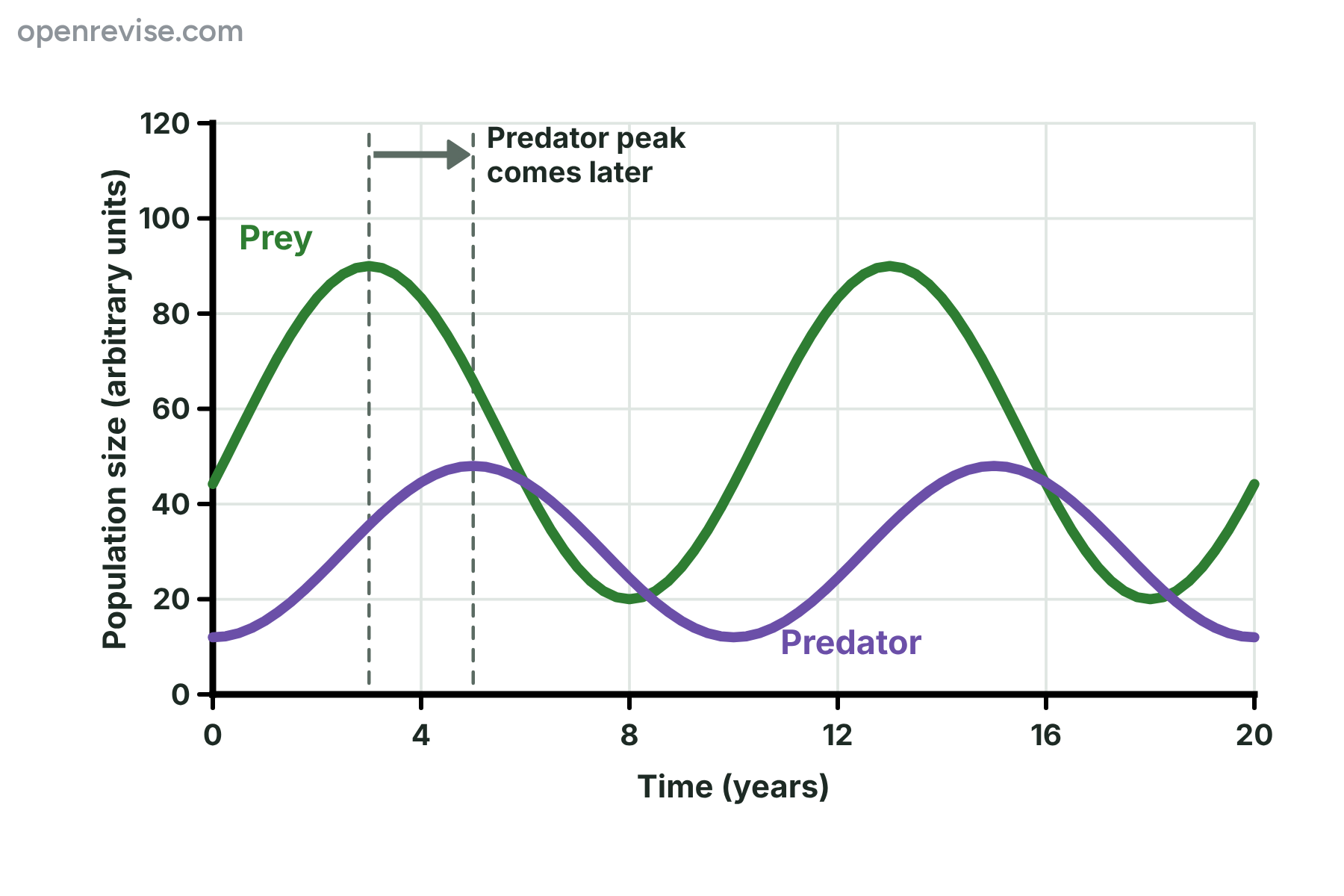
The graph shows the sizes of a prey population and a predator population over 20 years. Describe the pattern shown by the graph.
Show answerHide answer
Model answer
Both populations rise and fall in a repeating cycle, with a peak about every 10 years. The prey population peaks first, at about 90 units in year 3, and the predator population peaks about 2 years later, at about 48 units in year 5. The predator population is always smaller than the prey population.
Mark scheme
- Both populations rise and fall in a repeating (cyclical) pattern — 1 mark
- The predator peak comes after the prey peak (about 2 years later, with figures) — 1 mark
- There are fewer predators than prey — 1 mark
-
4 Explain [3 marks]
Use the graph to explain why the number of predators falls between year 5 and year 10.
Show answerHide answer
Model answer
After year 5 the number of prey is falling, because there are many predators eating them. With less prey to eat, there is less food for the predators, so many starve or fail to breed and the predator population falls.
Mark scheme
- Prey numbers are falling (more eaten by the many predators) — 1 mark
- So less food is available for the predators — 1 mark
- So predators starve or breed less, and their numbers fall — 1 mark
-
5 Calculate [2 marks]
In a predator-prey graph, the prey population falls from a peak of 90 units to a low of 20 units. Calculate the percentage decrease in the prey population. Give your answer to the nearest whole number.
Show answerHide answer
Model answer
Change = 90 - 20 = 70 units. Percentage decrease = \(70 \div 90 \times 100 = 77.8\%\), which is 78% to the nearest whole number.
Mark scheme
- \(70 \div 90 \times 100\) — 1 mark
- 78% — 1 mark
-
6 Explain [4 marks]
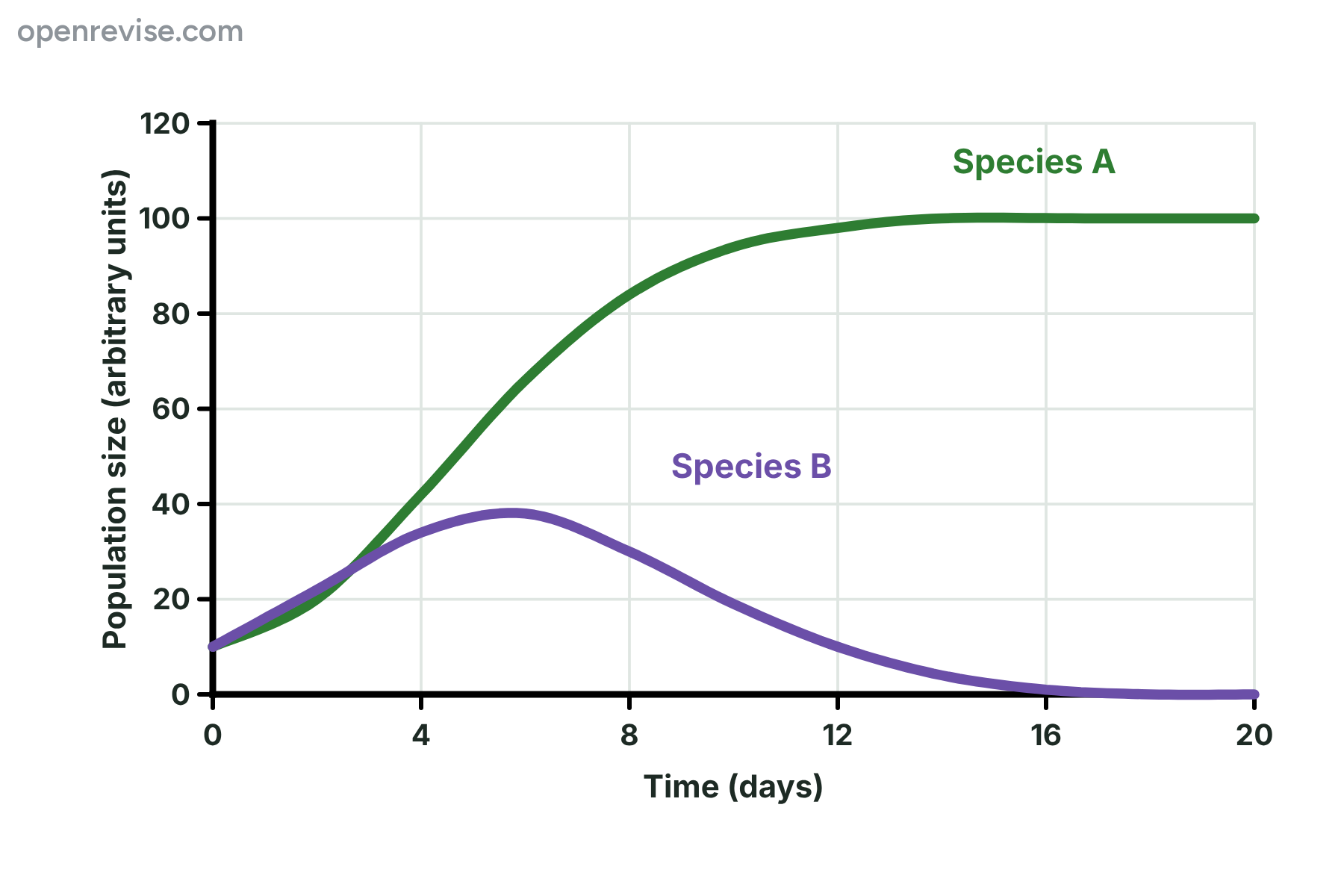
Two species of microorganism, A and B, were grown together in the same container with a limited supply of the same food. The graph shows the results. Describe what happened to each species and explain the pattern.
Show answerHide answer
Model answer
Species A increased and then stayed constant at about 100 units from day 14. Species B increased to about 38 units by day 6 but then fell and had almost died out by day 18. The two species were competing for the same limited food. Species A was better at getting the food, so it survived and reproduced more, and species B did not get enough food, so it declined.
Mark scheme
- Species A increased and then levelled off at about 100 — 1 mark
- Species B increased at first, then fell to almost zero — 1 mark
- The species competed for the same limited food — 1 mark
- Species A was better at getting the food (outcompeted B), so B declined — 1 mark
-
7 Explain [3 marks]
A power station burns coal and releases sulfur dioxide, which dissolves in rain. Explain how this could change the community of organisms in a nearby woodland.
Show answerHide answer
Model answer
Sulfur dioxide is a pollutant, and it makes the rain acidic. Acid rain damages the leaves and roots of trees and acidifies the soil and streams, so sensitive plants and animals die. The number of species in the woodland falls, and the animals that depended on them for food are affected too.
Mark scheme
- Sulfur dioxide is a pollutant that makes rain acidic — 1 mark
- Sensitive plants or animals are damaged or die — 1 mark
- Fewer species, and the animals that depend on them are affected — 1 mark
-
8 Explain [6 marks]
Explain how abiotic and biotic factors can affect the species found in a community. Use examples in your answer.
Show answerHide answer
Model answer
Abiotic factors are the non-living parts of the environment. Temperature affects the enzymes in organisms, so very cold or very hot places support few species. Light is needed for photosynthesis, so on a woodland floor under a thick canopy only shade-tolerant plants survive. Water is needed by all organisms, so in a desert only plants such as cacti that store water can live there. Pollutants such as sulfur dioxide kill sensitive species, so the number of species falls. Biotic factors are living. In competition, organisms fight for limited resources such as food or light, so the species that is better adapted survives and the other declines. In predation, the number of predators rises and falls just after the number of their prey, so predators and prey are linked in a cycle. Disease can also reduce a population. All of these decide which species live in a community and how many there are.
Mark scheme
- Abiotic factors defined as non-living, with one named example and its effect (temperature) — 1 mark
- A second abiotic example with its effect on species (light, water or a pollutant) — 1 mark
- A third abiotic example, or a clear effect on the number of species — 1 mark
- Biotic factors defined as living, with competition and its effect on populations — 1 mark
- Predation and its effect, such as the predator-prey cycle — 1 mark
- A conclusion linking the factors to which species are present and how many — 1 mark
Quick check
-
1
Which of these is an abiotic factor?
Show answerHide answer
C: Light intensity
Light is a non-living factor. Predation, competition and disease involve living organisms, so they are biotic.
-
2
Which of these is a biotic factor?
Show answerHide answer
A: Competition for food
Competition between organisms is a biotic factor because it involves living things.
-
3
In a predator-prey cycle, which population reaches its peak first?
Show answerHide answer
B: The prey
The prey peak comes first, because the predators increase only after there is plenty of prey to eat.
-
4
Why does the number of prey fall after the number of predators rises?
Show answerHide answer
D: More prey are eaten by the extra predators
More predators eat more prey, so the prey population decreases.
-
5
What do plants in a woodland compete for?
Show answerHide answer
A: Light, water, mineral ions and space
Plants compete for light, water, mineral ions from the soil and space.
-
6
In a graph, a prey peak is at year 3 and the next predator peak is at year 5. What does this show?
Show answerHide answer
C: The predator numbers follow the prey numbers
The predator numbers lag behind the prey numbers, because the predators need time to increase when food becomes plentiful.
-
7
A prey population falls from 80 to 20. What is the percentage decrease?
Show answerHide answer
D: 75%
The change is 60, and 60 divided by 80 is 0.75, which is 75%.
-
8
How can a pollutant change a community?
Show answerHide answer
B: It kills sensitive species
Sensitive species die out when a pollutant is added to their environment, so the number of species falls.