Biology · Ecosystems and Communities
Abiotic and Biotic Factors
Why are there cacti in a desert, mosses in a damp wood and almost nothing growing under a dense pine plantation? This lesson is for both Combined Science and separate Biology. It explains how non-living (abiotic) factors and living (biotic) factors decide which organisms live in a community and how many there are, including how to read predator-prey graphs.
Learning Objectives
- 1Explain how the abiotic factors temperature, light, water and pollutants can affect a community.
- 2Explain how the biotic factors competition and predation can affect a community.
- 3Describe and explain the pattern of a predator-prey cycle shown on a graph.
- 4Interpret graphs of population size against time, including calculating a percentage change.
Retrieval practice
-
1
What is a community?
Show answerHide answer
All the populations of the different species living in the same place.
-
2
Which three things does a plant need for photosynthesis?
Show answerHide answer
Light, water and carbon dioxide.
-
3
What happens to an enzyme if the temperature gets too hot?
Show answerHide answer
Its shape changes (it is denatured) and it stops working.
-
4
What is a food chain?
Show answerHide answer
A diagram showing what eats what, with arrows pointing the way energy is transferred.
Why is this species here, and not that one?
Every community is shaped by the conditions it has to live in and by the other organisms around it. Biologists split these influences into two kinds. Abiotic factors are the non-living features of the environment, such as temperature and light. Biotic factors are the living features, such as the animals that eat you and the plants that compete with you. A change in either kind can change which species survive and how many individuals there are.
Abiotic factors
Abiotic factors are the non-living parts of an ecosystem. Four are on the specification, and each one acts on the producers first.
-
Temperature
Enzymes control the reactions of life, so temperature affects how fast organisms grow, move and reproduce. Few species can live in very cold or very hot places, and as the climate warms some species move to cooler places and others die out.
-
Light
Plants and algae need light for photosynthesis, so light intensity limits how many producers a place can support, and so how many consumers. Under a dense tree canopy only shade-tolerant plants grow, and in a lake the light fades with depth.
-
Water
All organisms need water, and in dry places there are fewer species and fewer organisms. Desert plants such as cacti store water, and in a drought the populations of many plants and animals fall.
-
Pollutants
A pollutant is a harmful substance added to the environment, such as sulfur dioxide from burning fossil fuels, fertiliser washed off fields, or oil. Sensitive species die out, so the number of species in the community falls.
Abiotic and biotic factors
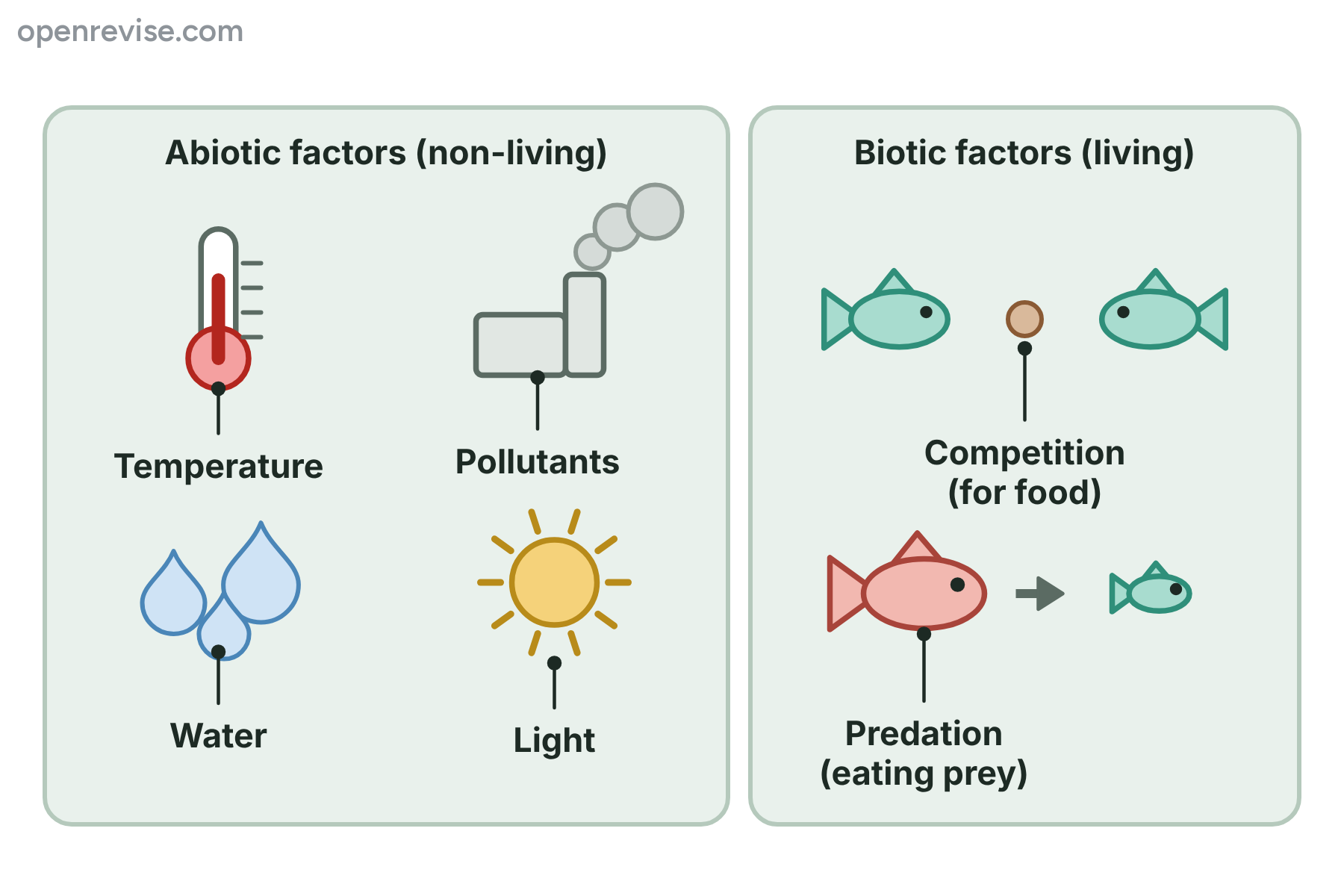
Abiotic factors are non-living. Biotic factors are living organisms and their interactions.
Biotic factors: competition
Competition happens when organisms need the same resource and there is not enough for all of them.
-
What organisms compete for
Animals compete for food, water, mates, territory and shelter. Plants compete for light, water, mineral ions from the soil, and space to grow.
-
Who wins
The individuals or species that are best adapted to get the resource survive and breed more. Their population grows while the population of the weaker competitor shrinks.
-
Effects on the community
If two species need exactly the same resources one may be driven out of the area completely, which lowers the number of species in the community. The graph shows this happening to species B.
-
Who competes with whom
Members of the same species compete most strongly, because they need exactly the same things. Different species compete too when they share a food or a place to live.
Competition between two species
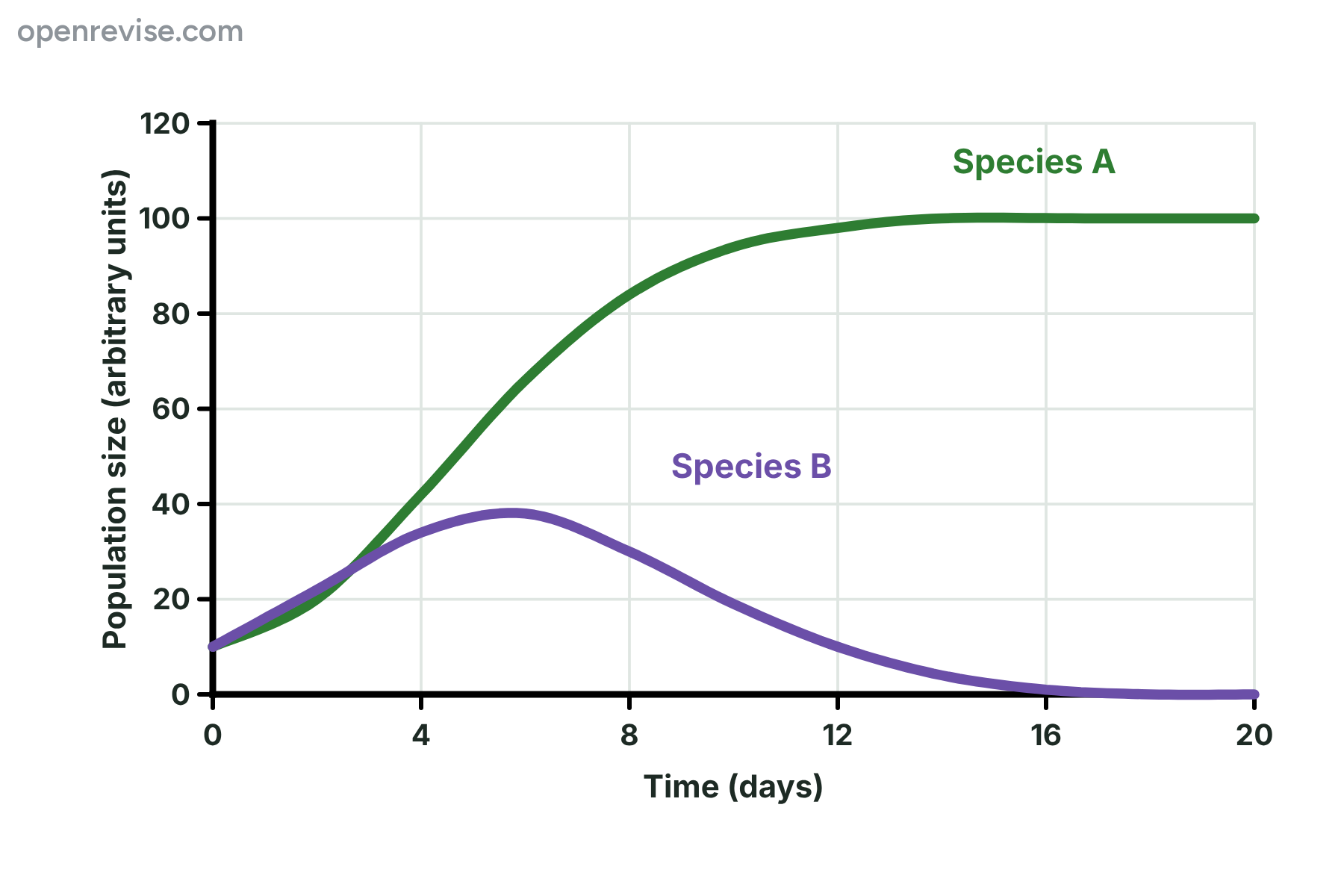
Two species sharing the same food: species A wins, and species B dies out. This is a simplified version of a classic laboratory experiment on Paramecium.
Biotic factors: predation
A predator is an animal that kills and eats other animals, which are its prey. Predation links the numbers of the two populations together.
-
Prey numbers
A new or growing predator population eats more prey, so the prey population falls. When there are fewer predators, more prey survive and the prey population can increase.
-
Predator numbers
The number of predators depends on how much prey there is. When prey is plentiful the predators have more food, so more survive and breed. When prey becomes scarce, predators starve or move away.
-
Effects on the community
Predators can stop a prey species from eating all of its food plants, so predation helps to keep a community balanced. If a predator is introduced to a new area, or removed from it, the community can change a lot.
-
Other biotic factors
Disease and the supply of food also change populations, so a species can be affected by a new pathogen, or by a fall in the numbers of the organisms it eats.
The predator-prey cycle
Where one predator mostly eats one prey, the two populations rise and fall in a repeating cycle. The predator numbers always follow the prey numbers.
-
1
Prey increases
There is plenty of food and few predators, so many prey survive and breed.
-
2
Predators increase
There is now plenty of prey to eat, so more predators survive and breed. Their numbers rise a little later than the prey numbers.
-
3
Prey decreases
More predators eat more prey, so the prey population falls.
-
4
Predators decrease
With less prey to eat, many predators starve or fail to breed, so the predator population falls.
-
5
The cycle repeats
With fewer predators, the prey recover and start to increase again.
Reading a predator-prey graph
Two features of the graph are worth quoting in an exam.
What the graph shows
- The prey peak comes first The prey population reaches its maximum before the predator population, because the predators can only increase once there is plenty of food.
- The predator peak is delayed Here the predators peak about 2 years after the prey, because predators take time to breed in response to more food.
- The predators are fewer There are always fewer predators than prey, because energy is lost at each step of a food chain, so the prey cannot support as many predators.
- The pattern repeats Both populations rise and fall again and again, so each stays within limits.
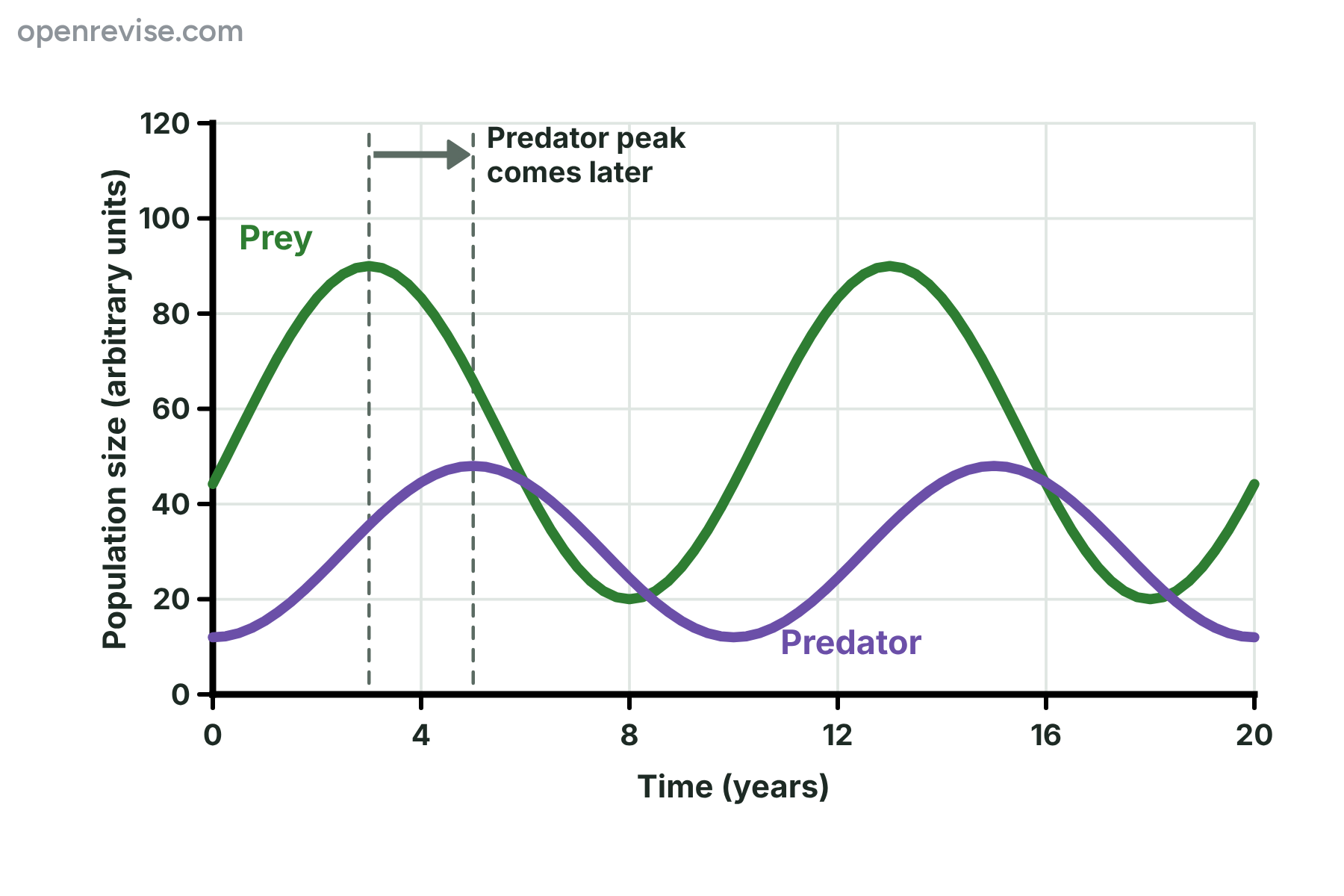
The predator peak comes after the prey peak, and there are fewer predators than prey.
Percentage change in a population from a graph
In the predator-prey graph the prey population falls from a peak of 90 units in year 3 to a low of 20 units in year 8. Calculate the percentage decrease in the prey population.
Show the solutionHide the solution
- 1 Find the change \(90 - 20 = 70\) units
- 2 Divide by the starting value \(70 \div 90 = 0.778\)
- 3 Multiply by 100 \(0.778 \times 100 = 77.8\%\)
- 4 Round and state the direction about 78% decrease
AnswerA decrease of about 78%.
Case study
Snowshoe hares and Canadian lynx
The best known predator-prey cycle comes from the fur records of the Hudson's Bay Company in Canada. The records show that the numbers of snowshoe hares and lynx that were trapped rose and fell together, with the lynx peaks coming just after the hare peaks. The cycle lasted about ten years. Food supply for the hares, disease and the weather matter too, so predation is not the whole story, but the lynx cannot survive without the hares.
Abiotic or biotic?
Abiotic factors (non-living)
- Temperature
- Light intensity
- Water availability
- Pollutants such as sulfur dioxide
Biotic factors (living)
- Competition for food, light or space
- Predation
- Disease caused by pathogens
- The food supply from other organisms
The big idea
A community is shaped by what the environment gives it and by what the other organisms take from it.
Describe a graph first, then use the factors to explain it.
Factors affecting communities
Factors affecting communities
-
Abiotic
- temperature
- light
- water
- pollutants
-
Biotic
- competition
- predation
- disease
- food supply
-
Competition
- same resources
- better adapted wins
- weaker declines
-
Predator-prey
- prey peak first
- predator peak later
- fewer predators
-
Graph skills
- describe the pattern
- quote values
- percentage change
Summary and exam focus
- Abiotic factors are non-living, such as temperature, light, water and pollutants, and they affect which organisms can live in a place and how many there are.
- Biotic factors are living, such as competition and predation, and they affect the populations of other species in the community.
- The better adapted competitor gets more of a limited resource and survives, while the weaker one declines and may die out locally.
- In a predator-prey cycle the prey peak comes first, then the predator peak, and the predator numbers are lower.
- A stable community has populations that rise and fall within limits rather than disappearing.
Exam focus
Describe and explain the pattern shown by a graph in which the number of prey rises and falls, and the number of predators rises and falls just after it. (4 marks) (4 marks)
Describe first with a quoted number or year, then explain. Say that the predator peak comes after the prey peak because predators need time to breed when food is plentiful, and that the prey fall because more are eaten. Use the words predator and prey, not just animals.
Key terms
The words this lesson expects you to use. Each one is linked from the first place it appears above.
- Abiotic factor
- A non-living part of the environment, such as temperature, light, water or a pollutant.
- Biotic factor
- A living part of the environment, such as competition, predation or disease.
- Competition
- The struggle between organisms for the same limited resource, such as food, light, water or space.
- Predator
- An animal that kills and eats other animals.
- Prey
- An animal that is killed and eaten by a predator.
- Predation
- The killing and eating of prey by a predator.
- Pollutant
- A harmful substance added to the environment, usually by human activity.
- Stable community
- A community in which the populations stay roughly constant over time because the factors that raise and lower them balance.
- Resource
- Something an organism needs, such as food, water, light, space or a mate.
You've finished the notes
Check your understanding
Test yourself while it is fresh. Start with the flashcards, then try the exam questions.
Something here looks wrong?
Tell us what and we will go and look. It goes to whoever writes these pages, nobody else, and we do not ask who you are — so there is nothing to sign and nothing comes back to you.