Exam questions · Biology · Ecosystems and Communities
Energy Transfer and Pyramids of Biomass
- 8 exam questions
- 27 marks
- 8 quick checks
-
1 Name [2 marks]
Name two ways in which energy is lost from a food chain between one trophic level and the next.
Show answerHide answer
Model answer
Any two of: heat from respiration, in waste such as faeces and urine, in parts that are not eaten such as bones.
Mark scheme
- First way of losing energy — 1 mark
- Second way of losing energy — 1 mark
-
2 Name [3 marks]
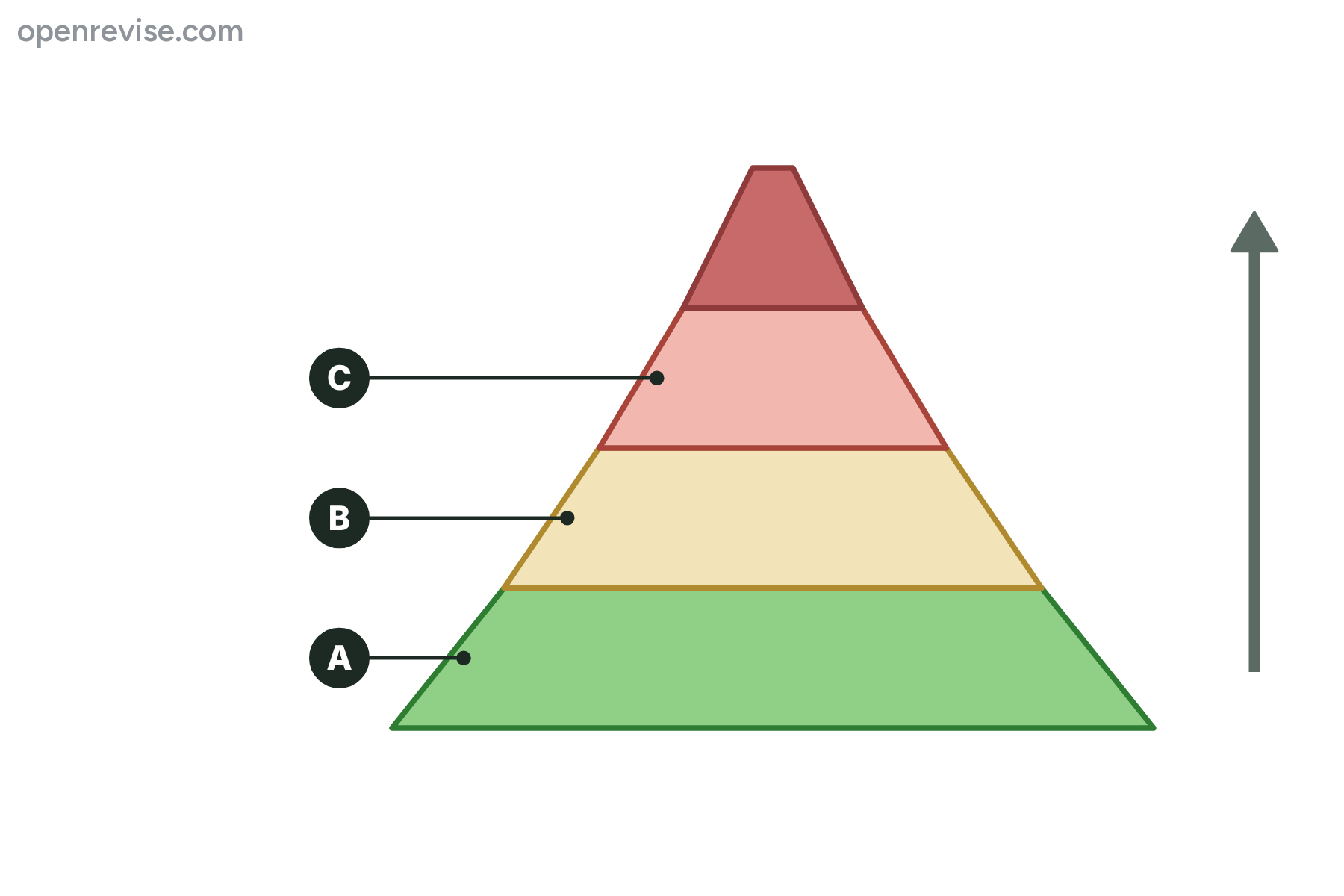
The diagram is a pyramid of biomass. Name the trophic levels A, B and C.
Show answerHide answer
Model answer
A is the producer(s), B is the primary consumer(s) and C is the secondary consumer(s).
Mark scheme
- A: producer — 1 mark
- B: primary consumer — 1 mark
- C: secondary consumer — 1 mark
-
3 Explain [3 marks]
Explain why a pyramid of biomass is always wider at the bottom than at the top.
Show answerHide answer
Model answer
The producers at the bottom contain the most biomass. At each step in the food chain some energy is lost, as heat from respiration, in waste and in parts that are not eaten. Less energy is transferred to the next level, so less biomass can be made, and each level has less biomass than the one below it.
Mark scheme
- Producers have the most biomass (the base) — 1 mark
- Energy is lost at each trophic level (with a named way, such as respiration or waste) — 1 mark
- So there is less energy and less biomass at each higher level — 1 mark
-
4 Calculate [2 marks]
The grass in a field contains 25 000 kJ of energy per square metre per year. The primary consumers that eat the grass gain 2 000 kJ of energy in their biomass. Calculate the efficiency of the energy transfer from the grass to the primary consumers.
Show answerHide answer
Model answer
Efficiency = \(2000 \div 25000 \times 100 = 8\%\).
Mark scheme
- \(2000 \div 25000\) (equation with numbers) — 1 mark
- 8% — 1 mark
-
5 Calculate [3 marks]
A food chain has the following biomass at each trophic level: producers 640 g per m\(^2\), primary consumers 80 g per m\(^2\), secondary consumers 6 g per m\(^2\). Calculate the percentage of the biomass transferred (a) from the producers to the primary consumers and (b) from the primary consumers to the secondary consumers. State which transfer is less efficient.
Show answerHide answer
Model answer
(a) \(80 \div 640 \times 100 = 12.5\%\). (b) \(6 \div 80 \times 100 = 7.5\%\). The transfer from primary consumers to secondary consumers is less efficient.
Mark scheme
- (a) 12.5% — 1 mark
- (b) 7.5% — 1 mark
- Primary to secondary consumers is less efficient — 1 mark
-
6 Explain [4 marks]
Explain why food chains rarely have more than five trophic levels.
Show answerHide answer
Model answer
Energy is lost at each trophic level, as heat from respiration, in waste such as faeces and urine, and in parts of the organisms that are not eaten. This means that less energy is available at each higher level. By the fifth level, so little energy is left that it cannot support a population that is big enough to survive, so there is no sixth level.
Mark scheme
- Energy is lost at each trophic level — 1 mark
- A named way of losing energy (heat from respiration, waste, parts not eaten) — 1 mark
- Less energy (and biomass) is available at each higher level — 1 mark
- Not enough energy left to support another viable population after four or five levels — 1 mark
-
7 Calculate [4 marks]
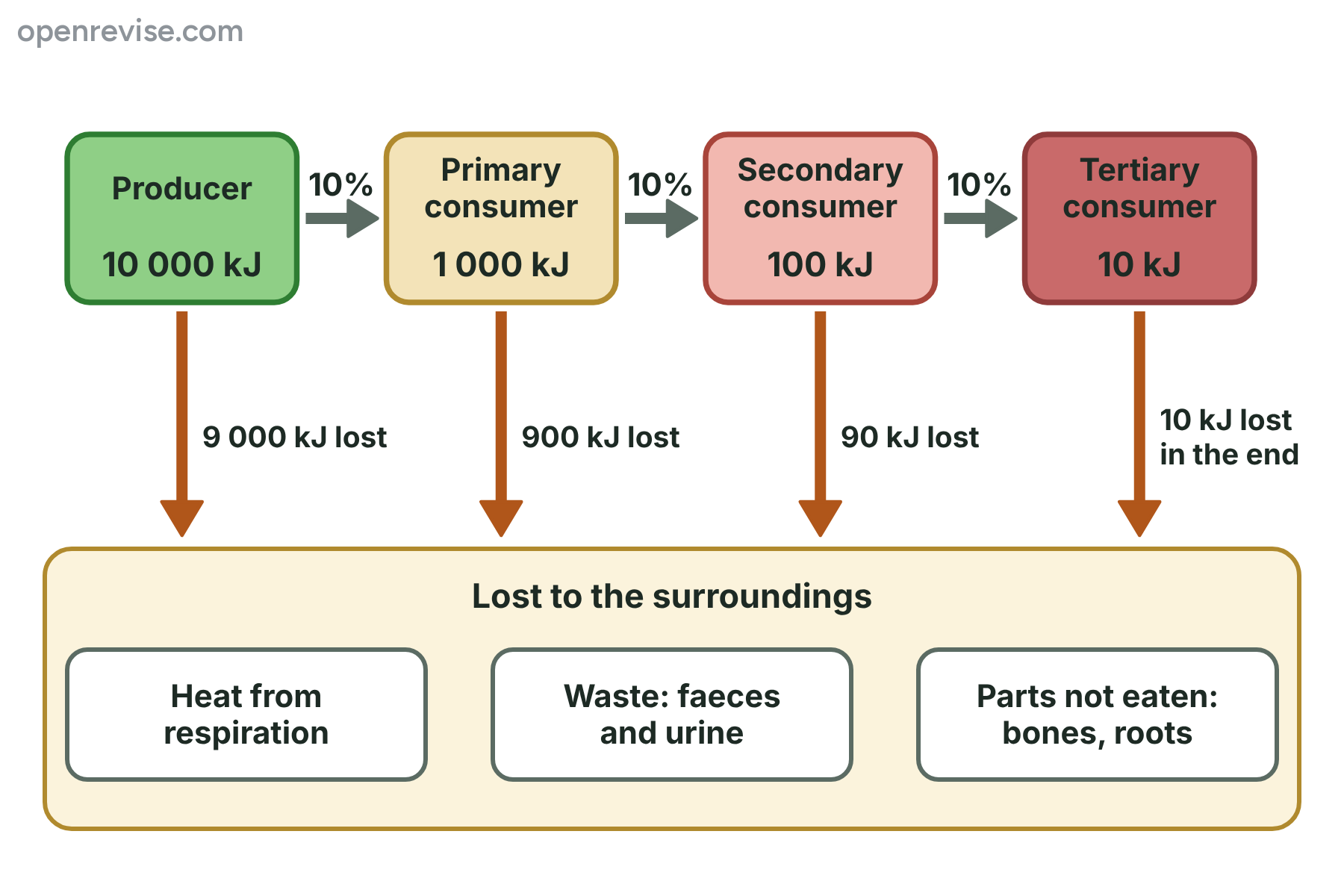
The diagram shows the energy in each trophic level of a food chain. (a) Calculate the efficiency of the energy transfer from the primary consumers to the secondary consumers. (2 marks) (b) Explain two ways in which the 900 kJ is lost. (2 marks)
Show answerHide answer
Model answer
(a) \(100 \div 1000 \times 100 = 10\%\). (b) Some of the energy is released as heat during respiration, which the primary consumers use for movement and keeping warm. Some is lost in faeces and urine, or in parts of the primary consumers, such as bones, that are not eaten.
Mark scheme
- (a) \(100 \div 1000 \times 100\) — 1 mark
- (a) 10% — 1 mark
- (b) First way, such as heat from respiration, with a reason — 1 mark
- (b) Second way, such as faeces and urine, or parts not eaten — 1 mark
-
8 Explain [6 marks]
A farmer can use a field to grow wheat for people to eat, or to grow grass to feed beef cattle. Explain, in terms of energy transfer, why the field would provide food for more people if it is used to grow wheat.
Show answerHide answer
Model answer
Wheat is a producer, so people who eat it are primary consumers. This is a short food chain with only one energy transfer. If the field is used to grow grass for cattle, there is an extra trophic level: grass, cattle, people. At each transfer, much of the energy is lost. The cattle use energy in respiration, which is released as heat, for movement and for keeping warm. Some is lost in their faeces and urine, and some is stored in parts of the cow that people do not eat, such as bones. Only a small percentage, about 10%, of the energy in the grass ends up in the meat. So a lot more of the energy in the wheat reaches people than the energy in the grass would. This means that more people can be fed from the same area of land if it is used for wheat.
Mark scheme
- Wheat is eaten directly, so the chain is shorter — 1 mark
- With cattle there is an extra trophic level (an extra energy transfer) — 1 mark
- Energy is lost at each transfer — 1 mark
- A named way energy is lost by the cattle, such as respiration (heat), waste or uneaten parts — 1 mark
- Only a small percentage (about 10%) of the energy reaches the next level — 1 mark
- So more energy is available to people from the wheat, so the field feeds more people — 1 mark
Quick check
-
1
At which trophic level are the primary consumers?
Show answerHide answer
B: Trophic level 2
Producers are at level 1, primary consumers at level 2, secondary consumers at level 3 and tertiary consumers at level 4.
-
2
Which is the main way in which energy is lost between trophic levels?
Show answerHide answer
C: Heat from respiration
Respiration releases most of the energy in food as heat, which transfers to the surroundings.
-
3
Why are food chains rarely longer than five trophic levels?
Show answerHide answer
A: Too little energy is left to support another level
Energy is lost at each level, so there is too little left to support another population.
-
4
What shape does a pyramid of biomass normally have?
Show answerHide answer
D: Widest at the bottom and narrowest at the top
Each trophic level has less biomass than the level below it, so the pyramid has a wide base and a narrow top.
-
5
A producer level contains 8 000 kJ and the primary consumers contain 640 kJ. What is the efficiency of the energy transfer?
Show answerHide answer
B: 8%
The efficiency is 640 divided by 8000, multiplied by 100, which is 8%.
-
6
Why is biomass measured as dry mass?
Show answerHide answer
D: The water content of an organism varies
The water content of organisms varies, so removing it gives a fairer measure of the living material.
-
7
In a pyramid of biomass, the secondary consumers contain 12 g per m\(^2\) and the primary consumers contain 150 g per m\(^2\). What percentage of the biomass is transferred between them?
Show answerHide answer
A: 8%
The higher level is divided by the lower level: 12 divided by 150 is 0.08, which is 8%.
-
8
Why can a field of wheat feed more people than the same field used for beef cattle?
Show answerHide answer
C: Fewer energy transfers means less energy is lost
Eating the wheat directly is a shorter food chain, so less energy is lost than when it passes through cattle first.