Biology · Ecosystems and Communities
Energy Transfer and Pyramids of Biomass
A lion needs a huge territory, yet a field of wheat can feed far more people than a field of cattle. The reason is energy loss along food chains. This lesson is for separate Biology only: Combined Science students do not need it. It explains how energy is lost at each trophic level, why food chains are short, why pyramids of biomass narrow, and how to calculate efficiency and percentage biomass.
Learning Objectives
- 1Explain how some energy is transferred to less useful forms at each trophic level.
- 2Explain how this affects the number of organisms at each trophic level, limits the length of a food chain and determines the shape of a pyramid of biomass.
- 3Describe how a pyramid of biomass is drawn and what it shows.
- 4Calculate the efficiency of energy transfer between trophic levels, and carry out percentage calculations of biomass.
Retrieval practice
-
1
What does an arrow in a food chain show?
Show answerHide answer
The direction in which energy and biomass are transferred, from the organism that is eaten to the organism that eats it.
-
2
What is a producer?
Show answerHide answer
An organism that makes its own food by photosynthesis, usually a green plant or alga.
-
3
What is respiration?
Show answerHide answer
The process in all living cells that transfers energy from food, such as glucose, for the cell to use.
-
4
What is biomass?
Show answerHide answer
The mass of living material in organisms.
Where the energy goes
Nearly all the energy in a food chain starts as light from the Sun. Producers capture only a small fraction of the light that falls on their leaves, because much of it is reflected, passes straight through, or is the wrong colour for photosynthesis. That small fraction is stored as chemical energy in the biomass of the plant. Each time one organism eats another, only a part of this stored energy reaches the next trophic level, and the rest escapes. Understanding where it escapes explains the shape of every food chain.
Trophic levels and biomass
A trophic level is one feeding stage in a food chain. Biologists measure the amount of living material at each one.
-
Trophic levels
Producers are at trophic level 1. Primary consumers eat the producers, and are at level 2. Secondary consumers eat the primary consumers (level 3), and tertiary consumers eat the secondary consumers (level 4). Decomposers break down the dead remains from every level.
-
Biomass
Biomass is the mass of the living material at a trophic level, and it holds the energy stored as chemical energy in the organisms. It is usually measured as dry mass, because the amount of water in an organism changes from day to day.
-
Energy transfer
When an organism is eaten, only some of the energy stored in its biomass is transferred into the biomass of the organism that eats it. The percentage that is transferred is the efficiency of the transfer, and it is often about 10%, though it varies between food chains.
-
Less useful forms
The energy that is not transferred is not destroyed. It is transferred to the surroundings, mostly as heat, which is a less useful form of energy because organisms cannot use it to build biomass.
Why energy is lost at each trophic level
Several things stop energy from passing up a food chain, and the first one is the biggest.
-
Respiration
Organisms use most of the energy in their food for respiration, to move, keep warm, grow and make new materials. Respiration transfers energy to the surroundings as heat, so it never reaches the next level. Birds and mammals lose a lot of heat to keep a constant body temperature.
-
Waste products
Faeces contain material that the animal could not digest, so the energy stored in it is lost to decomposers. Urine also carries away urea and its energy.
-
Parts that are not eaten
A predator rarely eats the whole of its prey. Bones, shells, fur and feathers are left, and herbivores do not eat roots or tough stems, so the energy stored in them is not passed on.
-
Not all food is absorbed
Some of the energy in the food that is eaten is not digested and absorbed, so it is not used for growth. This is part of the loss to waste products.
Energy lost along a food chain
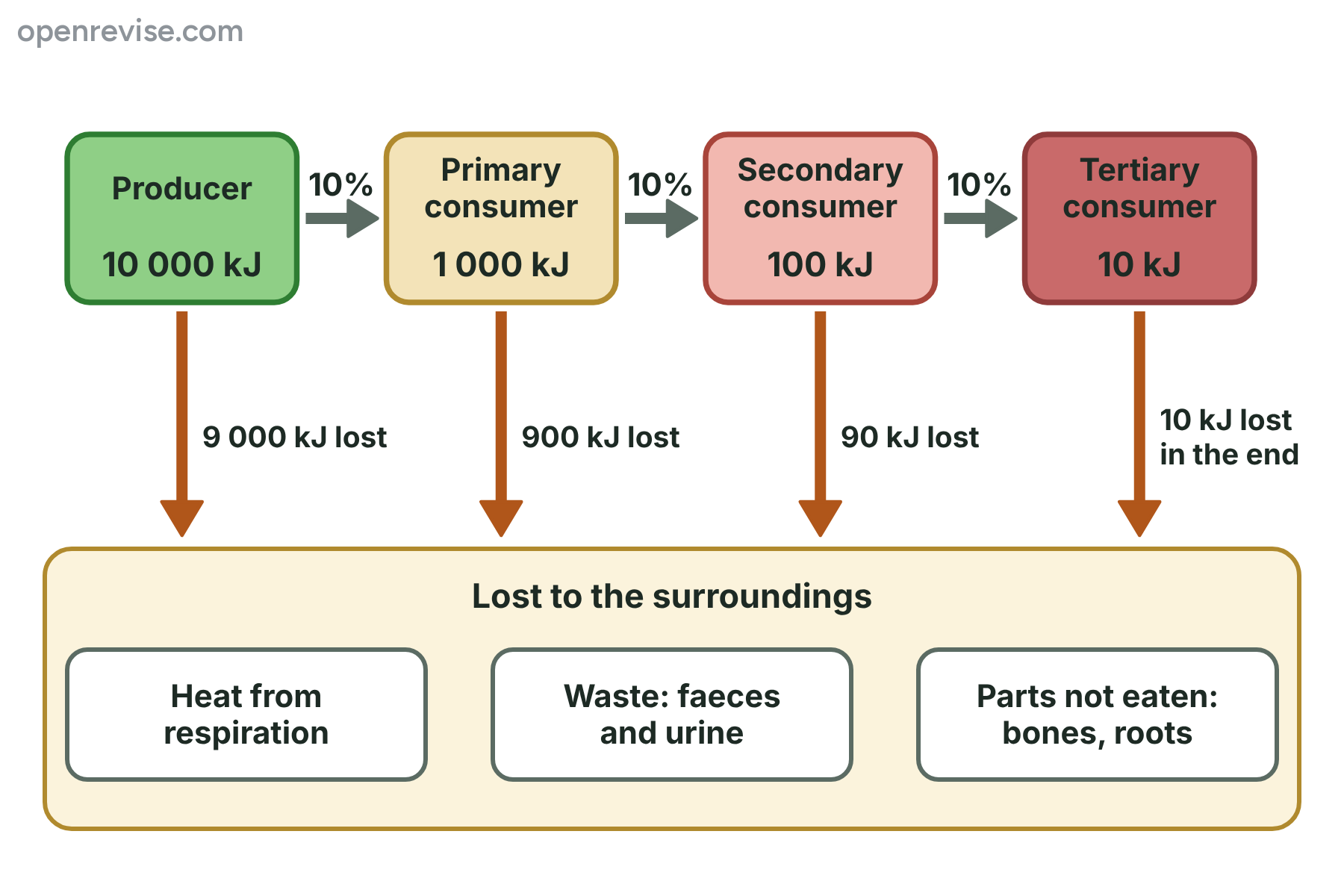
In this example, 10% of the energy is passed on at each step, so 90% is lost.
What energy loss causes
The loss of energy at every step has three important effects, and the specification asks you to link each one to it.
-
Fewer organisms higher up
There is less energy and less biomass at each level, so each level can support fewer organisms, or smaller ones, than the level below it.
-
Short food chains
After four or five trophic levels there is too little energy left to support another population of organisms, so food chains are rarely longer than five levels.
-
The shape of a pyramid of biomass
Each trophic level has less biomass than the one below it, so a pyramid of biomass is widest at the bottom and narrows towards the top.
-
Top predators
Top predators are few in number and need a large area to find enough food, so they are the first to suffer when the energy supply at lower levels falls.
A pyramid of biomass
A pyramid of biomass shows the mass of living material at each trophic level.
Reading a pyramid of biomass
- Producers at the bottom The base is the producers, because everything else depends on them.
- Each bar is a trophic level In a drawn pyramid the width of each bar is in proportion to the biomass at that level.
- It always narrows Energy is lost at each step, so there is less biomass at each higher level.
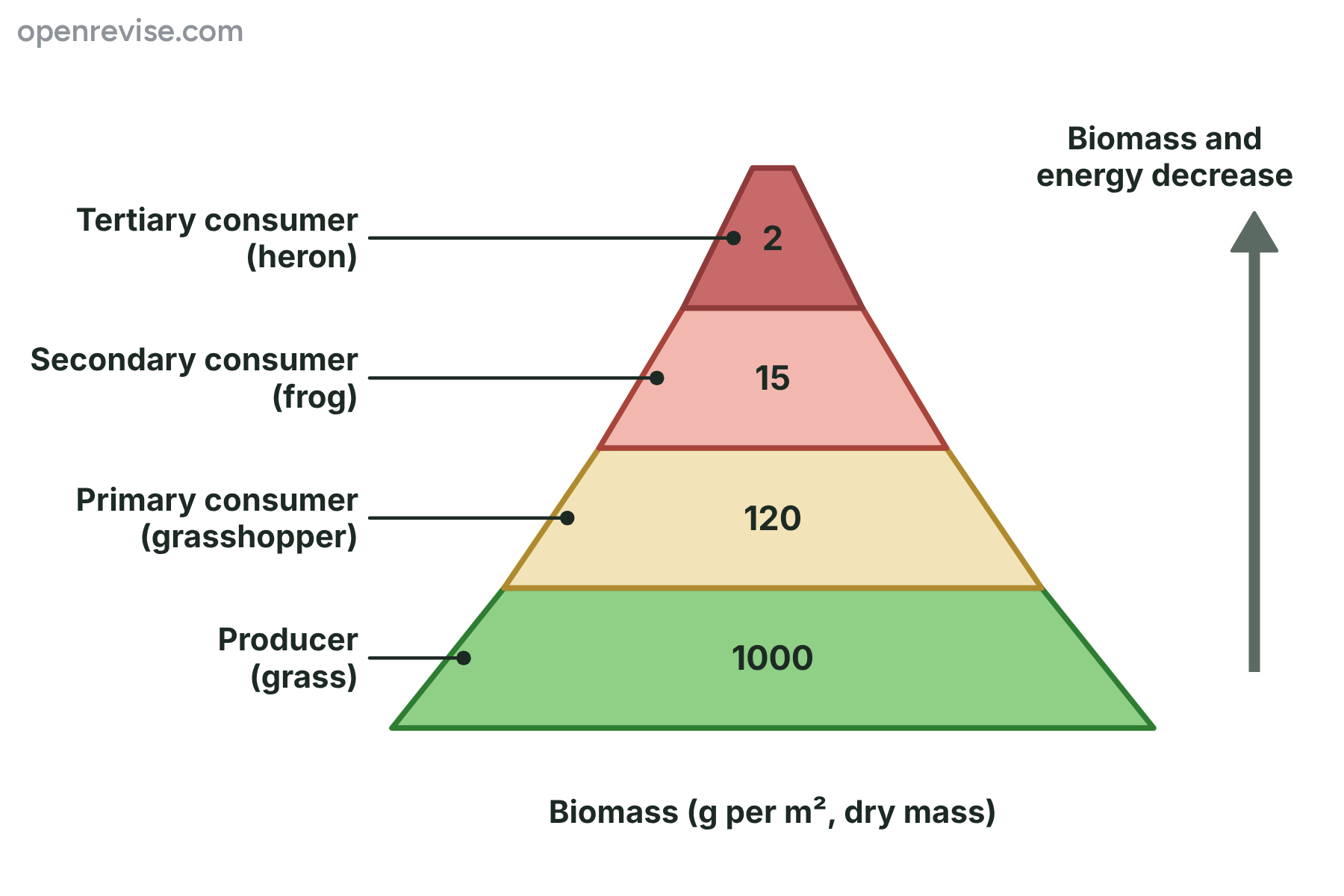
The layers show the biomass at each trophic level. The drawing is not to scale.
How to draw a pyramid of biomass
A pyramid of biomass needs measurements for every trophic level of a food chain.
-
1
Identify the food chain
List the organisms in order, from the producer up to the top consumer.
-
2
Measure the biomass
Collect a sample, dry it to remove the water and find the dry mass. Scale this up to a standard area, such as grams per square metre.
-
3
Choose a scale
Pick a scale so that the biggest bar fits on the page, for example 1 cm for every 100 g per square metre.
-
4
Draw the bars
Draw horizontal bars centred on the same line, with the producers at the bottom and the widths in proportion to the biomass.
-
5
Label
Label each bar with the trophic level and the organism, and give the units.
Long and short food chains
A short food chain (crop, then people)
- Fewer energy transfers
- Less energy is lost to the surroundings
- More energy reaches the final consumer
- A field can feed more people
A long food chain (crop, cattle, people)
- More energy transfers
- More energy is lost as heat, waste and uneaten parts
- Less energy reaches the final consumer
- A field feeds fewer people
Calculating efficiency and percentage biomass
The specification asks for calculations between trophic levels. Take care to use the amount at the higher level on top and the lower level underneath.
-
Efficiency of energy transfer
Divide the energy transferred to the next trophic level by the energy available at the first, then multiply by 100. The answer is a percentage.
-
Percentage of biomass transferred
Divide the biomass at the higher level by the biomass at the lower level, then multiply by 100.
-
Energy or biomass lost
Subtract the amount passed on from the amount available. As a percentage, this is 100 minus the efficiency.
-
Percentage of dry mass
Divide the dry mass by the fresh mass and multiply by 100. This shows how much of a living organism is biomass rather than water.
-
Units
Use the same units for both amounts, such as kJ or g per square metre, before dividing.
Efficiency of energy transfer
A field of grass has 20 000 kJ of energy stored in its biomass. The cows that graze it gain 2 400 kJ of energy in their biomass. Calculate the efficiency of the energy transfer from the grass to the cows.
Show the solutionHide the solution
- 1 Write the equation Efficiency = (energy transferred to the next level \(\div\) energy available) \(\times\) 100
- 2 Substitute the values \(2\,400 \div 20\,000 = 0.12\)
- 3 Convert to a percentage \(0.12 \times 100 = 12\%\)
- 4 Find the loss if asked The energy lost is \(20\,000 - 2\,400 = 17\,600\) kJ, which is 88%
Answer12%
Percentage of biomass transferred
In a pond the biomass of the producers is 800 g per m\(^2\), of the primary consumers is 96 g per m\(^2\) and of the secondary consumers is 12 g per m\(^2\). Calculate the percentage of the biomass that is transferred from the primary consumers to the secondary consumers.
Show the solutionHide the solution
- 1 Write the equation Percentage transferred = (biomass at the higher level \(\div\) biomass at the lower level) \(\times\) 100
- 2 Choose the right levels Higher level = secondary consumers (12), lower level = primary consumers (96)
- 3 Calculate \(12 \div 96 = 0.125\), and \(0.125 \times 100 = 12.5\%\)
- 4 Check the other step Producers to primary consumers is \(96 \div 800 \times 100 = 12\%\)
Answer12.5%
Percentage dry mass
A 40 g sample of fresh grass is dried in an oven until its mass stops changing. The dry mass is 9 g. Calculate the percentage of the fresh mass that is dry biomass.
Show the solutionHide the solution
- 1 Write the equation Percentage dry mass = (dry mass \(\div\) fresh mass) \(\times\) 100
- 2 Substitute the values \(9 \div 40 = 0.225\)
- 3 Convert to a percentage \(0.225 \times 100 = 22.5\%\), so the remaining 77.5% of the fresh mass was water
Answer22.5%
Case study
Feeding people from a field
A field of wheat grown for people to eat is a food chain with only two trophic levels, so people can eat it directly. If the same field is used to grow grass for beef cattle, the cattle lose a large share of the energy in the grass as heat from respiration, in faeces and urine, and in parts such as bones and hide that people do not eat. Only a small percentage of the energy in the grass ends up in meat. A field used for crops can therefore provide food for more people than the same field used for beef, which is one reason why rising meat consumption puts pressure on the food supply.
The big idea
Energy is lost at every trophic level, so food chains are short and pyramids of biomass narrow towards the top.
In calculations, put the higher level on top and multiply by 100.
Energy transfer in ecosystems
Energy transfer in ecosystems
-
Trophic levels
- producer
- primary, secondary, tertiary consumer
- decomposers
-
Losses
- respiration (heat)
- faeces and urine
- parts not eaten
-
Effects
- fewer organisms
- short food chains
- pyramid narrows
-
Pyramid of biomass
- dry mass
- producers at the base
- bars in proportion
-
Calculations
- efficiency
- percentage biomass
- percentage dry mass
Summary and exam focus
- Energy is transferred to less useful forms at each trophic level, mainly as heat from respiration but also in waste and in parts that are not eaten.
- Because energy is lost, there is less biomass and fewer organisms at each higher trophic level.
- Food chains are short because there is not enough energy left to support more than about five trophic levels.
- A pyramid of biomass has the producers at the base and narrows at the top, because the biomass falls at every level.
- Efficiency of energy transfer is the energy transferred to the next level divided by the energy available, multiplied by 100, and percentage of biomass is worked out the same way.
Exam focus
Explain why food chains rarely have more than five trophic levels. (4 marks) (4 marks)
Give a clear chain of reasoning. Say that energy is lost at each trophic level, name two ways it is lost (such as heat from respiration, and waste or uneaten parts), say that this leaves less energy at each higher level, and finish by saying that after four or five levels there is not enough energy to support another population.
Key terms
The words this lesson expects you to use. Each one is linked from the first place it appears above.
- Trophic level
- A feeding stage in a food chain, such as producer, primary consumer or secondary consumer.
- Biomass
- The mass of living material in organisms, usually measured as dry mass.
- Pyramid of biomass
- A diagram with a bar for each trophic level, the width in proportion to its biomass, producers at the base.
- Producer
- An organism that makes its own food by photosynthesis, at the start of a food chain.
- Primary consumer
- An animal that eats producers, at the second trophic level.
- Secondary consumer
- An animal that eats primary consumers, at the third trophic level.
- Efficiency of energy transfer
- The percentage of the energy available at one trophic level that is transferred to the next.
- Dry mass
- The mass of an organism with the water removed, used as a measure of biomass.
- Decomposer
- A microorganism, such as a bacterium or fungus, that breaks down dead organisms and waste.
- Respiration
- The process in cells that transfers energy from food, releasing much of it as heat.
You've finished the notes
Check your understanding
Test yourself while it is fresh. Start with the flashcards, then try the exam questions.
Something here looks wrong?
Tell us what and we will go and look. It goes to whoever writes these pages, nobody else, and we do not ask who you are — so there is nothing to sign and nothing comes back to you.