Flashcards · Biology · Ecosystems and Communities
Energy Transfer and Pyramids of Biomass
-
What is a trophic level?
A feeding stage in a food chain.
-
Which organisms are at trophic level 1?
The producers.
-
What is biomass?
The mass of living material in organisms.
-
Why is biomass measured as dry mass?
The water content of organisms varies, so dry mass gives a fair comparison.
-
Name three ways energy is lost between trophic levels.
Heat from respiration, waste (faeces and urine), and parts that are not eaten.
-
What is the biggest loss of energy at each trophic level?
Heat released by respiration.
-
What typical percentage of energy is transferred to the next trophic level?
About 10%, although it varies.
-
Why is energy loss to heat described as a transfer to a less useful form?
Organisms cannot use heat in the surroundings to build biomass.
-
Why do birds and mammals lose a lot of energy as heat?
They keep a constant body temperature higher than their surroundings.
-
Why are there fewer organisms at higher trophic levels?
Less energy and less biomass are available at each higher level.
-
Why are food chains rarely longer than five trophic levels?
Too little energy is left to support another population.
-
Why is a pyramid of biomass wider at the bottom?
There is more biomass at each lower level, because energy is lost at every step.
-
What is the equation for efficiency of energy transfer?
(energy transferred to the next level \(\div\) energy available) \(\times\) 100.
-
A level has 5 000 kJ and the next has 400 kJ. What is the efficiency?
\(400 \div 5000 \times 100 = 8\%\).
-
Calculate the percentage of biomass transferred: 250 g to 30 g.
\(30 \div 250 \times 100 = 12\%\).
-
Why can a field of crops feed more people than a field of beef cattle?
The crops are a shorter food chain with fewer energy losses.
-
Which trophic level has the least energy in a food chain?
The top (tertiary or final) consumer.
-
Where does the energy that is lost from a food chain end up?
In the surroundings as heat, with some in the dead material that decomposers break down.
-
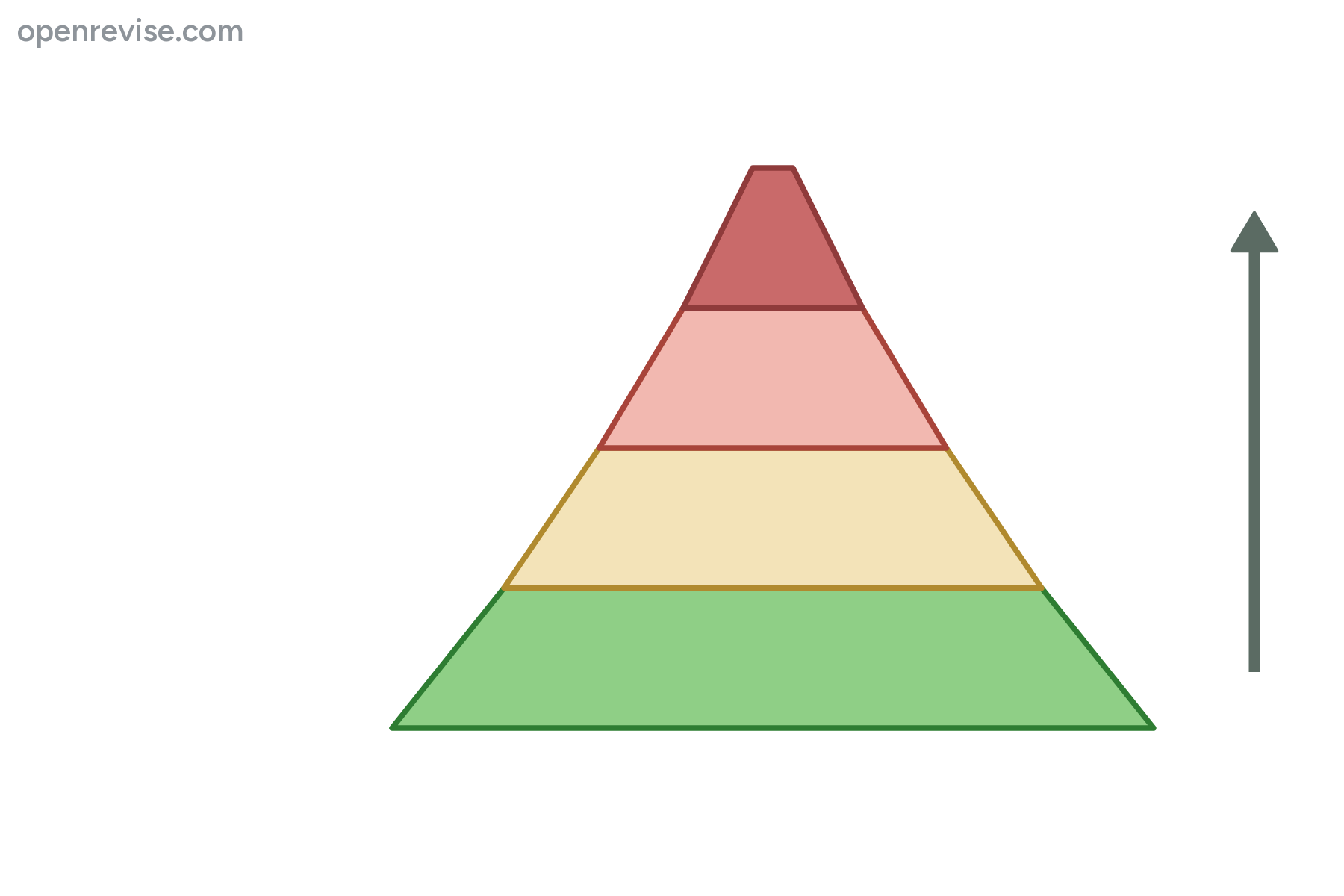 Name each trophic level, and say why the pyramid is this shape.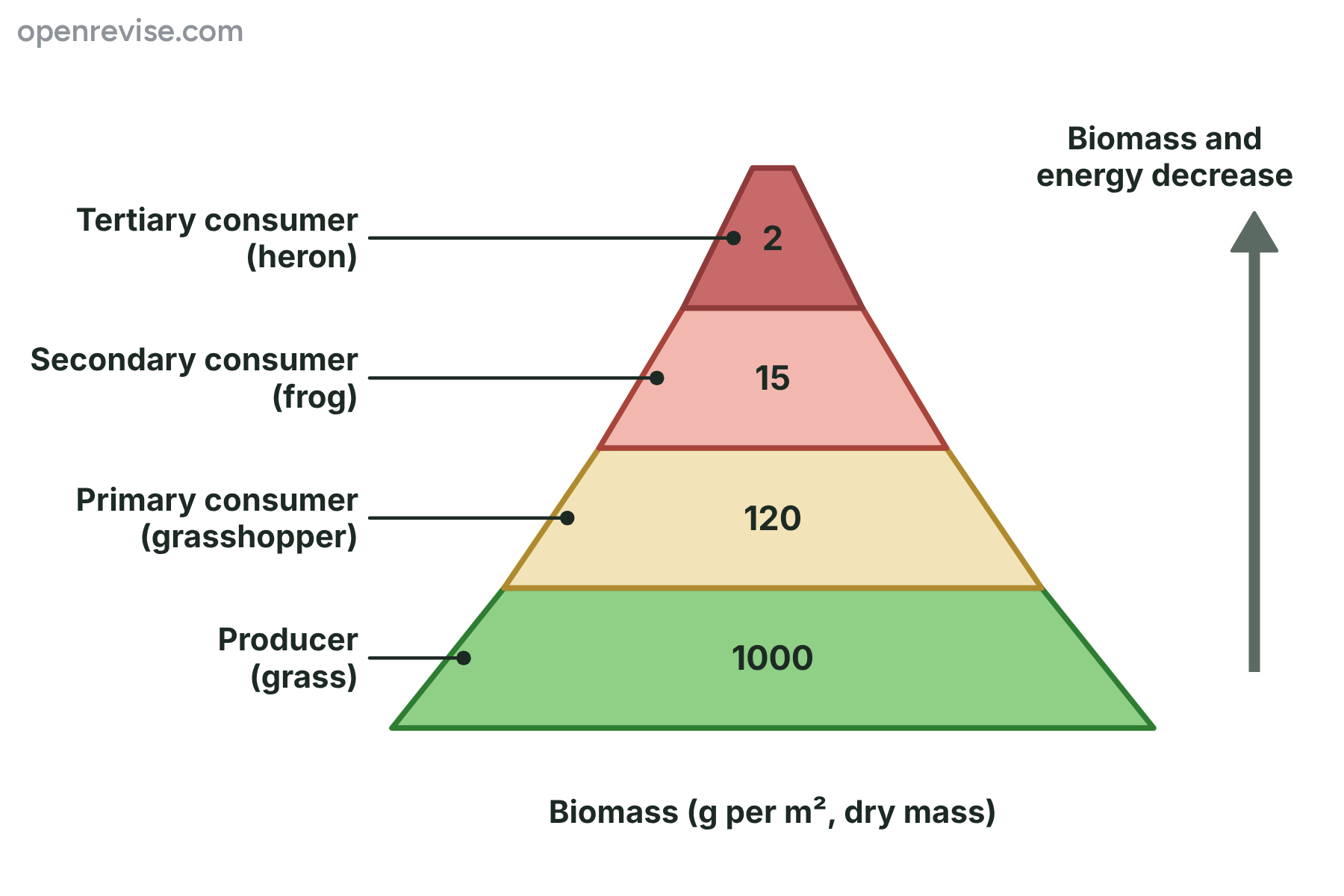
From the bottom: producer, primary consumer, secondary consumer and tertiary consumer. It narrows because energy is lost at each trophic level (as heat, waste and uneaten parts), so there is less biomass at each higher level.
-
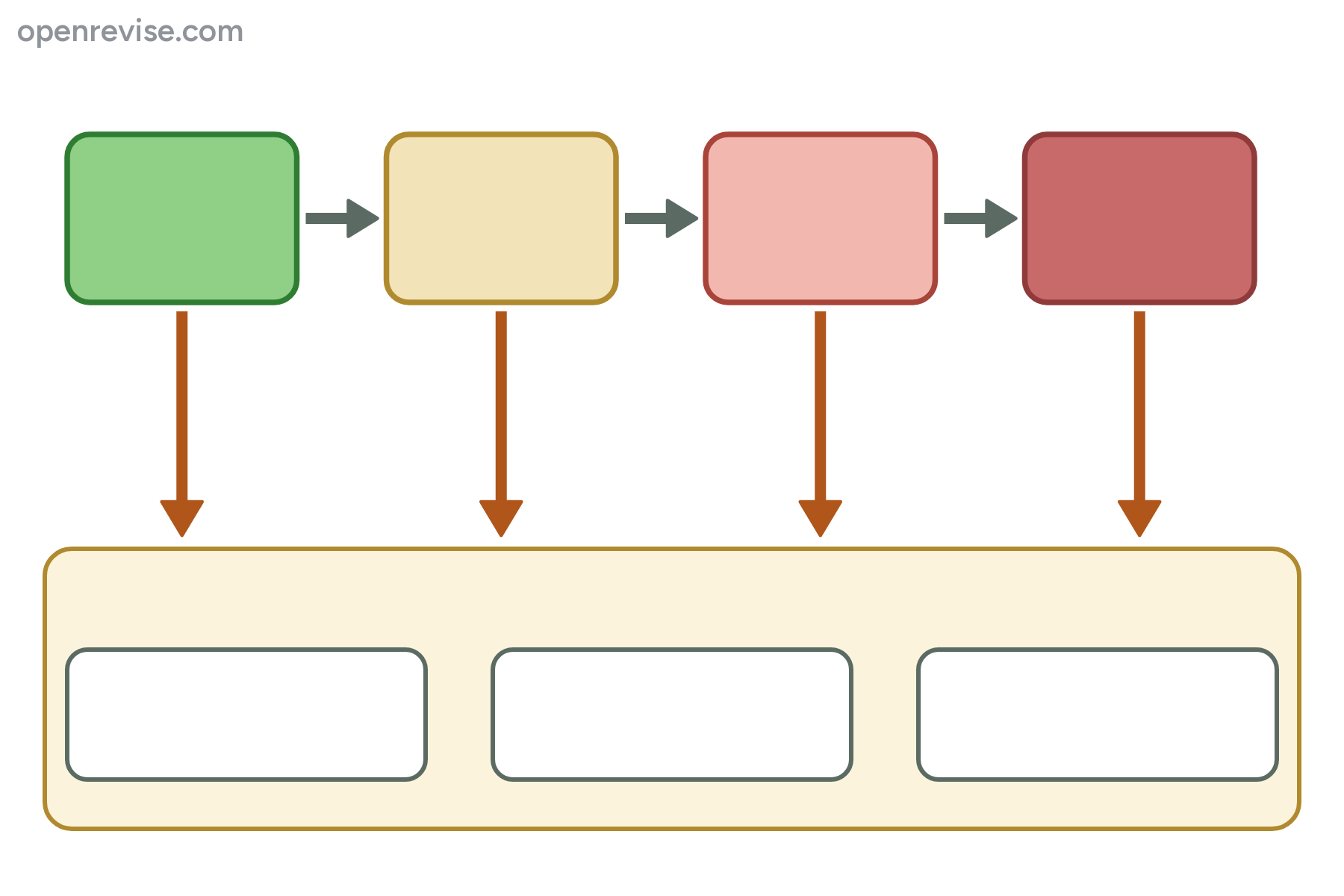 Describe what happens to the energy at each stage in this food chain.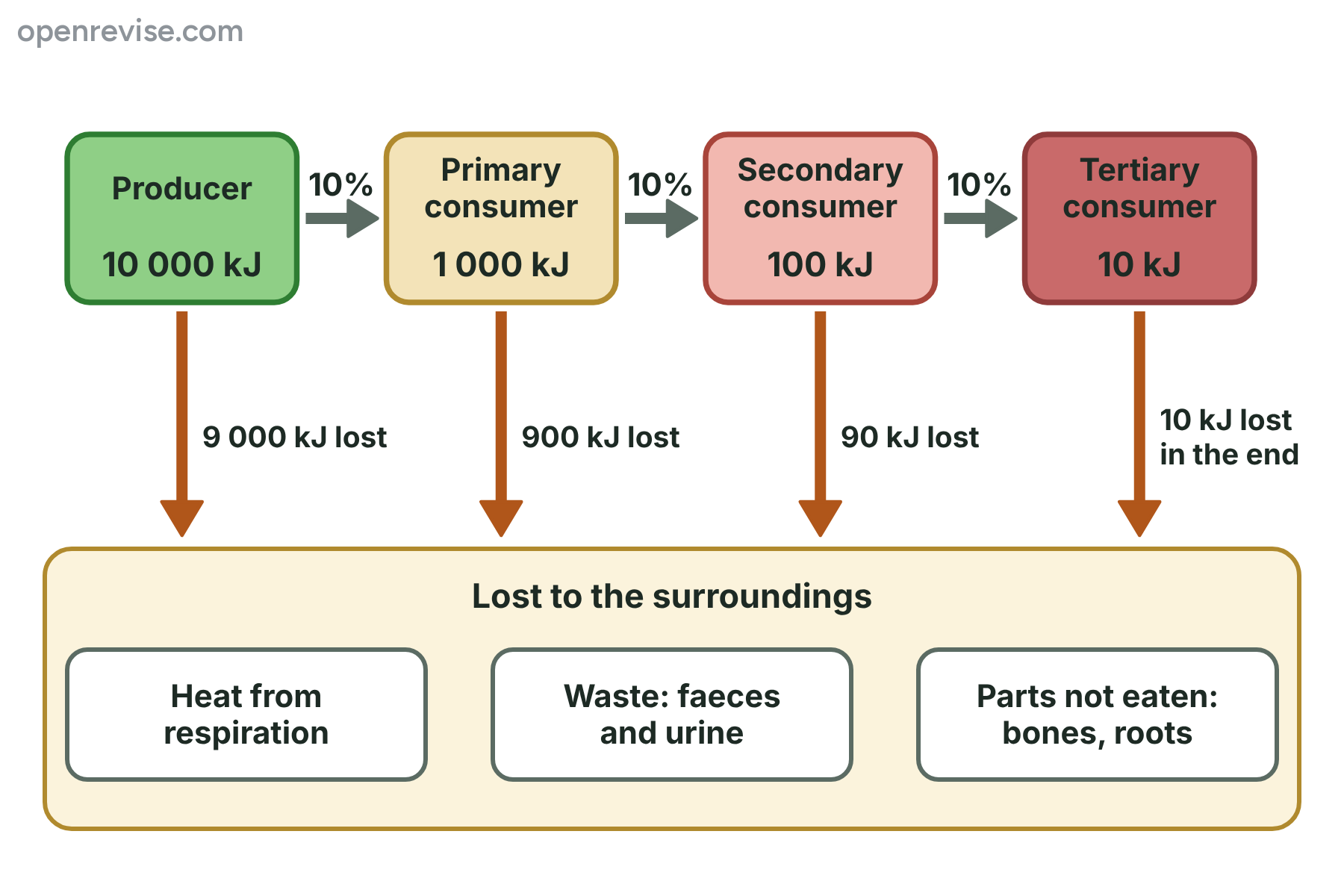
About 10% of the energy is passed on at each step, and the other 90% is lost to the surroundings. It is lost as heat from respiration, in waste such as faeces and urine, and in parts that are not eaten, such as bones and roots.