Exam questions · Biology · Ecosystems and Communities
Levels of Organisation and Interdependence
- 8 exam questions
- 27 marks
- 8 quick checks
-
1 Name [1 mark]
A field contains one hundred rabbits. Name the level of organisation that describes all of the rabbits in the field.
Show answerHide answer
Model answer
A population.
Mark scheme
- Population — 1 mark
-
2 Name [4 marks]
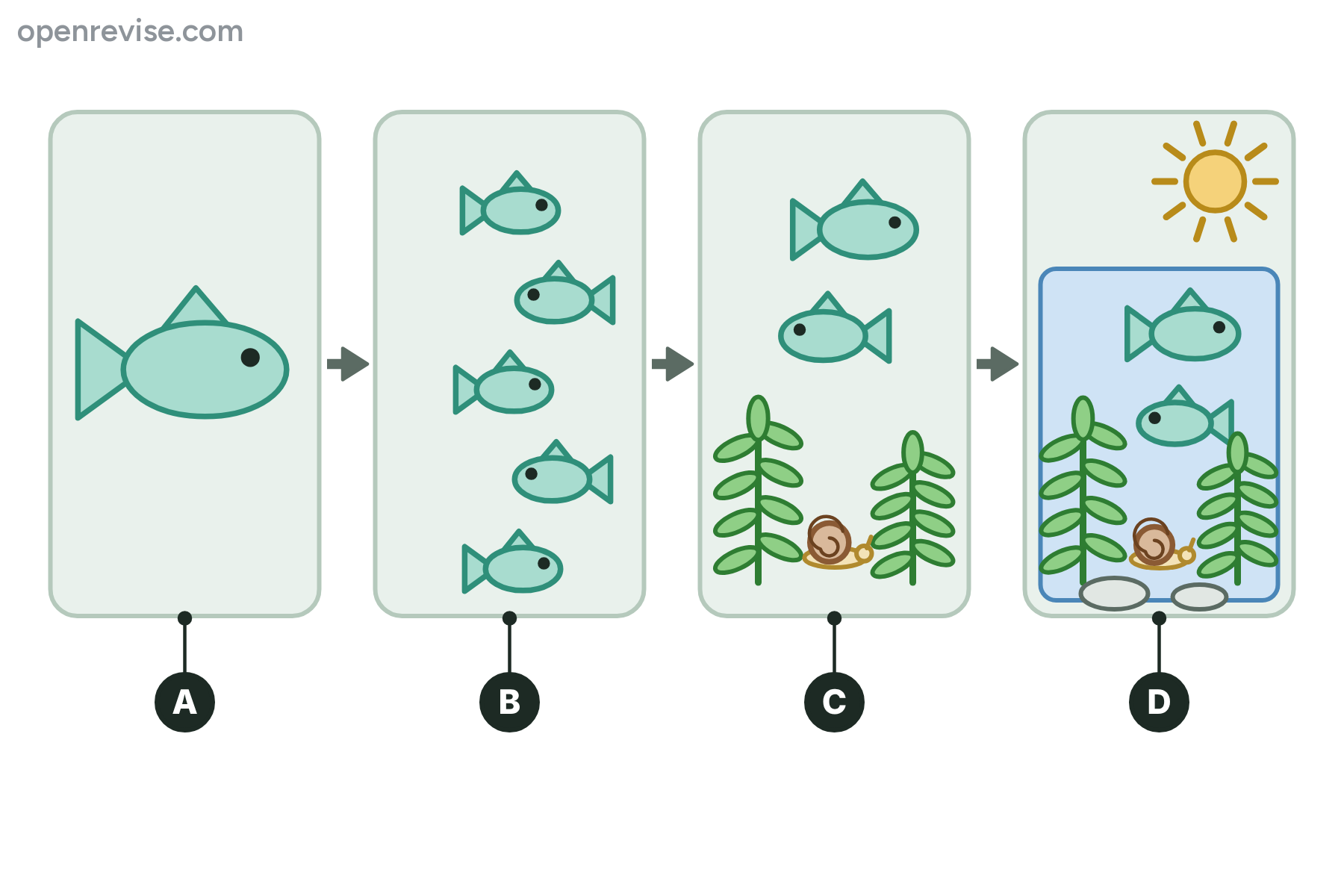
The diagram shows four levels of organisation in a pond. Name the level shown in each of A, B, C and D.
Show answerHide answer
Model answer
A is an individual organism. B is a population. C is a community. D is an ecosystem.
Mark scheme
- A: individual (organism) — 1 mark
- B: population — 1 mark
- C: community — 1 mark
- D: ecosystem — 1 mark
-
3 Describe [2 marks]
Describe the difference between a community and an ecosystem.
Show answerHide answer
Model answer
A community is all the populations of different species living in the same place. An ecosystem is the community together with the non-living (abiotic) factors of the environment, such as light, temperature and water, which interact with it.
Mark scheme
- A community is all the living organisms (populations of different species) in an area — 1 mark
- An ecosystem also includes the non-living factors — 1 mark
-
4 Explain [3 marks]
A food chain in a woodland is: oak leaves, caterpillar, blue tit, sparrowhawk. Explain what is meant by interdependence, using this food chain as an example.
Show answerHide answer
Model answer
Interdependence means that the organisms in a community depend on each other. The caterpillar depends on oak leaves for food, the blue tit depends on caterpillars, and the sparrowhawk depends on blue tits. If the caterpillars died out, the blue tits would lose their food, and the number of sparrowhawks could fall too.
Mark scheme
- Organisms in a community depend on each other (for food or other needs) — 1 mark
- A correct link from the food chain, such as blue tits depend on caterpillars for food — 1 mark
- A consequence of losing one species for another — 1 mark
-
5 Explain [3 marks]
A tapeworm lives in the small intestine of a pig. Explain why this is an example of parasitism and not mutualism.
Show answerHide answer
Model answer
The tapeworm is a parasite and the pig is its host. The tapeworm benefits because it absorbs the digested food in the pig's gut. The pig is harmed, because it loses some of its food and may lose weight. In mutualism both organisms would benefit.
Mark scheme
- The tapeworm lives in or on the pig and feeds from it (parasite and host) — 1 mark
- The tapeworm benefits (gets food or shelter) — 1 mark
- The pig is harmed (loses nutrients), but in mutualism both organisms benefit — 1 mark
-
6 Explain [4 marks]
Clover is a plant with nitrogen-fixing bacteria in nodules on its roots. Explain why this relationship is an example of mutualism.
Show answerHide answer
Model answer
Mutualism is a relationship in which both organisms benefit. The bacteria convert nitrogen gas from the air into nitrogen compounds such as nitrates, which the clover uses to make proteins, so the plant grows better. In return the clover gives the bacteria sugars, which they use for energy, and a safe place to live in its nodules.
Mark scheme
- Mutualism means both organisms benefit — 1 mark
- The bacteria make nitrogen compounds (nitrates) from nitrogen gas — 1 mark
- The plant uses these to make protein (so benefits) — 1 mark
- The plant gives the bacteria sugars or shelter (so they benefit) — 1 mark
-
7 Explain [4 marks]
Bees feed on nectar from foxglove flowers. Explain how the bees and the foxgloves depend on each other, and what would happen to the foxglove population if the bees disappeared.
Show answerHide answer
Model answer
The bees depend on the flowers for food, because they collect nectar. The foxgloves depend on the bees for pollination, because the bees carry pollen from one flower to another as they feed. This is a mutualistic relationship and an example of interdependence. If the bees disappeared, the flowers would not be pollinated, so fewer seeds would be made and the foxglove population would fall.
Mark scheme
- Bees depend on the flowers for nectar (food) — 1 mark
- Flowers depend on the bees for pollination (transfer of pollen) — 1 mark
- Without pollination fewer seeds would be produced — 1 mark
- The foxglove population would decrease — 1 mark
-
8 Explain [6 marks]
Explain, using named examples, how the survival of one species in a community can depend on other species. You should include parasitism and mutualism in your answer.
Show answerHide answer
Model answer
Organisms in a community are interdependent. Some depend on others for food: a hare depends on grass, and a fox depends on hares, so the loss of the grass would reduce both populations. In parasitism the parasite depends on its host for food and shelter and the host is harmed. For example, a tapeworm absorbs the digested food in the gut of its host, and a flea feeds on the blood of a dog, so these parasites could not survive without their hosts. In mutualism both organisms benefit, so each depends on the other. Nitrogen-fixing bacteria in root nodules get sugars from a pea plant, while the plant gets nitrates to make protein. Bees get nectar from flowers, while the flowers get pollinated and can make seeds. If one of these partners was lost the other would be less likely to survive, so the survival of a species can depend on others.
Mark scheme
- Interdependence explained for food, with a named food chain example — 1 mark
- Parasitism defined: one organism benefits and the other is harmed — 1 mark
- A named parasite example, with how it benefits (tapeworm, flea or mistletoe) — 1 mark
- Mutualism defined: both organisms benefit — 1 mark
- A named mutualism example with what each organism gains (nodules, pollinators or cleaner fish) — 1 mark
- A link to survival, such as the loss of one partner reducing the survival of the other — 1 mark
Quick check
-
1
All of the fish of one species living in a lake are best described as which level of organisation?
Show answerHide answer
B: A population
One species living in the same place at the same time is a population.
-
2
Which of these is an example of an ecosystem?
Show answerHide answer
D: A pond with its living organisms and its non-living surroundings
An ecosystem includes the living community and the non-living factors, such as a pond with its water, light and temperature.
-
3
Why is a woodland community called interdependent?
Show answerHide answer
A: Its organisms depend on each other
Interdependence means that the organisms in a community rely on each other for food, shelter, pollination and other needs.
-
4
A flea feeds on the blood of a dog. What kind of relationship is this?
Show answerHide answer
C: Parasitism
The flea benefits and the dog is harmed, which is parasitism.
-
5
In which relationship do both organisms benefit?
Show answerHide answer
B: A cleaner fish and a large fish
In mutualism both organisms gain, for example bees and flowers or cleaner fish and larger fish.
-
6
What does a pea plant gain from the nitrogen-fixing bacteria in its root nodules?
Show answerHide answer
D: Nitrogen compounds to make protein
The bacteria turn nitrogen gas into nitrogen compounds such as nitrates, which the plant uses to make proteins.
-
7
What does mistletoe take from the tree it grows on?
Show answerHide answer
A: Water and mineral ions
Mistletoe is a parasite that takes water and mineral ions from its host tree.
-
8
Foxes in a field are killed by a disease. What is the most likely effect on the rabbits at first?
Show answerHide answer
C: Their numbers rise
With fewer predators, fewer rabbits are eaten, so the population rises until food becomes the limit.