Biology · Ecosystems and Communities
Levels of Organisation and Interdependence
No living thing lives on its own. This lesson is for both Combined Science and separate Biology. It covers the levels of organisation from a single organism up to a whole ecosystem, why the organisms in a community depend on each other, and the two close relationships called parasitism and mutualism.
Learning Objectives
- 1Describe the levels of organisation in an ecosystem: individual organism, population, community and ecosystem.
- 2Describe the importance of interdependence in a community, using food chains and pollination as examples.
- 3Describe parasitism and mutualism, and say which organisms benefit and which are harmed in each.
- 4Explain how the survival of an organism can depend on another species, using examples such as tapeworms, mistletoe, nitrogen-fixing bacteria and cleaner fish.
Retrieval practice
-
1
What is a food chain?
Show answerHide answer
A diagram showing what eats what, with arrows pointing in the direction in which energy and biomass are transferred.
-
2
What is a producer?
Show answerHide answer
An organism, usually a green plant or alga, that makes its own food by photosynthesis.
-
3
What is a species?
Show answerHide answer
A group of similar organisms that can breed with each other to produce fertile offspring.
-
4
What does the word non-living mean in biology?
Show answerHide answer
Not alive and never alive, such as light, water, temperature and soil minerals.
Nothing lives alone
A rabbit in a field needs grass to eat, soil to burrow in and, ideally, a fox that is not hungry. Every organism sits inside a web of other living things and non-living surroundings. Biologists describe this web in layers, starting with one organism and widening out until the whole place is included. Once you can name the layers, it becomes much easier to explain how a change in one part, such as a disease or a drought, spreads through the rest.
The levels of organisation
Ecologists zoom out in four steps, and each step has its own name. Use the exact word in an exam.
-
Individual organism
One single living thing, for example one fish in a pond.
-
Population
All the organisms of the same species living in the same place at the same time, for example all the fish of one species in the pond.
-
Community
All the populations of the different species living together in the same place, for example every fish, snail, insect and plant in the pond.
-
Ecosystem
A community of living organisms together with the non-living parts of their surroundings, such as light, water, temperature and rocks, all interacting with each other.
From one organism to a whole ecosystem
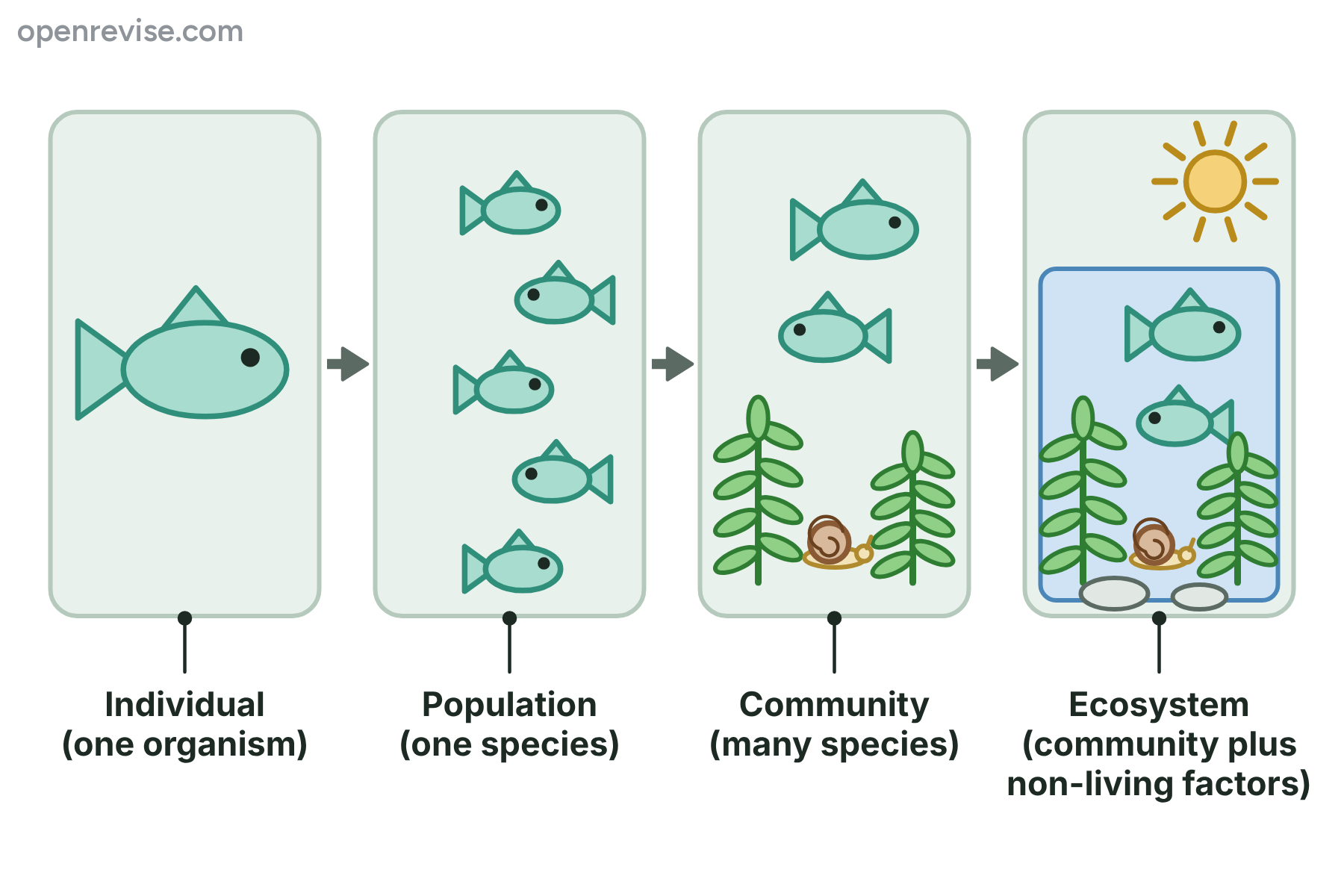
Each level includes the one before it. An ecosystem adds the non-living factors to the community.
Interdependence
The organisms in a community depend on each other, and on the non-living factors around them. This is called interdependence.
-
Food
Almost every organism depends on others for food. Herbivores depend on plants, and carnivores depend on the herbivores they eat, so a food chain links the whole community together.
-
Pollination and seed dispersal
Many flowering plants depend on insects such as bees to carry pollen from flower to flower, and the insects depend on the plants for nectar. Some plants rely on animals to eat their fruits and spread the seeds in their droppings.
-
Shelter and nutrients
Birds nest in trees, and the trees are fertilised by their droppings. Decomposers break down dead matter and return minerals to the soil, which plants then take up.
-
A stable community
In a stable community the populations of all the species stay roughly constant, because the processes that increase each population, such as food supply, balance the ones that decrease it, such as predators.
What happens when one species is lost
Because every species depends on others, removing one can change the whole community. Here is one possible chain of events in a field.
-
1
Foxes die out
A disease kills most of the foxes, so the rabbits are no longer hunted.
-
2
Rabbits increase
With fewer predators, more rabbits survive and breed, so the rabbit population grows.
-
3
Plants are overgrazed
The extra rabbits eat much more grass and wildflowers, so the producers decline.
-
4
Other species suffer
Insects and mice that depended on those plants lose their food and shelter, and eventually the rabbits themselves run short of food.
Parasitism
In parasitism one organism, the parasite, lives on or in another organism, the host, and feeds on it. The parasite benefits and the host is harmed.
-
The parasite benefits
It gets food, and often shelter, from the host without giving anything in return. Many parasites are very specialised and could not survive away from their host.
-
The host is harmed
The host loses nutrients, blood or energy, and may become weak, ill or even die. Most parasites do not kill their host quickly, because a dead host is no use to them.
-
Animal examples
Fleas live on the skin of dogs, cats and humans and feed on blood. Tapeworms live inside the intestine of a human or other animal and absorb the host's digested food.
-
Plant example
Mistletoe grows on the branches of trees such as apple and lime. It pushes special roots into the branch and takes water and mineral ions from the tree, which weakens the branch.
Case study
The tapeworm: a gut parasite
A tapeworm lives in the small intestine of its host, such as a human or a pig. Its head has hooks and suckers that grip the wall of the gut so it is not pushed out with the food. It has no digestive system of its own and simply absorbs the host's digested food through its thin, flat body, which can grow to several metres long. The host gets less of the food it has eaten, so it can lose weight and feel weak, which shows the harm to the host.
Mutualism
In mutualism two organisms of different species live in close association and both of them benefit from it.
-
Nitrogen-fixing bacteria
Bacteria living in nodules on the roots of peas, beans and clover turn nitrogen gas from the air into nitrogen compounds that the plant can use to make proteins. In return the plant supplies the bacteria with sugars and a home.
-
Pollinators
Bees, hoverflies and other insects feed on nectar and pollen from flowers. As they move from flower to flower they carry pollen, so the plant is pollinated and can make seeds.
-
Cleaner fish
Small cleaner fish eat parasites and dead skin from the bodies of larger fish. The cleaner gets a meal, and the larger fish loses parasites that could harm it.
-
Other examples
Bacteria in the human gut make useful vitamins and are fed and housed in return. A lichen is an alga and a fungus living together, with the alga making food and the fungus giving it protection and water.
Parasitism and mutualism
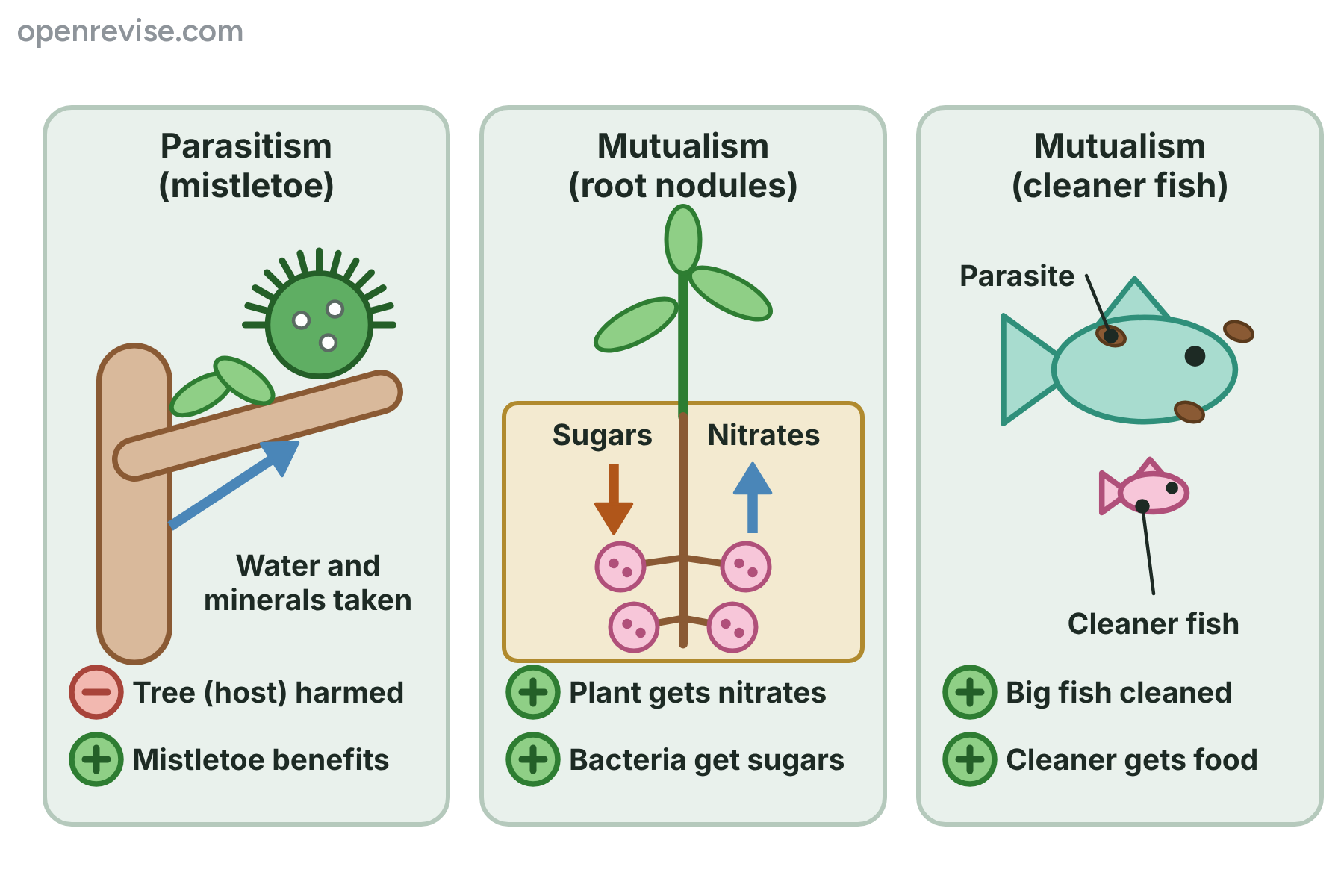
In parasitism one organism is harmed. In mutualism both organisms benefit.
Parasitism or mutualism?
Parasitism
- One organism, the parasite, benefits
- The host is harmed
- The parasite lives on or in the host
- Examples: tapeworm in the gut, fleas on a dog, mistletoe on a tree
Mutualism
- Both organisms benefit
- Neither is harmed
- The two species live in close association
- Examples: nitrogen-fixing bacteria in root nodules, pollinators, cleaner fish
The big idea
In parasitism one organism gains and the other loses. In mutualism both gain.
To decide which it is, ask who benefits and who is harmed.
Living together
Living together
-
Levels
- individual
- population
- community
- ecosystem
-
Interdependence
- food
- pollination
- shelter
- stable community
-
Parasitism
- parasite benefits
- host harmed
- tapeworm, flea, mistletoe
-
Mutualism
- both benefit
- nitrogen-fixing bacteria
- pollinators
- cleaner fish
-
Exam skill
- name the level
- say who benefits
- give an example
Summary and exam focus
- The levels of organisation are individual organism, population (one species), community (many species) and ecosystem (community plus the non-living factors).
- Interdependence means that organisms in a community depend on each other, for food, pollination, shelter and more, so a change to one species can affect many others.
- In parasitism the parasite benefits and the host is harmed, as with tapeworms, fleas and mistletoe.
- In mutualism both organisms benefit, as with nitrogen-fixing bacteria in root nodules, pollinators and cleaner fish.
- A stable community has populations that stay roughly constant because the factors that raise and lower each population balance out.
Exam focus
Nitrogen-fixing bacteria live in nodules on the roots of pea plants. Explain why this is an example of mutualism. (3 marks) (3 marks)
Mutualism needs a benefit to both organisms, so say what each one gets. Give one benefit for the bacteria and one for the plant, and name the relationship in your first sentence. Do not say that the bacteria help the plant without saying what the plant does in return.
Key terms
The words this lesson expects you to use. Each one is linked from the first place it appears above.
- Population
- All the organisms of one species living in the same place at the same time.
- Community
- All the populations of the different species living in the same place.
- Ecosystem
- A community of living organisms together with the non-living parts of their environment.
- Interdependence
- The way the organisms in a community depend on each other, for food, shelter, pollination and other needs.
- Parasitism
- A relationship in which one organism, the parasite, lives on or in another and feeds on it, harming the host.
- Parasite
- An organism that lives on or in a host and gets its food from it, harming the host.
- Host
- The organism that a parasite lives on or in, and which is harmed by it.
- Mutualism
- A relationship between two organisms of different species in which both of them benefit.
- Nitrogen-fixing bacteria
- Bacteria in the root nodules of plants such as peas that convert nitrogen gas into compounds the plant can use.
- Pollinator
- An animal, such as a bee, that carries pollen from one flower to another and so pollinates it.
You've finished the notes
Check your understanding
Test yourself while it is fresh. Start with the flashcards, then try the exam questions.
Something here looks wrong?
Tell us what and we will go and look. It goes to whoever writes these pages, nobody else, and we do not ask who you are — so there is nothing to sign and nothing comes back to you.