Exam questions · Biology · Exchange Surfaces and Gas Exchange
Alveoli and Gas Exchange
- 8 exam questions
- 26 marks
- 8 quick checks
-
1 State [1 mark]
Name the tiny air sacs in the lungs where gas exchange takes place.
Show answerHide answer
Model answer
Alveoli.
Mark scheme
- Alveoli (alveolus) — 1 mark
-
2 Name [3 marks]
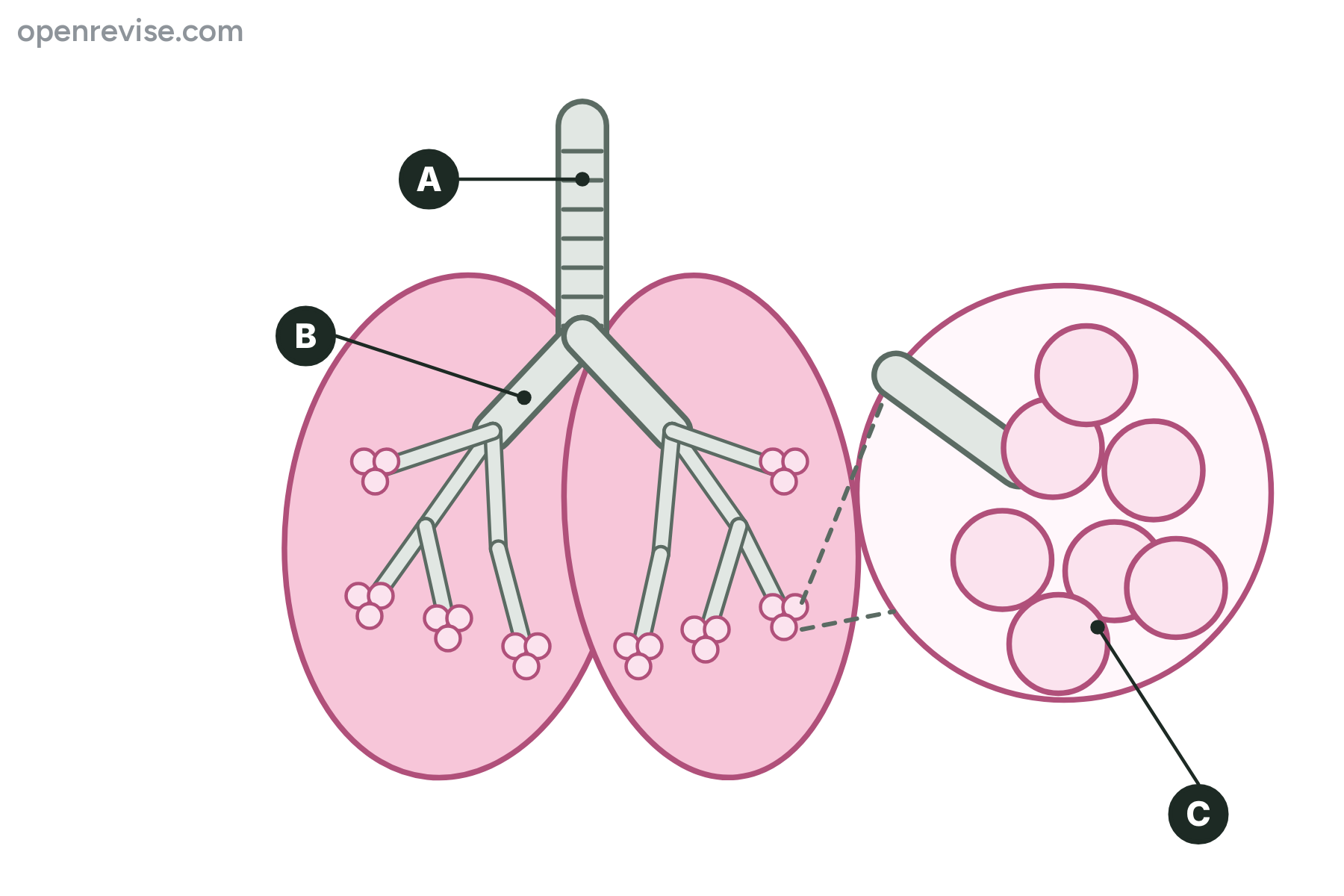
The diagram shows the human lungs. Name the parts labelled A, B and C.
Show answerHide answer
Model answer
A is the trachea. B is a bronchus. C is an alveolus.
Mark scheme
- A: trachea — 1 mark
- B: bronchus — 1 mark
- C: alveolus — 1 mark
-
3 Name [3 marks]
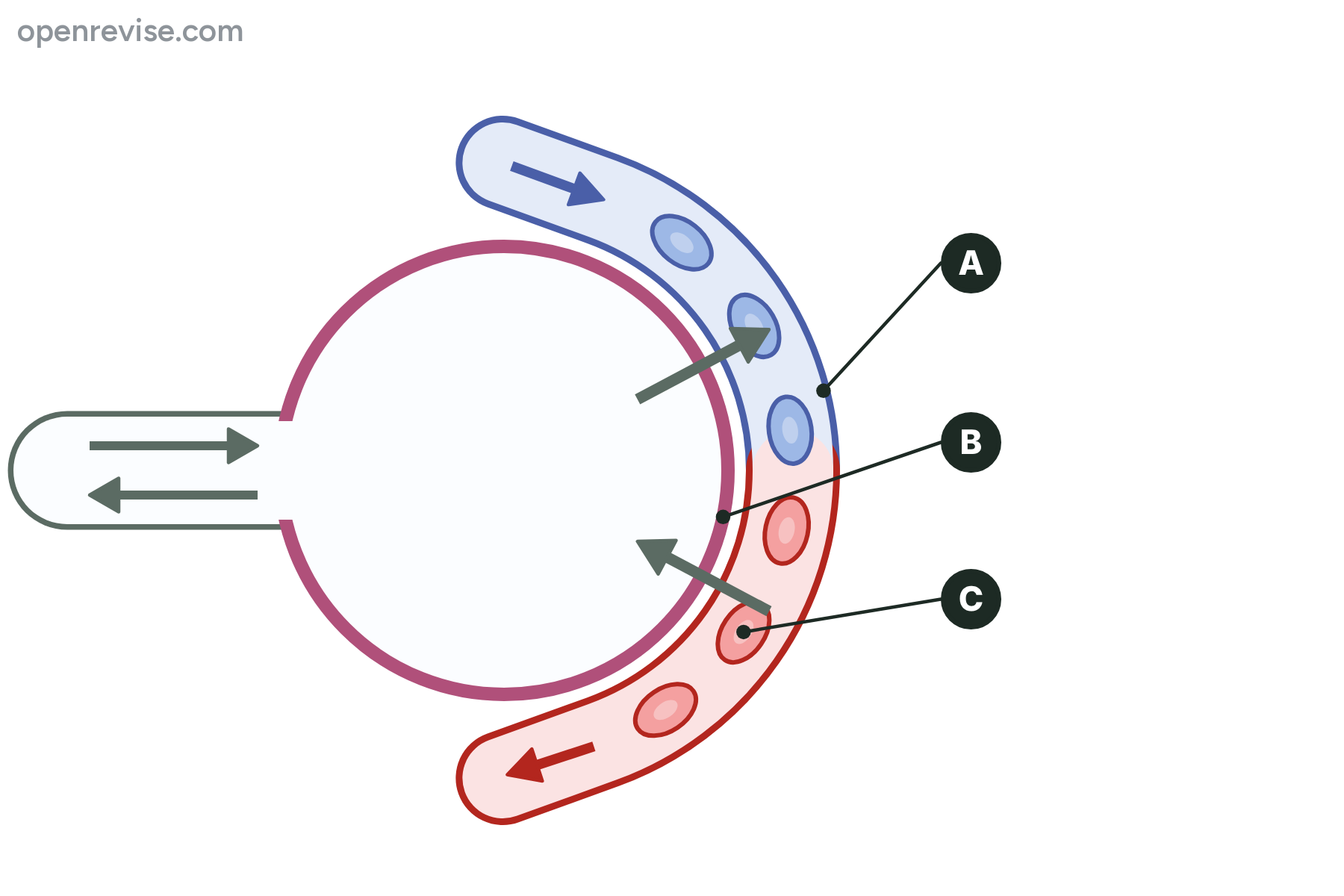
The diagram shows an alveolus and a capillary. Name the parts labelled A, B and C.
Show answerHide answer
Model answer
A is the capillary (or the wall of the capillary). B is the wall of the alveolus. C is a red blood cell.
Mark scheme
- A: capillary — 1 mark
- B: alveolus wall — 1 mark
- C: red blood cell — 1 mark
-
4 Describe [4 marks]
Describe the route taken by oxygen from the air outside the body to the blood in the capillaries of the lungs.
Show answerHide answer
Model answer
The oxygen is breathed in through the nose or mouth and passes down the trachea. It then passes through a bronchus and a bronchiole into an alveolus. In the alveolus it diffuses across the thin wall of the alveolus and the wall of the capillary into the blood.
Mark scheme
- Down the trachea — 1 mark
- Through a bronchus and then a bronchiole — 1 mark
- Into an alveolus — 1 mark
- Diffuses across the walls of the alveolus and capillary into the blood — 1 mark
-
5 Explain [4 marks]
Explain how the alveoli are adapted for gas exchange.
Show answerHide answer
Model answer
There are millions of alveoli, which give the lungs a very large surface area for diffusion. The walls of the alveoli and the capillaries are one cell thick, so the diffusion distance is short. Each alveolus is surrounded by a rich supply of capillaries, and the flowing blood keeps the concentration gradient steep. Ventilation brings in fresh air with a high concentration of oxygen and removes carbon dioxide, which also keeps the gradient steep.
Mark scheme
- A very large surface area from many alveoli — 1 mark
- Thin walls give a short diffusion distance — 1 mark
- A rich blood supply keeps the concentration gradient steep — 1 mark
- Ventilation keeps the concentration gradient steep — 1 mark
-
6 Explain [3 marks]
Explain why the blood flowing past the alveoli helps oxygen to diffuse into the blood.
Show answerHide answer
Model answer
The flowing blood carries the oxygen away from the alveolus, so the concentration of oxygen in the blood stays lower than in the air. The blood arriving has a low oxygen concentration because the cells have used it up. This keeps the concentration gradient steep, so oxygen continues to diffuse into the blood quickly.
Mark scheme
- Blood carries oxygen away — 1 mark
- The oxygen concentration in the blood stays lower than in the alveolus — 1 mark
- So the concentration gradient is kept steep and diffusion stays fast — 1 mark
-
7 Calculate [2 marks]
A sample of inhaled air contains 21 percent oxygen. The exhaled air contains 17 percent oxygen. Calculate the percentage of the oxygen in the inhaled air that has been taken into the blood. Give your answer to 2 significant figures.
Show answerHide answer
Model answer
The change is \(21 - 17 = 4\). Then \(4 \div 21 \times 100 = 19.04\), which is 19 percent.
Mark scheme
- \(4 \div 21 \times 100\) — 1 mark
- 19 percent — 1 mark
-
8 Explain [6 marks]
A person has pulmonary fibrosis, a disease in which the walls of the alveoli become thick and scarred. Explain why the person becomes breathless when they exercise.
Show answerHide answer
Model answer
The thick, scarred walls of the alveoli make the diffusion distance longer, so oxygen diffuses into the blood more slowly. Less oxygen reaches the red blood cells, so less oxygen is carried to the muscles. During exercise the muscle cells need much more oxygen for aerobic respiration to release the energy for contraction, and carbon dioxide is made faster. Because the lungs cannot supply enough oxygen, the muscles cannot respire aerobically fast enough. The person has to breathe faster and deeper to try to keep the concentration gradient steep, which makes them feel breathless and tired quickly.
Mark scheme
- Thicker walls make a longer diffusion distance — 1 mark
- Oxygen diffuses into the blood more slowly — 1 mark
- Less oxygen is carried to the muscles — 1 mark
- Exercise increases the demand for oxygen for aerobic respiration — 1 mark
- Supply cannot meet the demand, so less energy is released — 1 mark
- The person breathes faster to try to keep the gradient steep, which causes breathlessness — 1 mark
Quick check
-
1
Which of these is the correct order of the airways, from the mouth to the gas exchange surface?
Show answerHide answer
C: Trachea, bronchus, bronchiole, alveolus
Air passes down the trachea, then through a bronchus and a bronchiole, and reaches the alveoli.
-
2
How does oxygen cross from the alveolus into the blood?
Show answerHide answer
A: By diffusion
Oxygen moves by diffusion, down its concentration gradient, so no energy is needed.
-
3
How many cells thick are the wall of an alveolus and the wall of a capillary?
Show answerHide answer
D: One each
Both walls are one cell thick, which gives a very short diffusion distance.
-
4
Which feature of the alveoli gives a large surface area?
Show answerHide answer
B: The very large number of them
There are hundreds of millions of alveoli, which together have an area of about 70 square metres.
-
5
What is the main effect of ventilation on gas exchange?
Show answerHide answer
C: It keeps the concentration gradients steep
Breathing replaces the air in the alveoli, which keeps the concentration of oxygen high and carbon dioxide low in the air, so the gradients stay steep.
-
6
Which statement about the blood arriving at the alveoli is correct?
Show answerHide answer
A: It is low in oxygen and high in carbon dioxide
The blood has come from the body, where oxygen has been used up and carbon dioxide has been made, so it is low in oxygen and high in carbon dioxide.
-
7
Why does a person with emphysema have less oxygen in their blood?
Show answerHide answer
D: Their alveoli have a smaller surface area
The walls between the alveoli break down, so the surface area for diffusion falls and less oxygen can cross.
-
8
Inhaled air has 21 percent oxygen and exhaled air has 16 percent oxygen. What is the best explanation of the difference?
Show answerHide answer
B: Oxygen has diffused into the blood
Some of the oxygen has diffused from the alveoli into the blood, so there is less in the air that is breathed out.