Exam questions · Biology · Respiration
Anaerobic Respiration
- 8 exam questions
- 27 marks
- 8 quick checks
-
1 Write [2 marks]
Write the word equation for anaerobic respiration in human muscle cells.
Show answerHide answer
Model answer
glucose → lactic acid
Mark scheme
- Glucose as the reactant — 1 mark
- Lactic acid as the product — 1 mark
-
2 State [2 marks]
Yeast respires anaerobically when there is no oxygen. Name the two products of this process.
Show answerHide answer
Model answer
Ethanol and carbon dioxide.
Mark scheme
- Ethanol — 1 mark
- Carbon dioxide — 1 mark
-
3 Explain [3 marks]
Explain why anaerobic respiration releases less energy than aerobic respiration.
Show answerHide answer
Model answer
In aerobic respiration oxygen is used to break the glucose down completely into carbon dioxide and water, so most of its energy is released. In anaerobic respiration the glucose is only partly broken down, to lactic acid or to ethanol and carbon dioxide, so much of the energy is still held in those molecules and less is released.
Mark scheme
- Aerobic respiration breaks glucose down completely — 1 mark
- Anaerobic respiration breaks glucose down only partly — 1 mark
- The lactic acid or ethanol still contains energy that is not released — 1 mark
-
4 Explain [4 marks]
A baker mixes yeast, flour, sugar and water to make dough and leaves it in a warm place for an hour. The dough rises. Explain why.
Show answerHide answer
Model answer
The yeast respires the sugar anaerobically, because there is little oxygen in the dough, and this is fermentation. Fermentation makes ethanol and carbon dioxide. The carbon dioxide forms bubbles in the dough, which make it rise. The warm place makes the enzymes in the yeast work faster, so the fermentation and the rising are faster.
Mark scheme
- Yeast respires the sugar anaerobically (fermentation) — 1 mark
- Carbon dioxide is produced — 1 mark
- The carbon dioxide forms bubbles that make the dough rise — 1 mark
- Warmth makes the yeast enzymes work faster — 1 mark
-
5 Compare [4 marks]
Compare aerobic respiration and anaerobic respiration in human muscle cells.
Show answerHide answer
Model answer
Aerobic respiration needs oxygen but anaerobic respiration does not. Aerobic respiration breaks glucose down completely to carbon dioxide and water, but anaerobic respiration makes lactic acid. Aerobic respiration releases much more energy from each glucose molecule than anaerobic respiration. Aerobic respiration can continue for a long time, but anaerobic respiration causes lactic acid to build up and the muscles to tire.
Mark scheme
- Aerobic needs oxygen, anaerobic does not — 1 mark
- Aerobic makes carbon dioxide and water, anaerobic makes lactic acid — 1 mark
- Aerobic releases much more energy — 1 mark
- Anaerobic causes lactic acid build-up and muscle fatigue — 1 mark
-
6 Calculate [2 marks]
A student's pulse was 72 beats per minute at rest and 156 beats per minute immediately after exercise. Calculate the percentage increase in the pulse rate. Give your answer to the nearest whole number.
Show answerHide answer
Model answer
Increase = 156 − 72 = 84. \(84 \div 72 \times 100 = 116.7\), which is 117%.
Mark scheme
- \(84 \div 72 \times 100\) — 1 mark
- 117% — 1 mark
-
7 Explain [4 marks]
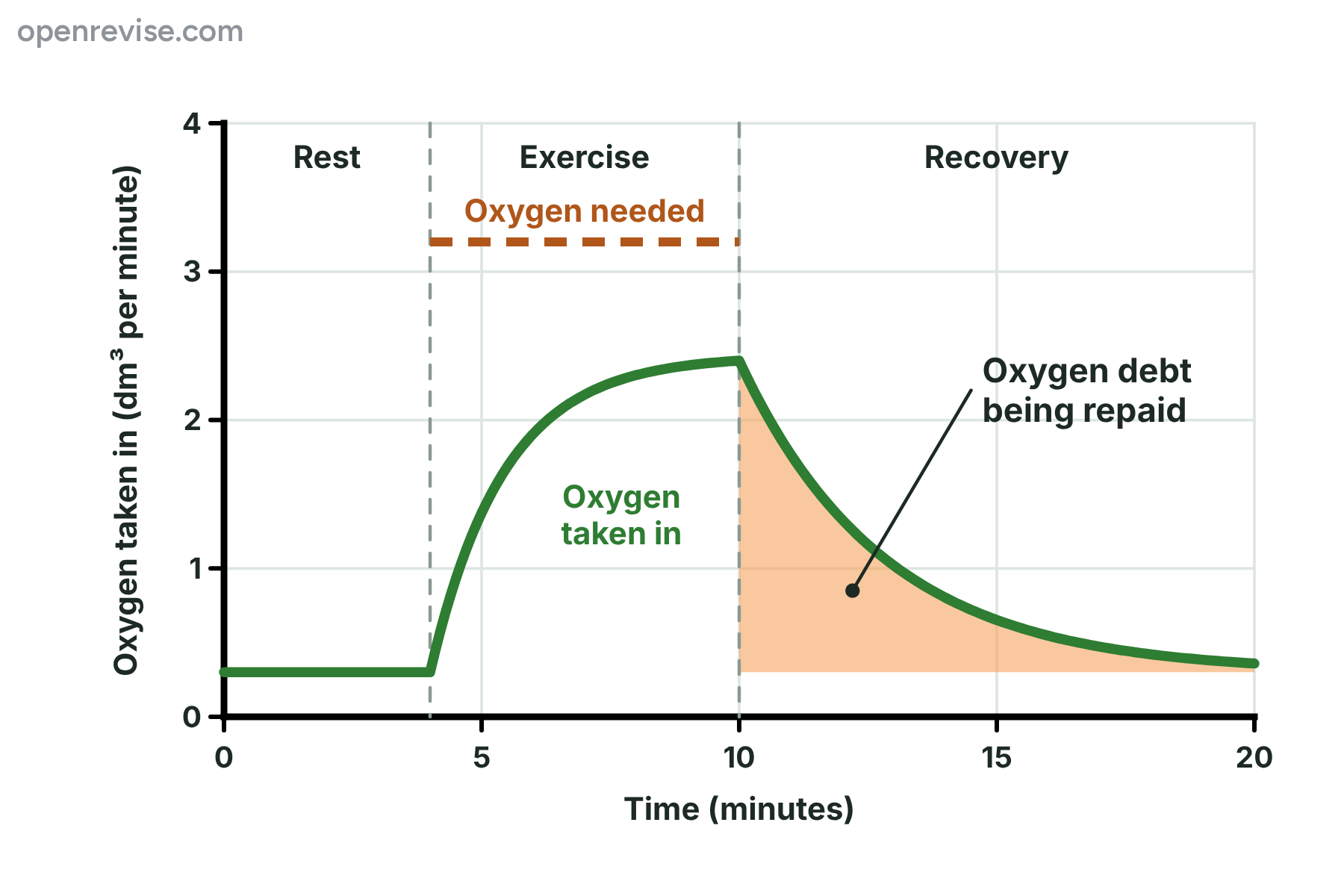
The graph shows the oxygen taken in by a person before, during and after exercise. (a) State the oxygen taken in at rest. (1) (b) Explain why the oxygen taken in is still higher than at rest 5 minutes after the exercise stops. (3)
Show answerHide answer
Model answer
(a) 0.3 dm³ per minute. (b) During the exercise the muscles did not get all the oxygen they needed, so they respired anaerobically and made lactic acid. After the exercise the person has an oxygen debt. Extra oxygen is needed to break down the lactic acid, so the oxygen taken in stays high until the debt has been repaid.
Mark scheme
- (a) 0.3 dm³ per minute — 1 mark
- Anaerobic respiration during exercise made lactic acid — 1 mark
- Extra oxygen is needed to break down the lactic acid (oxygen debt) — 1 mark
- Oxygen uptake stays high until the debt is repaid — 1 mark
-
8 Explain [6 marks]
A sprinter runs a 400 metre race. Explain what happens to her breathing rate, her heart rate and the respiration in her leg muscles during the race and in the five minutes after it.
Show answerHide answer
Model answer
During the race her leg muscles respire much faster, so her breathing rate and heart rate increase to bring more oxygen to the muscles and remove the carbon dioxide. The blood cannot deliver oxygen fast enough, so the muscles also respire anaerobically, making lactic acid, which causes muscle fatigue. After the race her breathing rate and heart rate stay high. She takes in extra oxygen to repay the oxygen debt, which is used to break down the lactic acid in the liver. Once the lactic acid has been removed, her heart rate and breathing rate return to their resting levels.
Mark scheme
- Breathing rate and heart rate increase during the race — 1 mark
- To supply more oxygen and remove carbon dioxide — 1 mark
- Muscles respire anaerobically because oxygen cannot be supplied fast enough — 1 mark
- Lactic acid is made and causes muscle fatigue — 1 mark
- After the race rates stay high to repay the oxygen debt — 1 mark
- Extra oxygen breaks down the lactic acid, then rates return to resting levels — 1 mark
Quick check
-
1
What is the word equation for anaerobic respiration in muscle cells?
Show answerHide answer
B: glucose → lactic acid
Muscle cells convert glucose to lactic acid when there is not enough oxygen, and no carbon dioxide is made.
-
2
Which two products does a yeast cell make by anaerobic respiration?
Show answerHide answer
C: Ethanol and carbon dioxide
Yeast ferments glucose to ethanol and carbon dioxide.
-
3
What causes muscle fatigue during a sprint?
Show answerHide answer
A: A build-up of lactic acid
Lactic acid builds up in the muscles when they respire anaerobically, and it makes them tire.
-
4
What is the oxygen debt?
Show answerHide answer
D: The extra oxygen needed after exercise to break down lactic acid
After vigorous exercise the extra oxygen is needed to break down the lactic acid.
-
5
Why does anaerobic respiration release less energy than aerobic respiration?
Show answerHide answer
B: The glucose is only partly broken down
Glucose is only partly broken down in anaerobic respiration, so lactic acid or ethanol still holds energy.
-
6
Why does bread dough rise when yeast is added?
Show answerHide answer
C: The yeast makes carbon dioxide bubbles
Yeast ferments the sugar, and the carbon dioxide it makes forms bubbles in the dough.
-
7
Where is lactic acid broken down after exercise?
Show answerHide answer
A: In the liver
The blood carries lactic acid to the liver, where it is broken down using oxygen.
-
8
What happens to the muscles during vigorous exercise?
Show answerHide answer
D: They also respire anaerobically
In vigorous exercise oxygen cannot be supplied fast enough, so the muscles also respire anaerobically and lactic acid builds up.